✵The article records the herb Storax, including its English name, Latin name, Pinyin name, properties and flavor, botanical source—namely, the plant species Liquidambar orientalis Mill.—and provides a detailed introduction to the botanical features, growth characteristics, and ecological environment of this species, as well as the characteristics of the herb Storax, its pharmacological actions, medicinal efficacy, and administration guidelines.
Styrax (Storax)
Pinyin Name: Sū Hé Xiānɡ
English Name: Storax
Latin Name:Styrax Property and Flavor: Warm, pungent
Brief Introduction:Styrax is the purified, semi-fluid, viscid balsam obtained from the trunk of Liquidambar orientalis Mill., used as an aromatic stimulant for treating loss of consciousness due to apoplexy and for relieving angina pectoris. The herb is commonly known as Styrax, Storax, storax resin, Oriental sweetgum, or Sū Hé Xiāng.
Botanical Source: Common herbal classics and other authoritative materia medica define Styrax (Storax) as the purified, semi-fluid, viscid balsam (resin) obtained from the trunk of Liquidambar orientalis Mill. It is a tree of the genus Liquidambar (formerly in genus Acorus), family Hamamelidaceae (witch-hazel family), order Saxifragales (formerly in order Arales). This commonly used species is described below:
(1) Liquidambar orientalis Mill.
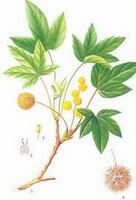
Botanical Description:Liquidambar orientalis Mill. is commonly known as Sū Hé Xiāng Shù. It is a deciduous tree reaching 10–15 meters in height. Leaves are alternate, with long petioles; stipules are small and caducous; leaf blades are palmately 5-lobed (occasionally 3- or 7-lobed); lobes are ovate, rectangular-ovate, or oblong-ovate; apex is acute; base is cordate; margin is serrate.
Flowers are small, unisexual, and monoecious; numerous flowers form spherical capitula (flower heads); florets are yellow-green. Male inflorescences are racemose; male flowers are achlamydeous (lacking a perianth), bearing only bracts and numerous stamens; anthers are oblong, bilocular, and dehisce longitudinally; filaments are short. Female inflorescences are solitary; pedicels are pendulous; the perianth is minute; the pistil consists of multiple carpels with connate bases; the ovary is semi-inferior, bilocular, with several ovules; two styles are curved.
Fruit is a spherical infructescence (~2.5 cm in diameter), composed of clustered capsule fruits bearing persistent, spinous styles; the apex of each capsule is beaked and dehiscent at maturity. Each capsule contains one or two narrowly oblong, flattened seeds with winged apices.
Ecological Environment: The tree thrives in fertile, moist soil. It is native to southern Anatolia—including Turkey and northern Syria—and has been introduced and cultivated in China.
Growth Characteristics:Liquidambar orientalis Mill. prefers moist, fertile soil.
Characteristics of the Herb: Storax is a semi-fluid, viscous liquid, brown to dark brown and translucent. Its texture is sticky and gelatinous when lifted; it forms threads (seriate). It is denser than water. It possesses a strong aromatic odor; taste is bitter and pungent, and it is adhesive to the teeth when chewed. It is soluble in 90% ethanol and glacial acetic acid, and slightly soluble in ether.
Modern Uses: In addition to its use in traditional Chinese medicine, storax is employed as a spice, household fragrance, mosquito and insect repellent, and cosmetic ingredient.
Spice: Storax serves as a spice that eliminates odors, inhibits spoilage, and exerts preservative effects. In food processing, it may be added to meat, eggs, and other foods as a condiment to enhance flavor and improve quality.
Home Fragrance: Storax is widely used for indoor fragrance. Its aroma not only neutralizes unpleasant odors but also uplifts mood and alleviates stress.
Mosquito and Insect Repellent: Storax functions as a natural mosquito and insect repellent. Placing it indoors helps deter mosquitoes and reduce bites. It may also mitigate adverse effects associated with chemical repellents, such as mosquito-repellent incense.
Cosmetics: Storax is widely used in cosmetics—including facial creams and hand creams—due to its volatile oil components, which penetrate deeply into the skin and promote blood circulation, thereby supporting skin health and vitality.
Medicinal Efficacy: Resuscitation, clearing orifices, dispelling turbidity, resolving phlegm, promoting the circulation of qi, and relieving pain. It is indicated for apoplexy, phlegm-induced syncope, sudden fainting, convulsive epilepsy (also known as "fright epilepsy"), coma due to qi stagnation and cold obstruction, chest bi syndrome (thoracic obstruction) and heartache, cold-type chest and abdominal pain, warm malaria (characterized by fever followed by chills), damp-turbidity syndromes with vomiting and diarrhea, acute chest or abdominal pain, chilblains, and scabies, among others.
Administration of Styrax (Sū Hé Xiānɡ):
Reference:
Administration Guide for Styrax (Sū Hé Xiānɡ)
TCM Books:
(1) Internally: 0.3–1 grams, preferably formulated into pills or powders. (2) Internally: 0.3–1 grams, formulated into pills or powders; or used in medicinal wine (tincture); not added directly to decoctions. Externally: Apply an appropriate amount—dissolved in ethanol, or prepared as an ointment or liniment—and smear onto the affected area.
Contraindications, Precautions, and Adverse Reactions: Styrax is contraindicated in cases of yin deficiency with hyperactivity of fire.

 ✵The article records the herb Storax, including its English name, Latin name, Pinyin name, properties and flavor, botanical source—namely, the plant species Liquidambar orientalis Mill.—and provides a detailed introduction to the botanical features, growth characteristics, and ecological environment of this species, as well as the characteristics of the herb Storax, its pharmacological actions, medicinal efficacy, and administration guidelines.
 Pinyin Name: Sū Hé Xiānɡ
 Botanical Source: Common herbal classics and other authoritative materia medica define Styrax (Storax) as the purified, semi-fluid, viscid balsam (resin) obtained from the trunk of Liquidambar orientalis Mill. It is a tree of the genus Liquidambar (formerly in genus Acorus), family Hamamelidaceae (witch-hazel family), order Saxifragales (formerly in order Arales). This commonly used species is described below:
 Botanical Description: Liquidambar orientalis Mill. is commonly known as Sū Hé Xiāng Shù. It is a deciduous tree reaching 10–15 meters in height. Leaves are alternate, with long petioles; stipules are small and caducous; leaf blades are palmately 5-lobed (occasionally 3- or 7-lobed); lobes are ovate, rectangular-ovate, or oblong-ovate; apex is acute; base is cordate; margin is serrate.
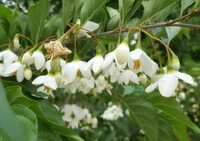 Flowers are small, unisexual, and monoecious; numerous flowers form spherical capitula (flower heads); florets are yellow-green. Male inflorescences are racemose; male flowers are achlamydeous (lacking a perianth), bearing only bracts and numerous stamens; anthers are oblong, bilocular, and dehisce longitudinally; filaments are short. Female inflorescences are solitary; pedicels are pendulous; the perianth is minute; the pistil consists of multiple carpels with connate bases; the ovary is semi-inferior, bilocular, with several ovules; two styles are curved.
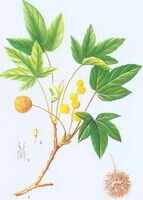 Ecological Environment: The tree thrives in fertile, moist soil. It is native to southern Anatolia—including Turkey and northern Syria—and has been introduced and cultivated in China.
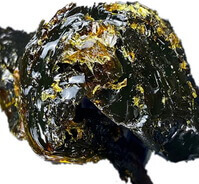 Characteristics of the Herb: Storax is a semi-fluid, viscous liquid, brown to dark brown and translucent. Its texture is sticky and gelatinous when lifted; it forms threads (seriate). It is denser than water. It possesses a strong aromatic odor; taste is bitter and pungent, and it is adhesive to the teeth when chewed. It is soluble in 90% ethanol and glacial acetic acid, and slightly soluble in ether.
 Modern Uses: In addition to its use in traditional Chinese medicine, storax is employed as a spice, household fragrance, mosquito and insect repellent, and cosmetic ingredient.
 URL QR code: