✵The article provides records of the herb Trumpetflower Seed, including its English name, Latin name, Pinyin name, properties and flavor, botanical source—namely one plant species, (1) Oroxylum indicum (L.) Kurz.—and a detailed introduction to the botanical features, growth characteristics, and ecological environment of this plant species; as well as the morphological characteristics of the herb Trumpetflower Seed, its pharmacological actions, medicinal efficacy, and administration guidelines.
Semen Oroxyli (Trumpetflower Seed)
Pinyin Name: Mù Hú Dié
English Name: Trumpetflower Seed
Latin Name:Semen Oroxyli Properties and Flavor: Cool, bitter, and sweet
Brief Introduction:Semen Oroxyli is the dried ripe seed of Oroxylum indicum (L.) Kurz., used to clear lung heat and soothe the throat for the treatment of cough, sore throat, and hoarseness in wind-heat syndromes.
Botanical Source:Semen Oroxyli (Trumpetflower Seed) is the dried ripe seed of Oroxylum indicum (L.) Kurz., a plant belonging to the genus Oroxylum in the family Bignoniaceae (commonly known as the bignonia, catalpa, or trumpet creeper family) and order Lamiales (formerly in order Scrophulariales). It is also known as Trumpetflower Seed, Seed of Trumpetflower, or Mù Hú Dié.
Classical herbal works define Semen Oroxyli (Trumpetflower Seed) as the dried seed of (1) Oroxylum indicum (L.) Kurz. This commonly used species is introduced below:
(1) Oroxylum indicum (L.) Kurz.
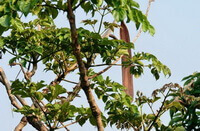
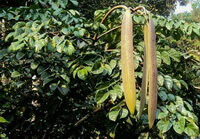
Botanical Description:Oroxylum indicum (L.) Kurz. is also known as Bignonia indica L. It is a small tree reaching 7–12 meters in height. The bark is thick and bears lenticels. Branchlets are covered with numerous lenticels and are protuberant; leaf scars are conspicuous and large. Leaves are opposite, large imparipinnate to quadripinnate compound leaves inserted near the apex of stems and branches, measuring 60–160 cm in length and 20–80 cm in width; leaflets are numerous, petiolules are 5–10 mm long, leaflets are triangular-ovate, 6–14 cm long and 4–9 cm wide, apex is short-acuminate, base is rounded or broadly cuneate and deflexed, margins are entire; upper surface is green, lower surface is light green, both surfaces are glabrous, turning bluish upon drying.
Cymes are terminal, 40–150 cm long; pedicels are ~7 cm long; calyx is campanulate (bell-shaped), 2.2–4.5 cm long and 2–3 cm wide, purple, apex is truncate and persistent; corolla is salmon (reddish-orange), fleshy, 3–9 cm long, campanulate, 5–8.5 cm in diameter, apex is 5-lobed with unequal lobes; stamens 5, inserted at the middle of the corolla tube and exserted beyond it; filament bases are tomentose, one filament is shorter; nectary disc is large and fleshy; styles are 5–7 cm long, stigma is bilobed.
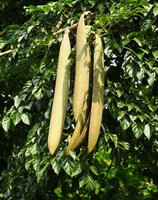
Fruit is a woody capsule, flat and broadly linear, pendulous, 40–120 cm long and 5–8.5 cm wide, apex is mucronate, base is cuneate, margin is slightly introflexed, with a slightly protruding slit along the midline of the dorsal surface; mature fruit is yellowish-brown, dehiscing along the ventral suture; carpel bearing a prominent midrib. Seeds are numerous; each winged seed is 6–7.5 cm long and 3.5–4 cm wide, the wing—white, translucent, and membranous—surrounding the seed except at the base; flowering period: July–October; fruiting period: October–December.
Ecological Environment:Oroxylum indicum grows on slopes, along streams, in valleys, or within shrublands, at altitudes below 1,000 meters above sea level.
Characteristics of the Herb: Seeds are nearly elliptical and flaky, 2–3 cm long and 1.5–2 cm wide. Surface is light yellowish-white, exhibiting silky, filamentous luster (tiffany-like). Seed coat expands outward from three sides into a broad, membranous, translucent wing ~2.5 cm wide, with radial striations; wing edges are often fragmented. Herb is lightweight; when the seed coat is removed, a thin, membranous endosperm tightly envelops the cotyledons. Two cotyledons, flat and papilionaceous (butterfly-shaped), yellow-green or light yellow, major diameter is ~1.5 cm, minor diameter is ~1 cm; radicle is prominent. Odor is slight; taste slightly bitter.
Medicinal Efficacy: Clears lung heat and soothes the throat; regulates liver Qi stagnation and harmonizes the stomach. Indicated for cough due to lung heat, pharyngitis (throat obstruction), hoarseness, and epigastric pain caused by emotional depression and hyperactive liver Qi invading the stomach.
Administration of Semen Oroxyli (Mù Hú Dié):
Reference:
Administration Guide for Semen Oroxyli (Mù Hú Dié)
TCM Books:
(1) Internally: 1.5–3 grams; (2) 2–3 qián (approximately 6–9 grams), water decoction; or prepared as fine powder or pills; External use: Apply topically to the affected area. (3) water decoction, 6–9 grams, or prepared as fine powder or pills; 1.5–3 grams; External use: Apply an appropriate amount of the powdered herb topically to the affected area.

 ✵The article provides records of the herb Trumpetflower Seed, including its English name, Latin name, Pinyin name, properties and flavor, botanical source—namely one plant species, (1) Oroxylum indicum (L.) Kurz.—and a detailed introduction to the botanical features, growth characteristics, and ecological environment of this plant species; as well as the morphological characteristics of the herb Trumpetflower Seed, its pharmacological actions, medicinal efficacy, and administration guidelines.
 Pinyin Name: Mù Hú Dié
 Botanical Description: Oroxylum indicum (L.) Kurz. is also known as Bignonia indica L. It is a small tree reaching 7–12 meters in height. The bark is thick and bears lenticels. Branchlets are covered with numerous lenticels and are protuberant; leaf scars are conspicuous and large. Leaves are opposite, large imparipinnate to quadripinnate compound leaves inserted near the apex of stems and branches, measuring 60–160 cm in length and 20–80 cm in width; leaflets are numerous, petiolules are 5–10 mm long, leaflets are triangular-ovate, 6–14 cm long and 4–9 cm wide, apex is short-acuminate, base is rounded or broadly cuneate and deflexed, margins are entire; upper surface is green, lower surface is light green, both surfaces are glabrous, turning bluish upon drying.
 Ecological Environment: Oroxylum indicum grows on slopes, along streams, in valleys, or within shrublands, at altitudes below 1,000 meters above sea level.
 URL QR code: