
Zhang Zhongjing: Biographical introduction and legendary stories, major works and academic contributions
-
 ✵Zhang Ji, also known as Zhang Zhongjing, was one of the most influential herbalists in Chinese history. He was a legendary herbalist and master of herbs in both Chinese and world history. He is not mentioned in the history book Hou Han Shu (The Book of the Later Han, or History of the Later Han), but his achievements were first recorded in the ancient book Ming Yi Lu (Records of Famous Herbalists), written by Gan Bozong (甘伯宗 Gān Bózōng) of the Tang Dynasty. It recorded that: "Zhang Zhongjing is from Nan Yang. His name is Ji; Zhong Jing is an alias. He started learning crafts from a local herbalist named Zhang Bozu. People at that time said his ideas and skills were more refined than his master's. His books are brief, essential, and profound. His method is simple but detailed and cannot be understood by those who know a little or are shallow."
- Zhang Zhongjing
-
Brief Introduction Chinese Name: 張機 (Zhāng Jī) Alias: Unknown Style Name: 仲景 (Zhòngjǐng) English Name: Zhang Ji (family name first) or Ji Zhang (given name first) Hometown: Nie Yang county, Nan Yang Jun Dates: c. 150-219 CE Major Works: Shang Han Za Bing Lun (Treatise on Cold Pathogenic and Miscellaneous Diseases), Bian Shang Han.10 Vols, Ping Bing Yao Fang.1 vol, Liao Fu Ren Fang.2 vols, Wu Zang Lun.1 vol Representative Work: Shang Han Za Bing Lun (Treatise on Cold Pathogenic and Miscellaneous Diseases) Biographical introduction and legendary stories
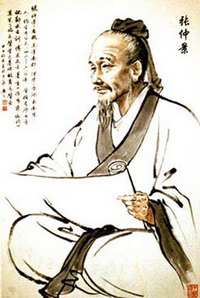 Zhang Zhongjing is one of the most influential physicians in the history of Traditional Chinese Medicine (TCM). He was born in Nanyang Commandery, Nieyang County, during the Han Dynasty (present-day Zhangzhai Village, Dongyang Town, Dengzhou City, Henan Province). His birth and death years are estimated to be circa 150–219 CE. Beginning in the fourth year of the Yanxi era (161 CE), he studied under Zhang Bozu and mastered exceptional diagnostic and therapeutic skills.
He was a master of classical medicine and herbal prescriptions. His works were regarded as the foundational texts for subsequent developments in herbal medicine. During the Han dynasty, contemporaries declared that Bian Que and Cang Gong could not compare with him. Later generations revered him as the “Medical Sage.” In 1182 CE, Liu Wansu recorded in his work that "Zhong Jing, the Inferior Sage." In 1526 CE, the physician Li Lian noted in his text History of Medicine that Zhong Jing “was honored as the Inferior Sage.” In 1589 CE, the physician Fang Youzhi stated in his writing Shang Han Lun Tiao Bian that “Zhong Jing hailed as a sage."
During the late Eastern Han Dynasty, three eminent physicians were collectively known in history as the “Three Eminent Physicians of the Jian’an Period.” Jian’an was the third era name of Emperor Xian of the Han dynasty, lasting from approximately 196 to 220 CE. The three physicians were Zhang Zhongjing, Hua Tuo, and Dong Feng.
The history text Hou Han Shu (The Book of the Later Han) makes no mention of him. His achievements were first recorded in the Tang-dynasty text Ming Yi Lu (Records of Famous Physicians), compiled by Gan Bozong (Gān Bózōng). It states: "Zhang Zhongjing was from Nan Yang. His given name was Ji; 'Zhong Jing' was his style name. He began studying medicine under a local physician named Zhang Bozu. Contemporaries remarked that his ideas and skills surpassed those of his master. His writings are concise, essential, and profound; his methodology is simple yet detailed—beyond the comprehension of those with only superficial knowledge."Major works and academic contributions
According to the autobiographical notes of Zhang Zhongjing, classics such as Su Wen (The Plain Questions), Ling Shu (The Spiritual Pivot), Nan Jing (The Difficult Classic), Yin Yang Da Lun, Tai Lu Yao Lu and other texts were already widespread. Evidence from Jia Yi Jing·Xu (Preface to the Systematized Canon of Acupuncture and Moxibustion) shows that a professional classic on herbal prescriptions and treatments, titled Tang Ye Jing, had already been published. The foundational classics of Traditional Chinese Medicine (TCM) encompass basic theories, materia medica, prescriptions of Chinese medicinal substances, and acupuncture-moxibustion science. These works were already widely circulated, and the fundamental theoretical framework of medicine was gradually taking shape—becoming increasingly systematic, comprehensive, and mature.
Shang Han Za Bing Lun (Treatise on Cold-Induced and Miscellaneous Diseases) was the first canonical medical text to fully integrate "theory, diagnosis, treatment principles, herbal prescriptions, and therapeutic methods." In this work, Zhang Zhongjing first elucidates the etiology, pathogenesis, and treatment approaches for epidemic and miscellaneous diseases, thereby establishing a solid theoretical foundation for subsequent developments in medicine. The integrated theoretical system presented in Shang Han Za Bing Lun exhibits a high degree of scientific rigor and practical applicability. It provides highly effective therapeutic strategies for both exogenous febrile diseases and miscellaneous disorders and has served herbalists as a long-standing clinical practice guide since its publication. It has exerted profound influence on the academic development of TCM.
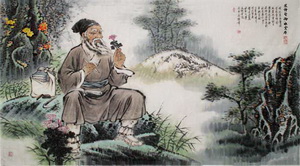 During the Jin Dynasty, the imperial physician Wang Shuhe collected the surviving portions of Shang Han Za Bing Lun and attempted to edit and organize them. While editing, he found it impossible to reconstruct the original 16-volume structure; only 10 volumes were ultimately compiled. This edition focuses primarily on cold-induced diseases, their syndrome differentiation (pattern identification), and corresponding treatment principles. Consequently, Wang Shuhe named it Shang Han Lun (Treatise on Cold-Induced Diseases). He also incorporated numerous passages from Shang Han Lun (The Treatise on Cold-induced Diseases) into his renowned work Mai Jing (The Pulse Classic).
References:
-
- 1. Zhang Zhongjing: Biographical introduction and legendary stories, major works and academic contributions
