✵This article documents Grand Torreya Seed—including its English name, Latin name, Pinyin name, properties and flavor—along with its botanical source: Torreya grandis Fort., including detailed descriptions of its botanical features, growth characteristics, ecological environment, macroscopic herb characteristics, pharmacological actions, medicinal efficacy, and administration guidelines.
Semen Torreyae (Grand Torreya Seed)
Pinyin Name: Fěi Zǐ
English Name: Grand Torreya Seed
Latin Name:Semen Torreyae Properties and Flavor: Neutral; sweet and astringent
Brief Introduction:Semen Torreyae is the dried, ripe seed of Torreya grandis Fort. (Chinese torreya), used clinically as an anthelmintic and mild laxative for taeniasis, enterobiasis, ancylostomiasis, ascariasis, and fasciolopsiasis. Common names include Semen Torreyae, Grand Torreya Seed, and Fěi Zǐ.
Botanical Source: Classical herbal works define Semen Torreyae (Grand Torreya Seed) as the dried, ripe seed of Torreya grandis Fort., a species belonging to the genus Torreya (Arn.) and family Taxaceae (yew family), order Cupressales. The following commonly used species is described:
Torreya grandis Fort. ex Lindl.
Botanical Description:Torreya grandis Fort. ex Lindl., also known as Torreya grandis var. dielsii Hu., is commonly called Chinese torreya or Fěi Zǐ. It is an evergreen tree reaching up to 25 m in height, with a diameter at breast height (DBH) of up to 55 cm. The bark is pale grayish-yellow, charcoal-gray, or grayish-brown, and irregularly longitudinally fissured. Branchlets are subopposite or verticillate; those of the current year are green; those aged two to three years are yellow-green, fawn (flavotestaceous), dark greenish-yellow, or rarely pale brown (hazel). Leaves are linear, usually straight, 1.1–2.5 cm long and 2.5–4 mm wide (not cm), with an obtuse or mucronate apex and a rounded base. The upper surface is smooth and green, with inconspicuous midveins and two slightly distinct longitudinal grooves. The lower surface is pale green (pea green); the stomatal band is equal in length to—or slightly wider than—the midvein band.
Dioecious. Male strobili (male cones) are solitary and axillary; female strobili (female cones) occur in pairs and are also axillary, each subtended by two pairs of decussate bracts and one lateral bracteole (bractlet); ovules are erect, solitary, and grow on the aril.
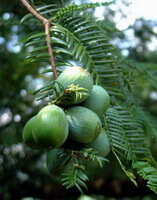
Seeds are elliptic, ovoid, obovate, or oblong-ovoid, 2–4.5 cm long and 1.5–2.5 cm in diameter. At maturity, the aril is pale purplish-brown and glaucous, with a small convex apical tip. The endosperm is slightly wrinkled. Flowering occurs in April; seeds mature in October of the following year.
Ecological Environment: The plant grows in warm, moist yellow soil, red loam, and yellow-brown loam, typically in forested habitats.
Growth Characteristics: Torreya grandis thrives in cool, foggy, and humid environments. Young plants tolerate shade, but require ample sunlight during flowering and fruiting. Cultivation is best undertaken in deep, loose, fertile, acidic or slightly acidic, well-drained loam. Arid and infertile soils are unsuitable.
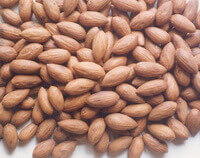
Characteristics of the Herb: Seeds are spheroidal or elongated-ovoid, 2–3.5 cm (or 2–4 cm) long and 1.3–2 cm (or 1.5–2.5 cm) in diameter. The outer surface is yellowish-brown to dark brown, bearing faint longitudinal ridges. One end is blunt, with an elliptic, light-colored, smooth hilum; the opposite end is slightly pointed. The testa (seed coat) is firm and brittle, ~1 mm thick. When broken, a single oval seed kernel is visible: the perisperm is membranous, grayish-brown (taupe), highly shriveled; the endosperm is hypertrophied, yellowish-white, firm, farctate, and oily. The herb has a mild odor and a slightly sweet, astringent taste. After stir-frying, it emits an aromatic fragrance.
Pharmacological actions: (1) Anthelmintic activity against hookworms (Ancylostoma duodenale and Necator americanus); effective against cat tapeworm (Dipylidium caninum); seed oil exhibits anthelmintic properties against hookworms. (2) Alkaloids from Torreya seeds induce uterine contraction.
Medicinal efficacy: Anthelmintic; promotes digestion and resolves food retention; moistens the lungs and alleviates dry cough; lubricates the intestines and relieves constipation. Indications include intestinal parasitosis, ancylostomiasis, ascariasis, taeniasis, parasitic abdominal pain, infantile malnutrition with stagnation, irritating dry cough, pulmonary dryness-induced cough, constipation due to intestinal dryness, hemorrhoids, etc.
Administration of Semen Torreyae (Fěi Zǐ):
Reference:
Administration Guide for Semen Torreyae (Fěi Zǐ)
TCM Books:
(1) Internally: 9–15 grams as a decoction. (2) Internally: water decoction, 1.5–3 qián (approximately 4.5–9 grams); alternatively, administered as pills or powder. (3) Internally:water decoction, 15–50 grams; —use raw, shelled seeds, cracked prior to decoction; or 10–40 grains of fried, hulled kernels, chewed; or prepared as pills or powder. For anthelmintic effect, higher doses are recommended, taken as a single dose; for constipation or hemorrhoids, lower doses are preferred, administered repeatedly.
Contraindications, Precautions, and Adverse Reactions: The seed shell of Semen Torreyae should not be co-administered with mung beans (Vigna radiata).

 ✵This article documents Grand Torreya Seed—including its English name, Latin name, Pinyin name, properties and flavor—along with its botanical source: Torreya grandis Fort., including detailed descriptions of its botanical features, growth characteristics, ecological environment, macroscopic herb characteristics, pharmacological actions, medicinal efficacy, and administration guidelines.
 Pinyin Name: Fěi Zǐ
 Botanical Source: Classical herbal works define Semen Torreyae (Grand Torreya Seed) as the dried, ripe seed of Torreya grandis Fort., a species belonging to the genus Torreya (Arn.) and family Taxaceae (yew family), order Cupressales. The following commonly used species is described:
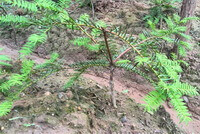 Botanical Description: Torreya grandis Fort. ex Lindl., also known as Torreya grandis var. dielsii Hu., is commonly called Chinese torreya or Fěi Zǐ. It is an evergreen tree reaching up to 25 m in height, with a diameter at breast height (DBH) of up to 55 cm. The bark is pale grayish-yellow, charcoal-gray, or grayish-brown, and irregularly longitudinally fissured. Branchlets are subopposite or verticillate; those of the current year are green; those aged two to three years are yellow-green, fawn (flavotestaceous), dark greenish-yellow, or rarely pale brown (hazel). Leaves are linear, usually straight, 1.1–2.5 cm long and 2.5–4 mm wide (not cm), with an obtuse or mucronate apex and a rounded base. The upper surface is smooth and green, with inconspicuous midveins and two slightly distinct longitudinal grooves. The lower surface is pale green (pea green); the stomatal band is equal in length to—or slightly wider than—the midvein band.
 Dioecious. Male strobili (male cones) are solitary and axillary; female strobili (female cones) occur in pairs and are also axillary, each subtended by two pairs of decussate bracts and one lateral bracteole (bractlet); ovules are erect, solitary, and grow on the aril.
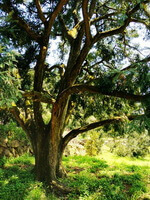 Ecological Environment: The plant grows in warm, moist yellow soil, red loam, and yellow-brown loam, typically in forested habitats.
 Characteristics of the Herb: Seeds are spheroidal or elongated-ovoid, 2–3.5 cm (or 2–4 cm) long and 1.3–2 cm (or 1.5–2.5 cm) in diameter. The outer surface is yellowish-brown to dark brown, bearing faint longitudinal ridges. One end is blunt, with an elliptic, light-colored, smooth hilum; the opposite end is slightly pointed. The testa (seed coat) is firm and brittle, ~1 mm thick. When broken, a single oval seed kernel is visible: the perisperm is membranous, grayish-brown (taupe), highly shriveled; the endosperm is hypertrophied, yellowish-white, firm, farctate, and oily. The herb has a mild odor and a slightly sweet, astringent taste. After stir-frying, it emits an aromatic fragrance.
 URL QR code:

