✵This article documents the herb Thunder Ball—including its English name, Latin name, Pinyin name, properties and flavor—as well as its botanical source: the fungus Omphalia lapidescens Schroet., with detailed descriptions of its botanical features, growth characteristics, ecological environment, macroscopic herb characteristics, pharmacological actions, medicinal efficacy, and administration guidelines.
Omphalia (Thunder Ball)
Pinyin Name: Léi Wán
English Name: Thunder Ball
Latin Name:Omphalia Properties and Flavor: Cold; slightly bitter
Brief Introduction: Thunder Ball is the dried sclerotium of Omphalia lapidescens Schroet., used clinically as an anthelmintic for taeniasis, ancylostomiasis, and ascariasis. Common names include Omphalia, Thunder Ball, and Léi Wán.
Botanical Source: Classical herbal works define Léi Wán (Thunder Ball) as the dried sclerotium of Omphalia lapidescens Schroet., a species belonging to the genus Omphalia (syn. Omphalotus), family Agaricaceae (formerly classified under Tricholomataceae), order Agaricales. The following commonly used species is described:
Omphalia lapidescens Schroet.
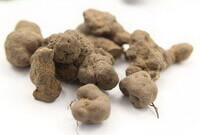
Botanical Description:Omphalia lapidescens Schroet. is also known as Polyporus mylittae Cooke et Massee, and Mylitta lapidescens Horak. It is commonly called Omphalia or Léi Wán (“thunder ball” or “thunder pill”). A saprophytic (and weakly parasitic) fungus, its sclerotia are irregularly spherical, ovoid (egg-shaped), or lumpy, 0.8–3.5 cm in diameter (rarely up to 4 cm). The surface is brown, dark brown, or black, bearing fine wrinkles. The interior consists of densely interwoven hyphae, white to waxy-white, translucent, and slightly viscous, with uniform texture. After winter, new fruiting bodies (encarpia) emerge from the sclerotia—though these are rarely observed in practice.
Ecological environment:Omphalia lapidescens Schroet. grows parasitically on the roots of diseased bamboo.
Growth Characteristics:Omphalia lapidescens Schroet. is a saprophytic and weakly parasitic fungus, commonly found in mixed bamboo forests and near rotting roots of host plants such as tung tree (Aleurites montana), sweetgum (Liquidambar formosana), and Elaeagnus pungens. It thrives in well-aerated, gravelly soils with pH 5.8. Optimal mycelial growth occurs at 25–30 °C (77–86 °F). It readily colonizes bran-based substrates with moisture content exceeding 60%.
Characteristics of the Herb: Dried sclerotia are nearly spherical or irregularly shaped masses, 1–3 cm in diameter. The surface is dark brown, purplish-brown, or grayish-brown (taupe), bearing faintly raised reticulate fine wrinkles. The texture is firm, farctate, heavy, and difficult to fracture. The fracture surface is uneven, white or light yellowish-gray, with a powdery (pulverulent) or granular appearance; often displaying a marbled pattern of yellowish-brown streaks. The herb is odorless and tastes slightly bitter. Upon initial chewing, it yields a granular sensation; prolonged mastication produces slight stickiness and complete dissolution without residue.
Pharmacological Actions: (1) Anthelmintic activity—particularly against tapeworms (Taenia saginata, Taenia asiatica, and Dipylidium caninum); contains a protease that induces tapeworm necrosis; exhibits trichomonacidal effects; significantly inhibits Ascaris suum in vitro; and demonstrates marked clinical efficacy against ancylostomiasis upon oral administration. (2) Anti-inflammatory effects. (3) Anticancer effects.
Medicinal efficacy: Anthelmintic; promotes digestion and resolves food retention or qi stagnation. Indications include taeniasis, ancylostomiasis, ascariasis, parasitic abdominal pain, infantile malnutrition with stagnation, nutritional deficiency, and wind-type epilepsy.
Administration of Omphalia (Léi Wán):
Reference:
Administration Guide for Omphalia (Léi Wán)
TCM Books:
(1) Internally: 15–21 grams; it is better not to add the herb to decoctions. Instead, it is typically prepared as a finely ground herb powder and taken orally—5–7 grams per dose, mixed with warm water and taken after meals, three times daily for three consecutive days. (2) Internally: water decoction, 2–3 qian (approximately 6–9 grams); or prepared as pills or powder. External use: prepare as a finely ground herb powder and apply as a dusting powder, or wash with a water decoction. (3) Internally: prepare as a finely ground herb powder, 15–21 g; or prepare as pills.
Contraindications, Precautions, and Adverse Reactions: The herb should not be combined with Radix Puerariae or Herba Polygoni Avicularis.

 ✵This article documents the herb Thunder Ball—including its English name, Latin name, Pinyin name, properties and flavor—as well as its botanical source: the fungus Omphalia lapidescens Schroet., with detailed descriptions of its botanical features, growth characteristics, ecological environment, macroscopic herb characteristics, pharmacological actions, medicinal efficacy, and administration guidelines.
 Pinyin Name: Léi Wán
 Botanical Description: Omphalia lapidescens Schroet. is also known as Polyporus mylittae Cooke et Massee, and Mylitta lapidescens Horak. It is commonly called Omphalia or Léi Wán (“thunder ball” or “thunder pill”). A saprophytic (and weakly parasitic) fungus, its sclerotia are irregularly spherical, ovoid (egg-shaped), or lumpy, 0.8–3.5 cm in diameter (rarely up to 4 cm). The surface is brown, dark brown, or black, bearing fine wrinkles. The interior consists of densely interwoven hyphae, white to waxy-white, translucent, and slightly viscous, with uniform texture. After winter, new fruiting bodies (encarpia) emerge from the sclerotia—though these are rarely observed in practice.
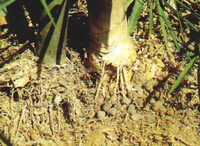 Growth Characteristics: Omphalia lapidescens Schroet. is a saprophytic and weakly parasitic fungus, commonly found in mixed bamboo forests and near rotting roots of host plants such as tung tree (Aleurites montana), sweetgum (Liquidambar formosana), and Elaeagnus pungens. It thrives in well-aerated, gravelly soils with pH 5.8. Optimal mycelial growth occurs at 25–30 °C (77–86 °F). It readily colonizes bran-based substrates with moisture content exceeding 60%.
 Characteristics of the Herb: Dried sclerotia are nearly spherical or irregularly shaped masses, 1–3 cm in diameter. The surface is dark brown, purplish-brown, or grayish-brown (taupe), bearing faintly raised reticulate fine wrinkles. The texture is firm, farctate, heavy, and difficult to fracture. The fracture surface is uneven, white or light yellowish-gray, with a powdery (pulverulent) or granular appearance; often displaying a marbled pattern of yellowish-brown streaks. The herb is odorless and tastes slightly bitter. Upon initial chewing, it yields a granular sensation; prolonged mastication produces slight stickiness and complete dissolution without residue.
 URL QR code:

