✵The article records the herb Ginkgo Seed, including its English name, Latin name, Pinyin name, properties and flavor, botanical source—namely, one plant species: (1) Ginkgo biloba L.—and provides a detailed introduction to the botanical features, growth characteristics, and ecological environment of this plant, as well as the characteristics of the herb Ginkgo Seed, its pharmacological actions, medicinal efficacy, and administration guidelines.
Semen Ginkgo (Ginkgo Seed)
Pinyin Name: Bái Guǒ.
English Name: Ginkgo Seed
Latin Name:Semen Ginkgo Properties and Flavor: Neutral; sweet, bitter, and astringent; toxic
Brief Introduction:Semen Ginkgo is the dried ripe seed of the maidenhair tree, Ginkgo biloba L. It is used (1) as an antitussive and anti-asthmatic for prolonged cough or asthma with profuse expectoration, (2) to arrest leukorrhea, and (3) to reduce urinary frequency in cases of enuresis and frequent micturition. The herb is commonly known as Semen Ginkgo, Ginkgo Seed, or Bái Guǒ.
Ginkgo biloba originates from the Ginkgo tree, one of the oldest living tree species. The Ginkgo tree has existed for 150–200 million years. Chinese people have used Ginkgo for thousands of years to treat various ailments. Ginkgo biloba was first introduced to Europe in the 1700s and is now widely used. It is among the most extensively researched herbal medicines. In traditional Chinese medicine, Ginkgo biloba is used to relieve asthma and lung congestion; it has also been employed to enhance sexual function, regulate blood circulation, and promote longevity.
Botanical Source:Semen Ginkgo (Ginkgo Seed) is the dried ripe seed of Ginkgo biloba L., a plant belonging to the genus Ginkgo, family Ginkgoaceae, order Ginkgoales. The commonly used species is:
(1) Ginkgo biloba L.
Botanical Description:Ginkgo biloba is a deciduous tree reaching up to 40 meters in height. It bears long and short branches. The bark of young trees is light grayish-brown, shallowly fissured; that of mature trees turns grayish-brown (taupe), deeply fissured. Leaves are sparsely arranged and spiral on long branches; 3–5 (occasionally 8) leaves form a tuft on short branches. Petioles measure 3–10 cm in length. Leaf blades are fan-shaped, light green, glabrous, with numerous parallel, dichotomously branched veinlets. The upper margin is 5–8 cm wide, sinuate, sometimes lobed or deeply incised at the center.
The tree is dioecious; flowers are unisexual (separate), rarely hermaphroditic. Strobili arise in the axils of scale leaves at the tips of short branches. Male strobili are catkin-like and pendulous; female strobili bear long pedicels, usually dichotomous at the apex. A disc-shaped ovuliferous seat develops at the tip of each pedicel, bearing one ovule; only one ovule matures into a seed.
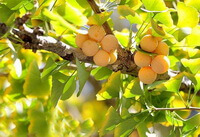
Seeds are drupe-like (pruniform), elliptical to nearly globular, 2.5–3.5 cm long and approximately 2 cm in diameter. The exocarp (testa) is fleshy, glaucous (covered with a whitish bloom), and turns light yellow or orange at maturity. The mesosperm (sclerotesta) is bony, white, and typically 2–3-ridged. The endotesta is membranous; the endosperm is nutrient-rich. Flowering occurs from March to April; seeds mature from September to October.
Ecological Environment: Ginkgo grows at altitudes of 500–1,000 meters above sea level, in natural forests and in well-drained acidic soils.
Growth Characteristics: Ginkgo prefers warm, humid climates and full sun; it is cold- and drought-tolerant but intolerant of waterlogging. It thrives in regions with a mean annual temperature of 10–18 °C (50–64.4 °F), winter minimum temperatures no lower than –20 °C (–4 °F), and annual precipitation of 600–1,500 mm. It grows best in deep, sandy loam soils. Cultivation should be avoided on shaded slopes, highly saline soils, or waterlogged sites.
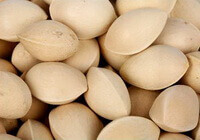
Characteristics of the Herb: The seed, with the exocarp removed, is oval (egg-shaped) or elliptical, 1.5–3 cm long and 1–2.2 cm wide. The mesosperm (hull) is bony and smooth, yellowish-white or light brown, with a dot-like protrusion at the base, one ridge along each lateral edge, and occasionally three ridges. The endotesta (inner seed coat) is membranous, reddish-brown or light yellowish-brown. The kernel is oblate, light yellow-green; the endosperm is thickened, mealy, and contains a central cavity; the embryo is minute. The herb is odorless and tastes slightly sweet and bitter. High-grade herb material exhibits a yellowish-white shell, plump kernel, and light yellow fracture surface.
Harvesting and Processing: Seeds are collected in late autumn upon maturity. The fleshy exocarp is removed, and the seeds are washed, cleaned, and sun-dried. The kernel is extracted by cracking the seed when required.
Pharmacological Actions: The nitrogen-free neutral component of the ginkgo seed kernel can induce convulsions, medullary paralysis, respiratory arrest, cardiac arrest, and death in mice. Raw ginkgo seeds are toxic; excessive ingestion may cause vomiting, abdominal pain, diarrhea, convulsions, restlessness, and dyspnea. Common emergency measures include gastric lavage, catharsis, administration of egg white and activated charcoal, as well as symptomatic treatment—such as sedatives, diuretics, intravenous hypertonic glucose, and oxygen therapy.
Medicinal Efficacy: Astringes the lung to relieve asthma; arrests leukorrhea and turbid vaginal discharge; reduces urinary frequency. Indicated for dyspnea with cough due to copious phlegm, leukorrhea, white turbid discharge, enuresis (bed-wetting), and frequent micturition (frequent urination).
Administration of Semen Ginkgo (Bái Guǒ):
Reference:
Administration Guide of Semen Ginkgo (Bái Guǒ)
TCM Books:
(1) Internally: 4.5–9 grams; (2) 1.5–3 qián (≈4.5–9 grams); (3) 3–9 grams, prepared as a water decoction; or processed into juice, fine powder, or pills. External use: Crushed fresh fruit or seed paste applied topically.
Precautions and Adverse Reactions: Raw ginkgo seeds are poisonous. Poisoning may occur from ingestion of raw seeds or overdose—even of fried preparations. Accidental poisoning is especially common in children.

 ✵The article records the herb Ginkgo Seed, including its English name, Latin name, Pinyin name, properties and flavor, botanical source—namely, one plant species: (1) Ginkgo biloba L.—and provides a detailed introduction to the botanical features, growth characteristics, and ecological environment of this plant, as well as the characteristics of the herb Ginkgo Seed, its pharmacological actions, medicinal efficacy, and administration guidelines.
 Pinyin Name: Bái Guǒ.
 Botanical Description: Ginkgo biloba is a deciduous tree reaching up to 40 meters in height. It bears long and short branches. The bark of young trees is light grayish-brown, shallowly fissured; that of mature trees turns grayish-brown (taupe), deeply fissured. Leaves are sparsely arranged and spiral on long branches; 3–5 (occasionally 8) leaves form a tuft on short branches. Petioles measure 3–10 cm in length. Leaf blades are fan-shaped, light green, glabrous, with numerous parallel, dichotomously branched veinlets. The upper margin is 5–8 cm wide, sinuate, sometimes lobed or deeply incised at the center.
 Pharmacological Actions: The nitrogen-free neutral component of the ginkgo seed kernel can induce convulsions, medullary paralysis, respiratory arrest, cardiac arrest, and death in mice. Raw ginkgo seeds are toxic; excessive ingestion may cause vomiting, abdominal pain, diarrhea, convulsions, restlessness, and dyspnea. Common emergency measures include gastric lavage, catharsis, administration of egg white and activated charcoal, as well as symptomatic treatment—such as sedatives, diuretics, intravenous hypertonic glucose, and oxygen therapy.
 URL QR code: