Introduction of He Shou Wu: Fleeceflower Root

TCM Herbalism:Medicinals and Classifications. ✵The article records the herb Fleeceflower Root (raw) and Prepared Fleeceflower Root, including its English name, Latin name, Pinyin name, properties and flavor, botanical source—namely, the plant species Polygonum multiflorum Thunb.—and provides a detailed introduction to the botanical features, growth characteristics, and ecological environment of this species; the characteristics of both raw and prepared forms of the herb; its pharmacological actions, medicinal efficacy, and administration guidelines.

Radix Polygoni Multiflori (Fleeceflower Root)

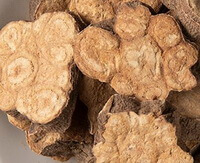
brownish dried root slices of Radix Polygoni Multiflori Pinyin Name: Hé Shǒu Wū
 English Name: Fleeceflower Root
 Latin Name: Radix Polygoni Multiflori
 Properties and Flavors: Slightly warm in nature; bitter, sweet, and slightly astringent in taste

 Brief introduction: Radix Polygoni multiflori is the dried tuberous root of Polygonum multiflorum Thunb. It is used to tonify the liver and kidneys, nourish blood and essence, darken hair, strengthen bones and tendons, and moisten the intestines to relieve constipation. It is commonly known as Fleeceflower Root, He Shou Wu, or Hé Shǒu Wū.

 Botanical Source: Classical herbal book define Fo-Ti (He Shou Wu) as the dried tuberous root of Polygonum multiflorum Thunb., a perennial vine belonging to the genus Fallopia, family Polygonaceae (smartweed or buckwheat family), order Caryophyllales (Polygonales in past). This widely used species is described below:

Polygonum multiflorum Thunb.


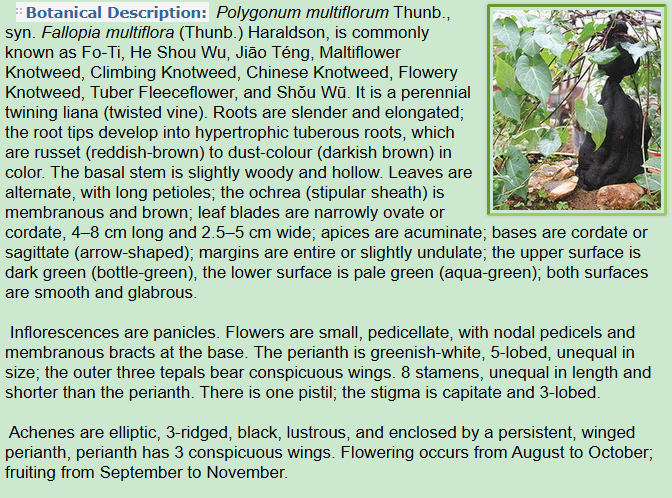
 growing plant of Polygonum multiflorum Thunb with many green leaves and its dark brown root in air Botanical Description: Polygonum multiflorum Thunb., syn. Fallopia multiflora (Thunb.) Haraldson, is commonly known as Fo-Ti, He Shou Wu, Jiāo Téng, Maltiflower Knotweed, Climbing Knotweed, Chinese Knotweed, Flowery Knotweed, Tuber Fleeceflower, and Shǒu Wū. It is a perennial twining liana (twisted vine). Roots are slender and elongated; the root tips develop into hypertrophic tuberous roots, which are russet (reddish-brown) to dust-colour (darkish brown) in color. The basal stem is slightly woody and hollow. Leaves are alternate, with long petioles; the ochrea (stipular sheath) is membranous and brown; leaf blades are narrowly ovate or cordate, 4–8 cm long and 2.5–5 cm wide; apices are acuminate; bases are cordate or sagittate (arrow-shaped); margins are entire or slightly undulate; the upper surface is dark green (bottle-green), the lower surface is pale green (aqua-green); both surfaces are smooth and glabrous.

 Inflorescences are panicles. Flowers are small, pedicellate, with nodal pedicels and membranous bracts at the base. The perianth is greenish-white, 5-lobed, unequal in size; the outer three tepals bear conspicuous wings. 8 stamens, unequal in length and shorter than the perianth. There is one pistil; the stigma is capitate and 3-lobed.

 Achenes are elliptic, 3-ridged, black, lustrous, and enclosed by a persistent, winged perianth, perianth has 3 conspicuous wings. Flowering occurs from August to October; fruiting from September to November.

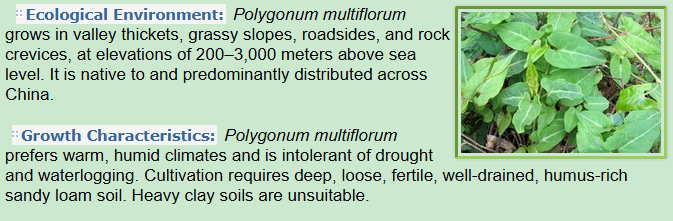
 plants of Polygonum multiflorum Thunb. with many green leaves grow in field Ecological Environment: Polygonum multiflorum grows in valley thickets, grassy slopes, roadsides, and rock crevices, at elevations of 200–3,000 meters above sea level. It is native to and predominantly distributed across China.

 Growth Characteristics: Polygonum multiflorum prefers warm, humid climates and is intolerant of drought and waterlogging. Cultivation requires deep, loose, fertile, well-drained, humus-rich sandy loam soil. Heavy clay soils are unsuitable.

 brownish fresh roots of Polygonum multiflorum Thunb are piled together in grass Production and Processing: Fleeceflower Root is produced throughout most regions of China. Tubers are harvested in spring or autumn—preferably from plants aged 3–4 years—washed thoroughly, sliced, and sun-dried to yield raw Fleeceflower Root. Prepared Fleeceflower Root is obtained by repeated steaming with black soybean juice (until dark brown) followed by sun-drying (until jet-black).

 Fo-Ti is native to China and remains widely cultivated. While the unprocessed (raw) root is occasionally used, traditional Chinese medicine considers the processed form—prepared with black soybean juice—to be superior, possessing distinct therapeutic properties. The raw root is sometimes referred to as "white Fo-Ti", whereas the processed root is termed "red Fo-Ti".

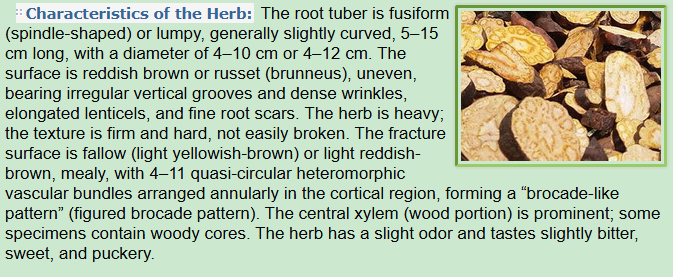
 fresh yellowish herb slices of Fleeceflower Root are piled together Characteristics of the Herb: The root tuber is fusiform (spindle-shaped) or lumpy, generally slightly curved, 5–15 cm long, with a diameter of 4–10 cm or 4–12 cm. The surface is reddish brown or russet (brunneus), uneven, bearing irregular vertical grooves and dense wrinkles, elongated lenticels, and fine root scars. The herb is heavy; the texture is firm and hard, not easily broken. The fracture surface is fallow (light yellowish-brown) or light reddish-brown, mealy, with 4–11 quasi-circular heteromorphic vascular bundles arranged annularly in the cortical region, forming a “brocade-like pattern” (figured brocade pattern). The central xylem (wood portion) is prominent; some specimens contain woody cores. The herb has a slight odor and tastes slightly bitter, sweet, and puckery.

 Pharmacological Actions: (1) lowering blood lipids; (2) prevention of atherosclerosis; (3) reduction of blood glucose; (4) anti-aging effects; (5) increase in hepatic glycogen content, etc.

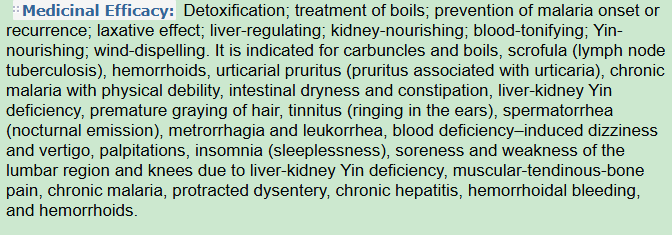
 Medicinal Efficacy: Detoxification; treatment of boils; prevention of malaria onset or recurrence; laxative effect; liver-regulating; kidney-nourishing; blood-tonifying; Yin-nourishing; wind-dispelling. It is indicated for carbuncles and boils, scrofula (lymph node tuberculosis), hemorrhoids, urticarial pruritus (pruritus associated with urticaria), chronic malaria with physical debility, intestinal dryness and constipation, liver-kidney Yin deficiency, premature graying of hair, tinnitus (ringing in the ears), spermatorrhea (nocturnal emission), metrorrhagia and leukorrhea, blood deficiency–induced dizziness and vertigo, palpitations, insomnia (sleeplessness), soreness and weakness of the lumbar region and knees due to liver-kidney Yin deficiency, muscular-tendinous-bone pain, chronic malaria, protracted dysentery, chronic hepatitis, hemorrhoidal bleeding, and hemorrhoids.

 Administration of Radix Polygoni Multiflori (Hé Shǒu Wū): 
 
Reference: Administration Guide of Radix Polygoni Multiflori (Hé Shǒu Wū)
TCM Books: (1) Internally: 3–6 grams; (2) Internally: Water decoction, 3–5 qian (≈9–15 grams); preparation as ointment, wine infusion, pills, or powder. External use: wash with decoction, apply finely powdered herb topically (sprinkling or smearing); (3) Internally: water decoction, 10–20 grams; preparation as ointment, wine infusion, pills, or powder. External use: appropriate amount—wash with decoction, apply finely powdered herb topically (sprinkling or smearing).
 Contraindications, Precautions, and Adverse Reactions: Radix Polygoni Multiflori should not be used concurrently with blood of pig, lamb, pork, or mutton. It should not be combined with radish. Concurrent use with scallion or garlic should be avoided.

 
Radix Polygoni Multiflori Preparata (Prepared Fleeceflower Root)

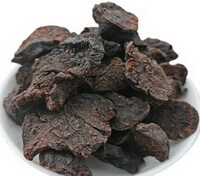
dark brownish herb slices and blocks of Radix Polygoni Multiflori Preparata are piled in a plate Pinyin Name: Zhì Hé Shǒu Wū or Zhì Shǒu Wū
 English Name: Prepared Fleeceflower Root
 Latin Name: Radix Polygoni Multiflori Preparata
 Property and Flavors: Warm or slightly warm in nature; bitter, sweet, and astringent in taste.

 Brief introduction: Radix Polygoni Multiflori Preparata is the root of Polygonum multiflorum processed with black bean juice. It is used to nourish Liver and Kidney Yin and tonify the Blood, primarily for conditions arising from Liver Blood deficiency and Kidney Essence deficiency—such as dizziness, tinnitus, soreness and weakness of the lower back and knees, and premature graying of hair. It is commonly known as Radix Polygoni Multiflori Preparata, Prepared Fleeceflower Root, or Zhì Hé Shǒu Wū.

 During the Tang dynasty, the herbalist Lin Daoren wrote a book titled Xian Shou Li Shang Xu Duan Mi Fang (The Secret Recipes of the Immortals for Treating Wounds and Fractures)(846 CE). In it, he described the processing of Ho-Shou-Wu to enhance its tonic properties (processed Ho-Shou-Wu is sometimes called Zhi Heshouwu to distinguish it from the unprocessed form, which may be designated Sheng Shouwu). The processing method involves stewing or steaming Ho-Shou-Wu in black soybean juice for several hours—up to three days, depending on the practitioner’s dedication to this method—and then drying the roots. This technique remains in use today. The black soybean juice is prepared by boiling black soybeans in water for about four hours; the liquid is decanted, and the beans are boiled again with less water for three hours; the resulting extract is combined with the first extract to make the final juice. Approximately 10 kg of black beans are used to process 100 kg of Ho-Shou-Wu roots. Black beans are traditionally ascribed the property of supplementing blood and essence, and prolonged cooking or steaming of the herb is believed to enhance its enriching and warming nature. The alchemical version of this processing—similar to the recommended method for preparing processed Rehmannia—involves repeating the stewing or steaming for a total of nine cycles. Thus, after preparation with black soybean juice (overnight) and drying, the roots are again processed with black soybean juice the next day, and so on, until nine complete cycles have been performed. This repeated processing was questioned by Chen Shiduo in his book Ben Cao Xin Bian (New Compilation of Herbs), in which he argued that excessive repetition would degrade the herb’s quality. Today, single-cycle processing is standard practice.

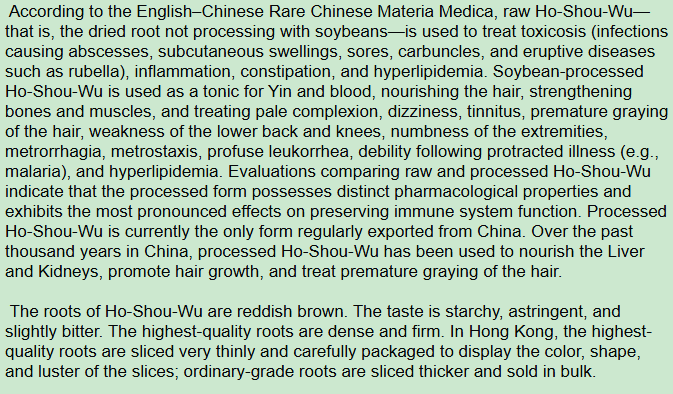
 According to the English–Chinese Rare Chinese Materia Medica, raw Ho-Shou-Wu—that is, the dried root not processing with soybeans—is used to treat toxicosis (infections causing abscesses, subcutaneous swellings, sores, carbuncles, and eruptive diseases such as rubella), inflammation, constipation, and hyperlipidemia. Soybean-processed Ho-Shou-Wu is used as a tonic for Yin and blood, nourishing the hair, strengthening bones and muscles, and treating pale complexion, dizziness, tinnitus, premature graying of the hair, weakness of the lower back and knees, numbness of the extremities, metrorrhagia, metrostaxis, profuse leukorrhea, debility following protracted illness (e.g., malaria), and hyperlipidemia. Evaluations comparing raw and processed Ho-Shou-Wu indicate that the processed form possesses distinct pharmacological properties and exhibits the most pronounced effects on preserving immune system function. Processed Ho-Shou-Wu is currently the only form regularly exported from China. Over the past thousand years in China, processed Ho-Shou-Wu has been used to nourish the Liver and Kidneys, promote hair growth, and treat premature graying of the hair.

 The roots of Ho-Shou-Wu are reddish brown. The taste is starchy, astringent, and slightly bitter. The highest-quality roots are dense and firm. In Hong Kong, the highest-quality roots are sliced very thinly and carefully packaged to display the color, shape, and luster of the slices; ordinary-grade roots are sliced thicker and sold in bulk.

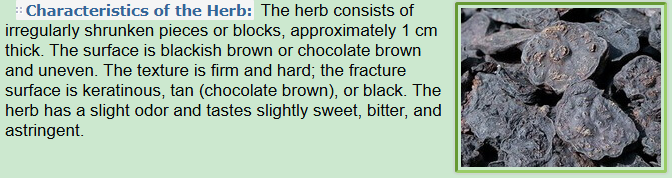
 dried blackish herb slices of Prepared Fleeceflower Root are piled together Characteristics of the Herb: The herb consists of irregularly shrunken pieces or blocks, approximately 1 cm thick. The surface is blackish brown or chocolate brown and uneven. The texture is firm and hard; the fracture surface is keratinous, tan (chocolate brown), or black. The herb has a slight odor and tastes slightly sweet, bitter, and astringent.

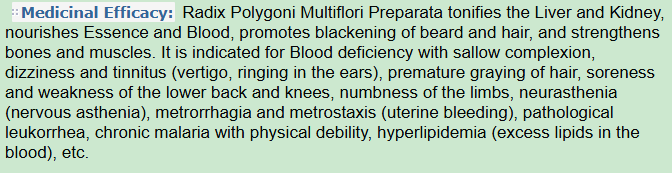
 Medicinal Efficacy: Radix Polygoni Multiflori Preparata tonifies the Liver and Kidney, nourishes Essence and Blood, promotes blackening of beard and hair, and strengthens bones and muscles. It is indicated for Blood deficiency with sallow complexion, dizziness and tinnitus (vertigo, ringing in the ears), premature graying of hair, soreness and weakness of the lower back and knees, numbness of the limbs, neurasthenia (nervous asthenia), metrorrhagia and metrostaxis (uterine bleeding), pathological leukorrhea, chronic malaria with physical debility, hyperlipidemia (excess lipids in the blood), etc.

 Administration of Radix Polygoni Multiflori Preparata (Zhì Hé Shǒu Wū): 
 
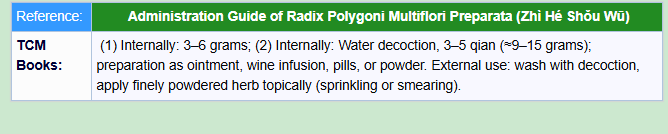
Reference: Administration Guide of Radix Polygoni Multiflori Preparata (Zhì Hé Shǒu Wū)
TCM Books: (1) Internally: 3–6 grams; (2) Internally: Water decoction, 3–5 qian (≈9–15 grams); preparation as ointment, wine infusion, pills, or powder. External use: wash with decoction, apply finely powdered herb topically (sprinkling or smearing); (3) Internally: Water decoction, 10–20 g; preparation as ointment, wine infusion, pills, or powder. External use: appropriate amount—wash with decoction, apply finely powdered herb topically (sprinkling or smearing).


 QR codeURL QR code:
 Website Address QR-code 

 
References:
  • 1. Introduction of He Shou Wu: Fleeceflower Root

 Edited and last revised:
   cool hit counter