✵The article records the herb Black Nightshade Herb—its English name, Latin name, Pinyin name, properties and flavor, botanical source—one plant species: Solanum nigrum L., and provides a detailed introduction to the botanical features, growth characteristics, and ecological environment of this plant species, as well as the macroscopic characteristics of the herb, its pharmacological actions, medicinal efficacy, and administration guidelines.
Herba Solani Nigri (Black Nightshade Herb)
Pinyin Name: Lónɡ Kuí
English Name: Black Nightshade Herb
Latin Name:Herba Solani Nigri Properties and Flavor: Cold, bitter
Brief Introduction:Herba Solani Nigri is the dried aerial part of Solanum nigrum L., used for the treatment of gastric and esophageal cancers. It is commonly known as Herba Solani Nigri, Black Nightshade Herb, or Long Kui.
Botanical Source: Herbal classics and official pharmacopoeias define Herba Solani Nigri (Black Nightshade Herb) as the dried aerial part of Solanum nigrum L. It is a plant of the genus Solanum L., family Solanaceae (nightshade or potato family), order Solanales. This commonly used species is described below:
(1) Solanum nigrum L.
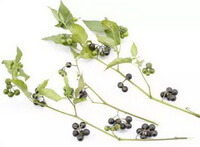
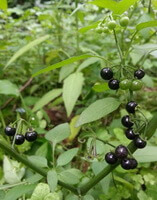
Botanical Description: Solanum nigrum L. is also known as Long Kui. It is an annual herb, growing up to 25–100 cm tall. The stem is erect, angular or nearly terete, glabrate or sparsely pubescent. Leaves are alternate; petioles are 1–2 cm long; leaf blades are ovate (egg-shaped), with a mucronate apex and a cuneate or broadly cuneate base that decurrents onto the petiole; they are usually 2.5–10 cm long and 1.5–5.5 cm wide, with entire or irregularly undulate margins bearing coarse teeth; both surfaces are smooth or sparsely pubescent.
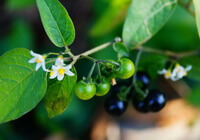
The inflorescence is a scorpioid cyme, extra-axillary, composed of 3–6 (sometimes up to 10) flowers; pedicels are 1–2.5 cm long; the calyx is small, shallowly cyathiform (cotyloid), sparsely pubescent, 5-lobed, with ovoid lobes ~2 mm long; the corolla is white, rotate (radiate), 5-lobed, with ovoid lobes ~2 mm long; there are 5 stamens inserted at the mouth of the corolla tube; filaments are free; anthers are yellow, with apical pores directed inward; there is 1 pistil, spherical in shape; the ovary is bilocular; the lower part of the style is densely white pilose; the stigma is rounded.
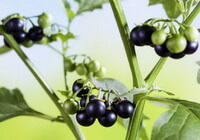
Berries are spherical, glossy, ~8 mm in diameter, turning black at maturity; seeds are mostly oblate. Flowering and fruiting occur from September to October.
Ecological Environment: The plant grows in fields, along roadsides, or on wastelands.
Growth Characteristics: It prefers a warm and humid climate. Soil requirements are not strict, though fertile, well-drained sandy loam is preferable.
Characteristics of the Herb: The stem is cylindrical and much-branched, 30–70 cm long and 2–10 mm in diameter, with a yellow-green surface bearing longitudinal wrinkles. The herb is hard and brittle; the fracture surface is yellowish-white and hollow. Leaves are shriveled or fragmented; intact leaves are ovate (egg-shaped) or elliptic, 2–12 cm long and 2–6 cm wide, with an acute or obtuse apex, entire or irregularly undulate-serrate margins, dark green color, and smooth or sparsely pubescent surfaces; petioles are 0.3–2.2 cm long. Flowers and fruits are rarely present. Cymes are cincinnate and extra-axillary, bearing 4–6 flowers; the calyx is tan (chocolate brown); the corolla is brownish-yellow. Berries are spherical, black or green, and wrinkled. Seeds are numerous and brown. The herb has a slight odor and a mild taste.
Pharmacological Actions: (1) Anti-inflammatory; (2) antitussive; (3) expectorant; (4) stimulation of smooth muscle, etc.
Medicinal efficacy: Clears heat, detoxifies, invigorates blood circulation, and reduces swelling. It is indicated for malignant boils, carbuncles, ulcerated sores, erysipelas, acute nephritis, chronic nephritis with edema, dysuria, chronic bronchitis (including senile chronic bronchitis), leukorrhea, prostatitis, dysentery, eczema, and traumatic injuries from falls.
Administration of Herba Solani Nigri (Lónɡ Kuí):
Reference:
Administration Guide of Herba Solani Nigri (Lónɡ Kuí)
TCM Books:
(1) Internally: water decoction, 0.5–1 liǎng (approximately 15–30 grams); topical: mashed herb applied externally or wash with decoction. (2) Internally: water decoction, 15–30 grams; topical: appropriate amount, mashed and applied externally or used as a wash.

 ✵The article records the herb Black Nightshade Herb—its English name, Latin name, Pinyin name, properties and flavor, botanical source—one plant species: Solanum nigrum L., and provides a detailed introduction to the botanical features, growth characteristics, and ecological environment of this plant species, as well as the macroscopic characteristics of the herb, its pharmacological actions, medicinal efficacy, and administration guidelines.
 Pinyin Name: Lónɡ Kuí
 Botanical Description: Solanum nigrum L. is also known as Long Kui. It is an annual herb, growing up to 25–100 cm tall. The stem is erect, angular or nearly terete, glabrate or sparsely pubescent. Leaves are alternate; petioles are 1–2 cm long; leaf blades are ovate (egg-shaped), with a mucronate apex and a cuneate or broadly cuneate base that decurrents onto the petiole; they are usually 2.5–10 cm long and 1.5–5.5 cm wide, with entire or irregularly undulate margins bearing coarse teeth; both surfaces are smooth or sparsely pubescent.
 The inflorescence is a scorpioid cyme, extra-axillary, composed of 3–6 (sometimes up to 10) flowers; pedicels are 1–2.5 cm long; the calyx is small, shallowly cyathiform (cotyloid), sparsely pubescent, 5-lobed, with ovoid lobes ~2 mm long; the corolla is white, rotate (radiate), 5-lobed, with ovoid lobes ~2 mm long; there are 5 stamens inserted at the mouth of the corolla tube; filaments are free; anthers are yellow, with apical pores directed inward; there is 1 pistil, spherical in shape; the ovary is bilocular; the lower part of the style is densely white pilose; the stigma is rounded.
 Ecological Environment: The plant grows in fields, along roadsides, or on wastelands.
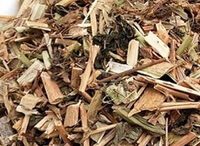 Characteristics of the Herb: The stem is cylindrical and much-branched, 30–70 cm long and 2–10 mm in diameter, with a yellow-green surface bearing longitudinal wrinkles. The herb is hard and brittle; the fracture surface is yellowish-white and hollow. Leaves are shriveled or fragmented; intact leaves are ovate (egg-shaped) or elliptic, 2–12 cm long and 2–6 cm wide, with an acute or obtuse apex, entire or irregularly undulate-serrate margins, dark green color, and smooth or sparsely pubescent surfaces; petioles are 0.3–2.2 cm long. Flowers and fruits are rarely present. Cymes are cincinnate and extra-axillary, bearing 4–6 flowers; the calyx is tan (chocolate brown); the corolla is brownish-yellow. Berries are spherical, black or green, and wrinkled. Seeds are numerous and brown. The herb has a slight odor and a mild taste.
 URL QR code:

