✵The article records the herb Dogbane Leaf—its English name, Latin name, Pinyin name, properties and flavors, botanical source—Apocynum venetum L., and provides a detailed introduction to the botanical features, growth characteristics, and ecological environment of this species, as well as the macroscopic characteristics of the herb, its pharmacological actions, medicinal efficacy, and administration guidelines.
Folium Apocyni Veniti (Dogbane Leaf)
Pinyin Name: Luó Bù Má Yè
English Name: Dogbane Leaf
Latin Name:Folium Apocyni Veniti Properties and Flavors: Cool; sweet and bitter
Brief Introduction:Folium Apocyni Veneti is the dried leaf of Apocynum venetum L. (red dogbane), used to subdue hyperactive Liver-Yang, clear heat, and promote diuresis. It is commonly known as Folium Apocyni Veneti, Dogbane Leaf, or Luó Bù Má Yè.
Botanical Source:Folium Apocyni Veneti (Dogbane Leaf) is the dried leaf of Apocynum venetum L., a perennial herb belonging to the genus Apocynum, family Apocynaceae (dogbane family), order Gentianales.
Classical herbal works define Folium Apocyni Veneti (Dogbane Leaf) as the dried leaf of Apocynum venetum L. This commonly used species is described below:
(1) Apocynum venetum L.
Botanical Description:Apocynum venetum L. is also known as Trachomitum venetum (L.) Woodson. Common names include red dogbane, Luó Bù Má, Zé Qī, and Qī Jīng. It is an erect, semi-woody shrub growing 1.5–3 m tall. The whole plant exudes milky latex. Branches are cylindrical, smooth, glabrous, and violet-red to pale red. Leaves are opposite; petioles 3–6 mm long; leaf blades are elliptic-lanceolate to ovoid-oblong, 1–5 cm long and 0.5–1.5 cm wide; apex is acute to obtuse; margins are finely serrated; both surfaces are glabrous.
Cymose inflorescences are conical, with one to several branches; usually terminal, occasionally axillary. Floral bracts are membranous and lanceolate, ~4 mm long and 1 mm wide. Each inflorescence bears 5 flowers. Calyx lobes are lanceolate to ovate-lanceolate, pubescent on both surfaces. Corolla tube is campanulate (bell-shaped), violet-red or pink, 6–8 mm long and 2–3 mm wide; corolla lobes are ovate-oblong, nearly equal in length to the tube. Stamens are inserted at the base of the corolla tube; anthers are arrow-shaped, concealed within the corolla throat; dorsal surface is raised; ventral surface adherent to the base of the style; filaments are short (2–2.5 mm). Style is short, with an enlarged upper portion and a narrowed lower portion; stigma base is discoid, apex is bilobed. Ovary is composed of two distinct carpels. Nectary disc is annular (ring-shaped), fleshy, and inserted on the receptacle.
Fruit consists of two follicles—parallel or slightly divergent, pendulous, 8–20 cm long and 2–3 mm in diameter. Seeds are numerous, ovoid-oblong, yellowish-brown, 2–3 mm long and 0.5–0.7 mm in diameter; apex bearing a tuft of white, silky hairs ~1.5–2.5 cm long. Flowering occurs from April to September; fruiting from July to December.
Ecological Environment: The plant grows in saline soils, desert margins, riverbanks, alluvial plains, lakeshores, and the Gobi Desert.
Growth Characteristics:Apocynum venetum L. is highly adaptable and exhibits strong tolerance to salinity, drought, cold, alkalinity, and wind. It thrives across diverse climates and soil types—even in the Turpan Basin, where summer droughts occur and temperatures exceed 50 °C (122 °F).
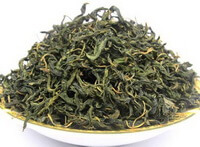
Characteristics of the Herb: Dried leaves are often wrinkled, curled, or fragmented. When flattened, intact leaves are elliptic-lanceolate to ovoid-oblong, 2–5 cm long and 0.5–2 cm wide, pale green to celadon (grayish-green). Apex is obtuse with a short awn; base is obtuse or cuneate; margin is finely serrated, often reflexed. Both surfaces are glabrous; veins are prominently raised on the abaxial surface. Petioles are slender, ~4 mm long. Texture is brittle. Odor is faint; taste is mild.
Medicinal Efficacy: Subdues Liver-Yang and calms the mind; clears heat and resolves edema (alleviate water retention); lowers blood pressure; strengthens the heart; promotes diuresis. Indicated for dizziness due to Liver-Yang hyperactivity, palpitations, insomnia, edema, oliguria, hypertension, neurasthenia, and nephritic edema.
Administration of Folium Apocyni Veniti (Luó Bù Má Yè):
Reference:
Administration Guide for Folium Apocyni Veniti (Luó Bù Má Yè)
TCM Books:
(1) Internally: 6–12 grams; (2) Internally: water decoction, 3–10 grams, or infused as tea and taken orally.

 ✵The article records the herb Dogbane Leaf—its English name, Latin name, Pinyin name, properties and flavors, botanical source—Apocynum venetum L., and provides a detailed introduction to the botanical features, growth characteristics, and ecological environment of this species, as well as the macroscopic characteristics of the herb, its pharmacological actions, medicinal efficacy, and administration guidelines.
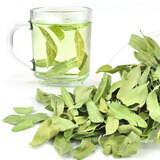 Pinyin Name: Luó Bù Má Yè
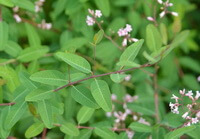 Botanical Description: Apocynum venetum L. is also known as Trachomitum venetum (L.) Woodson. Common names include red dogbane, Luó Bù Má, Zé Qī, and Qī Jīng. It is an erect, semi-woody shrub growing 1.5–3 m tall. The whole plant exudes milky latex. Branches are cylindrical, smooth, glabrous, and violet-red to pale red. Leaves are opposite; petioles 3–6 mm long; leaf blades are elliptic-lanceolate to ovoid-oblong, 1–5 cm long and 0.5–1.5 cm wide; apex is acute to obtuse; margins are finely serrated; both surfaces are glabrous.
 Ecological Environment: The plant grows in saline soils, desert margins, riverbanks, alluvial plains, lakeshores, and the Gobi Desert.
 URL QR code: