✵This article documents the herb Lái Fú Zǐ (Radish Seed), including its English name, Latin name, Pinyin name, properties and flavor, botanical source—Raphanus sativus L.—and provides a detailed description of the plant’s morphology, growth characteristics, ecological distribution, characteristics of the herb, pharmacological actions, medicinal efficacy, and administration guidelines.
Semen Raphani (Radish Seed)
Pinyin Name: Lái Fú Zǐ
English Name: Radish Seed
Latin Name:Semen Raphani Properties and Flavor: Neutral; pungent and sweet
Brief Introduction:Semen Raphani consists of the dried, ripe seeds of Raphanus sativus L. (garden radish). It is used (1) to promote digestion and direct Qi downward—indicated for food stagnation with abdominal distension and pain—and (2) to resolve phlegm and relieve cough and dyspnea with profuse sputum. It is commonly known as Semen Raphani, Radish Seed, or Lái Fú Zǐ.
Botanical Source: Classical TCM works define Semen Raphani (radish seed) as the dried, ripe seed of Raphanus sativus L., a species in the genus Raphanus, family Brassicaceae (Cruciferae, the mustard family within the order Brassicales). The species is described below:
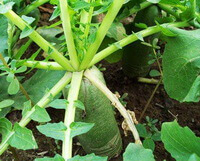
Raphanus sativus L.
Botanical Description:Raphanus sativus L. is commonly known as radish, garden radish, luóbo, or lái fú. It is an annual or biennial herb, growing 20–100 cm tall. The taproot is succulent and varies in shape—oblong, globular, or conical—with an epidermis that is green, white, or red. Stems are branched, glabrous, and slightly glaucous. Basal and lower cauline leaves are lyrate-pinnatifid, 8–30 cm long and 3–5 cm wide; the terminal lobe is ovate; lateral lobes occur in 4–6 pairs, are oblong and crenate, and bear sparse coarse hairs. Upper leaves are oblong, serrate or subentire.
Inflorescences are terminal or axillary racemes. Sepals are oblong. Flowers have four petals—white, purple, or pink—1.5–2 cm in diameter, obovate, 1–1.5 mm long, often with purple markings; the lower part bears claws ~5 mm long. There are six stamens: four long and two short. A single pistil is present; the ovary is subulate, and the stigma is prismatic.
The silique is cylindrical, 3–6 cm long and 10–12 mm wide, constricted between seeds to form spongy transeptae. The apex bears a rostrum (beak) 1–1.5 mm long. Each silique contains 1–6 seeds: ovate to slightly oblate, ~3 mm long, reddish-brown, with fine reticulate patterning. Flowering occurs from April to May; fruiting from May to June.
Ecological Environment:Raphanus sativus is widely distributed across China.
Growth Characteristics:Raphanus sativus exhibits strong adaptability and broad geographical distribution, and is cultivated throughout China. Sandy loam soils are optimal for cultivation. Suitable preceding crops include Glycine max (soybean), rice (Oryza sativa), and maize (Zea mays); cruciferous crops are unsuitable predecessors due to shared pests and diseases.
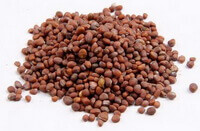
Characteristics of the Herb: The dried seeds are nearly circular, subellipsoidal, or subsphaeroidal, and slightly flattened—2.5–4 mm long (typically ~3 mm) and 2–3 mm wide. The seed coat is thin; the surface is reddish-brown, yellowish-brown, or dark taupe brown (deep grayish-brown), bearing several longitudinal grooves on one side and a black hilum at one end—a brown, punctiform protrusion. Under magnification, all seeds display fine, dense reticulate patterning. The seeds are hard in texture; the seed coat is thin and brittle. Each seed contains two cotyledons—yellowish-white or creamy yellow, fleshy and oily. The herb is odorless or has a faint aroma and tastes mild to sweet, with a slight pungency or mild bitterness and pungency.
Medicinal Efficacy: Promotes digestion and alleviates distension; resolves food stagnation; directs rebellious Qi downward; transforms phlegm; arrests wheezing. Indicated for food and drink retention; indigestion with Qi stagnation; epigastric distension and pain; chest oppression; abdominal distension; constipation; diarrhea (including dysenteric diarrhea and tenesmus); phlegm-damp accumulation with wheezing; copious-phlegm cough; and rebellious Qi causing dyspnea and fullness.
Administration of Semen Raphani (Lái Fú Zǐ):
Reference:
Administration Guide for Semen Raphani (Lái Fú Zǐ)
TCM Books:
(1) Internally: 5–12 grams; (2) Internally: water decoction, 1.5–3 qián (≈4.5–9 grams); or prepared as pills or powder. Externally: prepare as a finely ground herb powder and apply topically. (3) Internally: water decoction, 5–10 grams; or prepared as pills or powder—preferably stir-fried. Externally: use an appropriate amount; prepare as a finely ground herb powder, mix as needed, and apply topically.

 ✵This article documents the herb Lái Fú Zǐ (Radish Seed), including its English name, Latin name, Pinyin name, properties and flavor, botanical source—Raphanus sativus L.—and provides a detailed description of the plant’s morphology, growth characteristics, ecological distribution, characteristics of the herb, pharmacological actions, medicinal efficacy, and administration guidelines.
 Pinyin Name: Lái Fú Zǐ
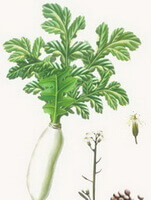 Botanical Description: Raphanus sativus L. is commonly known as radish, garden radish, luóbo, or lái fú. It is an annual or biennial herb, growing 20–100 cm tall. The taproot is succulent and varies in shape—oblong, globular, or conical—with an epidermis that is green, white, or red. Stems are branched, glabrous, and slightly glaucous. Basal and lower cauline leaves are lyrate-pinnatifid, 8–30 cm long and 3–5 cm wide; the terminal lobe is ovate; lateral lobes occur in 4–6 pairs, are oblong and crenate, and bear sparse coarse hairs. Upper leaves are oblong, serrate or subentire.
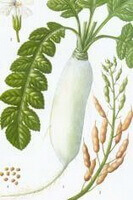 Inflorescences are terminal or axillary racemes. Sepals are oblong. Flowers have four petals—white, purple, or pink—1.5–2 cm in diameter, obovate, 1–1.5 mm long, often with purple markings; the lower part bears claws ~5 mm long. There are six stamens: four long and two short. A single pistil is present; the ovary is subulate, and the stigma is prismatic.
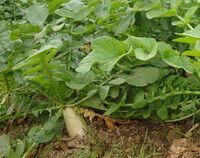 Ecological Environment: Raphanus sativus is widely distributed across China.
 Characteristics of the Herb: The dried seeds are nearly circular, subellipsoidal, or subsphaeroidal, and slightly flattened—2.5–4 mm long (typically ~3 mm) and 2–3 mm wide. The seed coat is thin; the surface is reddish-brown, yellowish-brown, or dark taupe brown (deep grayish-brown), bearing several longitudinal grooves on one side and a black hilum at one end—a brown, punctiform protrusion. Under magnification, all seeds display fine, dense reticulate patterning. The seeds are hard in texture; the seed coat is thin and brittle. Each seed contains two cotyledons—yellowish-white or creamy yellow, fleshy and oily. The herb is odorless or has a faint aroma and tastes mild to sweet, with a slight pungency or mild bitterness and pungency.
 URL QR code: