Introduction of Zhè Bèi Mǔ: Thunberg Fritillary Bulb
✵The article records the herb Thunberg Fritillary Bulb—its English name, Latin name, Pinyin name, properties and flavor, botanical source—a single plant species, Fritillaria thunbergii Miq., and provides a detailed introduction to the plant’s botanical features, growth characteristics, and ecological environment; as well as the herb’s macroscopic characteristics, pharmacological actions, medicinal efficacy, and administration guidelines.
Pinyin Name: Zhè Bèi Mǔ
English Name: Thunbery Fritillary Bulb
Latin Name:Bulbus Fritillariae Thunbergii Properties and Flavor: Cold, bitter
Brief Introduction:Bulbus Fritillariae Thunbergii (Thunberg Fritillary Bulb) is the dried bulb of Fritillaria thunbergii Miq. It is used (1) to clear heat and resolve phlegm in cases of cough with thick, sticky sputum, and (2) to dissipate nodules in cases of mastitis and scrofula. It is commonly known as Bulbus Fritillariae Thunbergii, Thunberg Fritillary Bulb, or Zhè Bèi Mǔ.
Botanical Source:Bulbus Fritillariae Thunbergii (Thunberg Fritillary Bulb) is the dried bulb of Fritillaria thunbergii Miq., a perennial herb belonging to the genus Fritillaria L., family Liliaceae (lily family), order Liliales (formerly in order Liliflorae). It is also known as Thunberg Fritillary Bulb or Zhè Bèi Mǔ.
Classical herbal works define Bulbus Fritillariae Thunbergii (Thunberg Fritillary Bulb) as the dried bulb of Fritillaria thunbergii Miq. This commonly used species is described below:
(1) Fritillaria thunbergii Miq.
Botanical Description:Fritillaria thunbergii Miq. is also known as Fritillaria collicola Hance and Fritillaria verticillata Willd. var. thunbergii (Miq.) Baker. It is commonly called Zhè Bèi Mǔ. A perennial herb, it grows 50–80 cm tall. The bulb is oblate, 1.5–4 cm in diameter, composed of two thick, white, connate scale leaves. Basal leaves are opposite; upward along the stem, leaf arrangement becomes alternate, opposite, or whorled; leaf blades are linear to lanceolate, 7–11 cm long and 1–2.5 cm wide, with an apex that is straight or slightly recurved.
It bears 1–6 flowers, pale yellow (sometimes faintly purplish); apical flowers have 3–4 leaflike bracts, while others have 2; bract apices are recurved. Flowers are campanulate (bell-shaped) and pendulous; perianth consists of 6 tepals, long-elliptic, 2–4 cm long and 1–1.5 cm wide; inner and outer whorls are similar; the inner surface bears purple reticulate markings, and nectaries are present at the base. There are 6 stamens, approximately 2/5 the length of the tepals; anthers are subbasifixed; filaments lack papillae; stigma segments measure 1.5–2 mm in length.
The capsule is ovoid, 6-ribbed, 2–2.2 cm long and 2.5 cm wide, with wings 6–8 mm wide along the ribs. Flowering occurs from March to April; fruiting occurs in May.
Ecological environment: The plant grows in shady habitats on hillsides or in bamboo forests at low elevations.
Growth characteristics: It prefers a warm, humid, maritime climate with abundant rainfall; it is cold-tolerant but intolerant of waterlogging. Above-ground stems and leaves grow rapidly at ~17 °C (62.6 °F); growth slows above 20 °C (68 °F), and the plant gradually withers as temperature rises further, entering dormancy underground. Its entire growth cycle lasts about three and a half months, classifying it as an ephemeral plant. Cultivation requires fields with ample sunlight, deep fertile loamy soil, good drainage, and slightly acidic to neutral pH.
Characteristics of the Herb: (1) Pearl Fritillary Bulb (Zhu Bei): A complete squamous bulb, oblate, 1–2.5 cm in diameter and 1–1.5 cm in height. Surface is whitish; the two outer scales are thick and folded; 2–3 inner scale leaves and residual stem remain inside. Texture is firm yet brittle, fracturing easily; fracture surface is white and mealy. Odor is slight; taste is bitter.
(2) Large Fritillary Bulb: A single hypertrophied scale leaf shaped like an ingot or rhombus, 2–4 cm long, 1–2.5 cm high, and 0.6–1.5 cm thick. Outer surface is whitish to light yellowish-white, often bearing light brown spots; inner surface is whitish to yellowish-white.
Pharmacological Actions: (1) Effects on smooth muscle and glandular secretion; (2) Effects on the circulatory and respiratory systems.
Medicinal Efficacy: Clears heat and resolves phlegm; disperses nodules and dissipates stagnation. It is indicated for cough due to wind-heat or dry-heat, phlegm-heat obstructing the lungs, lung abscess, acute mastitis, scrofula, carbuncles and sores, and chest oppression with emotional depression.
Administration of Bulbus Fritillariae Thunbergii (Zhè Bèi Mǔ):
Reference:
Administration Guide for Bulbus Fritillariae Thunbergii (Zhè Bèi Mǔ)
TCM Books:
(1) Internally:4.5–9 grams, decocted in water; (2) 1.5–3 qián (≈4.5–9 grams), decocted in water; (3) 3–10 grams, water decoction; Also administered as finely powdered herb, prepared into pills or powders. External use: Apply the finely powdered herb topically.
Precautions: Contraindicated with Aconitum species (e.g., Radix Aconiti).
Article Link:
URL QR code:
References:
1.Introduction of Zhè Bèi Mǔ: Thunberg Fritillary Bulb

 ✵The article records the herb Thunberg Fritillary Bulb—its English name, Latin name, Pinyin name, properties and flavor, botanical source—a single plant species, Fritillaria thunbergii Miq., and provides a detailed introduction to the plant’s botanical features, growth characteristics, and ecological environment; as well as the herb’s macroscopic characteristics, pharmacological actions, medicinal efficacy, and administration guidelines.
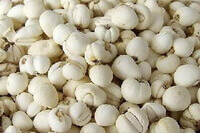 Pinyin Name: Zhè Bèi Mǔ
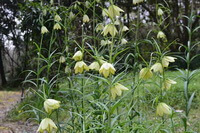 Botanical Description: Fritillaria thunbergii Miq. is also known as Fritillaria collicola Hance and Fritillaria verticillata Willd. var. thunbergii (Miq.) Baker. It is commonly called Zhè Bèi Mǔ. A perennial herb, it grows 50–80 cm tall. The bulb is oblate, 1.5–4 cm in diameter, composed of two thick, white, connate scale leaves. Basal leaves are opposite; upward along the stem, leaf arrangement becomes alternate, opposite, or whorled; leaf blades are linear to lanceolate, 7–11 cm long and 1–2.5 cm wide, with an apex that is straight or slightly recurved.
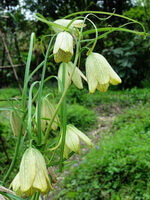 It bears 1–6 flowers, pale yellow (sometimes faintly purplish); apical flowers have 3–4 leaflike bracts, while others have 2; bract apices are recurved. Flowers are campanulate (bell-shaped) and pendulous; perianth consists of 6 tepals, long-elliptic, 2–4 cm long and 1–1.5 cm wide; inner and outer whorls are similar; the inner surface bears purple reticulate markings, and nectaries are present at the base. There are 6 stamens, approximately 2/5 the length of the tepals; anthers are subbasifixed; filaments lack papillae; stigma segments measure 1.5–2 mm in length.
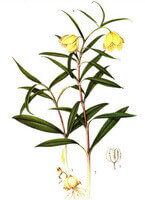 Ecological environment: The plant grows in shady habitats on hillsides or in bamboo forests at low elevations.
 URL QR code: