✵The article records the herb Seaweed—including its English name, Latin name, Pinyin name, properties and flavor, botanical sources—two plant species: (1) Sargassum pallidum (Turn.) C. Ag., and (2) Sargassum fusiforme (Harv.) Setch.—and provides a detailed introduction to the botanical features, growth characteristics, and ecological environments of these two species; the macroscopic and microscopic features of the herb Seaweed; its pharmacological actions; medicinal efficacy; and administration guidelines.
Sargassum (Seaweed)
Pinyin Name: Hái Zǎo
English Name: Seaweed
Latin Name: Sargassum
Properties and Flavor: Cold, bitter, salty.
Brief Introduction: The herb Sargassum is the dried thallus of Sargassum pallidum (Turn.) C. Ag. or Sargassum fusiforme (Harv.) Setch., used (1) to eliminate phlegm and soften hard masses—treating goiter, scrofula, and testicular swelling—and (2) to induce diuresis for edema. The herb is commonly known as Sargassum, Seaweed, or Hái Zǎo.
Botanical Source: The herb Sargassum (Seaweed) is the dried thallus of Sargassum pallidum (Turn.) C. Ag. and Sargassum fusiforme (Harv.) Setch., both belonging to the family Sargassaceae, order Fucales (formerly placed in order Moceros).
Herbal classic works define the herb Sargassum (Seaweed) as the dried thallus of seaweed: (1) Sargassum pallidum (Turn.) C. Ag. and (2) Sargassum fusiforme (Harv.) Setch. These two commonly used species are introduced below:
(1) Sargassum pallidum (Turn.) C. Ag.
Botanical Description:Sargassum pallidum (Turn.) C. Ag. is also known as Sargassum confusum C. Ag. It is commonly called Hǎi Hāo Zǐ, Dà Yè Zǎo (Big-leaf Seaweed), or Hǎi Cǎo (Seagrass). It is a perennial brown alga with a yellow-brown frond, growing up to 30–100 cm tall. At the initial stage, it has one to two upright, cylindrical trunks; pinnate branches arise from both sides at obtuse or right angles. Branchlets emerge from the axils of these branches. Young branches and the young main trunk bear short, small acanthous (thorn-like) protrusions. Leaf shape is variable: primary leaves are lanceolate, oblanceolate, or obovate—generally 5–9 cm long and 3–18 cm wide—with inconspicuous midrib-like protrusions and conspicuous sterile nest spots; however, such leaves abscise soon after development. Secondary leaves are linear, oblanceolate, obovate, or pinnately divided; branchlets arise from their axils, bearing numerous narrow-lanceolate or linear leaves. Air bladders mostly develop in the axils of terminal branches: fusiform (spindle-shaped) or obovate when young, becoming spherical upon maturity, with a rounded apex or a short, pointed, slender projection, 2–5 mm in diameter. The pyrenoids are solitary or arranged in raceme-like clusters on reproductive branchlets; they are cylindrical, approximately 3–15 mm long and about 1 mm in diameter. The species is dioecious. The holdfast (adhesive disc) is flat-discoid or short-conical.
Ecological Environment:Sargassum pallidum grows in tide pools within the low-tide zone and on submerged rocks at depths of 1–4 meters below the tidal line—habitats frequently subjected to wave action and strong water currents. It is mainly distributed in coastal regions.
Growth Characteristics:Sargassum pallidum grows attached to rocks in shallow, low-tide waters. It is distributed along coastal areas.
Characteristics of the Herb: The herb is also known as Alga Sargassi Pallidi or Big-leaf Seaweed. The main rachis bears short, thorn-like protrusions on its surface. Numerous branches arise; basal phyllids are lanceolate, entire or coarsely serrate, coriaceous; upper phyllids are narrow-lanceolate or filiform. Air bladders are spherical (globular) or ovoid (egg-shaped), with a pliable apex or a short mucro. The pyrenoids are cylindrical. The herb has a fishy odor and a salty taste.
Medicinal efficacy: Dissolving hard masses, resolving phlegm, and promoting diuresis; indicated for goiter, scrofula, testicular swelling and pain, phlegm retention and fluid accumulation, generalized edema, etc.
Administration of Sargassum (Hái Zǎo):
Reference:
Administration Guide of Sargassum (Hái Zǎo)
TCM Books:
(1) Internally: 6–12 grams; (2) Internally: water decoction, 1.5–3 qián (approximately 4.5–9 grams); infusion in wine; or prepared as pills or powder; (3) Internally: water decoction, 1.5–3 qián (approximately 4.5–9 grams); infusion in wine; or prepared as pills or powder;
Precautions and Adverse Reactions: Sargassum should not be combined with Glycyrrhiza uralensis (licorice root).
(2) Sargassum fusiforme (Harv.) Setchell
Botanical Description:Sargassum fusiforme (Harv.) Setchell is also known as Hizikia fusiformis (Harv.) Okamura. It is commonly known as Yang Qi Cai or small-leaf seaweed. It is a perennial brown alga whose fronds are yellow-brown and succulent, growing up to 20–500 cm tall—or over 2 meters in exceptional cases. Young plants bear 2–3 primary leaves at the base, which abscise early. The main axis is erect, branched, cylindrical, and 2–4 mm in diameter. Leaves are highly variable in shape and size: linear, spatulate (spoon-shaped), oval (egg-shaped), or clavate; the margins of spatulate leaves are serrated or shallowly lobed. The leaf apex is sometimes swollen into an air bladder, which may be spherical (globular), pyriform (pear-shaped), or fusiform (spindle-shaped). This alga grows in warm seas; most leaves are linear, whereas those from colder waters tend to be clavate and bear fusiform air bladders about 5–10 mm long, often with short apices and short cylindrical petioles. The receptacles (pyrenoids) occur in leaf axils or on branchlets; they are cylindrical, blunt-tipped, 5–15 mm long, grow on short stalks, and occasionally branched. The species is dioecious: male receptacles measure 4–10 mm in length and 1–1.5 mm in diameter; female receptacles are 2–4 mm long and slightly thicker. The holdfast is cylindrical and pseudorhizal.
Ecological Environment:Sargassum fusiforme grows on rocky substrata exposed to seawater during low tide and in areas above the mean high-tide line.
Characteristics of the Herb: The herb is also known as Alga Sargassi Fusiformis or small-leaf seaweed. The thallus fragments are shriveled and curled, blackish-brown, sometimes covered with a whitish bloom (epicuticular wax), and 15–40 cm long. The main rachis is cylindrical, bearing short lateral branches; the leaf-like projections are linear to elongate-rod-shaped, slightly flattened, and the apex is sometimes swollen, hollow, or peltate (shield-shaped). The air bladders are fusiform (spindle-shaped), pyriform (pear-shaped), or spherical (globular) and occur in clusters. The receptacles are cylindrical or oblong-ovoid. The herb has a fishy odor and a salty taste.

 ✵The article records the herb Seaweed—including its English name, Latin name, Pinyin name, properties and flavor, botanical sources—two plant species: (1) Sargassum pallidum (Turn.) C. Ag., and (2) Sargassum fusiforme (Harv.) Setch.—and provides a detailed introduction to the botanical features, growth characteristics, and ecological environments of these two species; the macroscopic and microscopic features of the herb Seaweed; its pharmacological actions; medicinal efficacy; and administration guidelines.
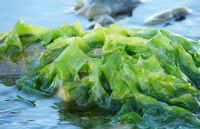 Pinyin Name: Hái Zǎo
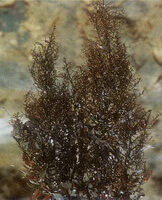 Botanical Description: Sargassum pallidum (Turn.) C. Ag. is also known as Sargassum confusum C. Ag. It is commonly called Hǎi Hāo Zǐ, Dà Yè Zǎo (Big-leaf Seaweed), or Hǎi Cǎo (Seagrass). It is a perennial brown alga with a yellow-brown frond, growing up to 30–100 cm tall. At the initial stage, it has one to two upright, cylindrical trunks; pinnate branches arise from both sides at obtuse or right angles. Branchlets emerge from the axils of these branches. Young branches and the young main trunk bear short, small acanthous (thorn-like) protrusions. Leaf shape is variable: primary leaves are lanceolate, oblanceolate, or obovate—generally 5–9 cm long and 3–18 cm wide—with inconspicuous midrib-like protrusions and conspicuous sterile nest spots; however, such leaves abscise soon after development. Secondary leaves are linear, oblanceolate, obovate, or pinnately divided; branchlets arise from their axils, bearing numerous narrow-lanceolate or linear leaves. Air bladders mostly develop in the axils of terminal branches: fusiform (spindle-shaped) or obovate when young, becoming spherical upon maturity, with a rounded apex or a short, pointed, slender projection, 2–5 mm in diameter. The pyrenoids are solitary or arranged in raceme-like clusters on reproductive branchlets; they are cylindrical, approximately 3–15 mm long and about 1 mm in diameter. The species is dioecious. The holdfast (adhesive disc) is flat-discoid or short-conical.
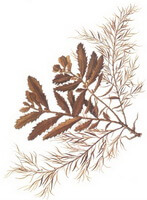 Ecological Environment: Sargassum pallidum grows in tide pools within the low-tide zone and on submerged rocks at depths of 1–4 meters below the tidal line—habitats frequently subjected to wave action and strong water currents. It is mainly distributed in coastal regions.
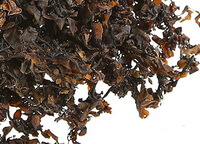 Characteristics of the Herb: The herb is also known as Alga Sargassi Pallidi or Big-leaf Seaweed. The main rachis bears short, thorn-like protrusions on its surface. Numerous branches arise; basal phyllids are lanceolate, entire or coarsely serrate, coriaceous; upper phyllids are narrow-lanceolate or filiform. Air bladders are spherical (globular) or ovoid (egg-shaped), with a pliable apex or a short mucro. The pyrenoids are cylindrical. The herb has a fishy odor and a salty taste.
 Botanical Description: Sargassum fusiforme (Harv.) Setchell is also known as Hizikia fusiformis (Harv.) Okamura. It is commonly known as Yang Qi Cai or small-leaf seaweed. It is a perennial brown alga whose fronds are yellow-brown and succulent, growing up to 20–500 cm tall—or over 2 meters in exceptional cases. Young plants bear 2–3 primary leaves at the base, which abscise early. The main axis is erect, branched, cylindrical, and 2–4 mm in diameter. Leaves are highly variable in shape and size: linear, spatulate (spoon-shaped), oval (egg-shaped), or clavate; the margins of spatulate leaves are serrated or shallowly lobed. The leaf apex is sometimes swollen into an air bladder, which may be spherical (globular), pyriform (pear-shaped), or fusiform (spindle-shaped). This alga grows in warm seas; most leaves are linear, whereas those from colder waters tend to be clavate and bear fusiform air bladders about 5–10 mm long, often with short apices and short cylindrical petioles. The receptacles (pyrenoids) occur in leaf axils or on branchlets; they are cylindrical, blunt-tipped, 5–15 mm long, grow on short stalks, and occasionally branched. The species is dioecious: male receptacles measure 4–10 mm in length and 1–1.5 mm in diameter; female receptacles are 2–4 mm long and slightly thicker. The holdfast is cylindrical and pseudorhizal.
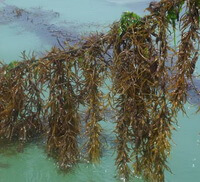 Ecological Environment: Sargassum fusiforme grows on rocky substrata exposed to seawater during low tide and in areas above the mean high-tide line.
 URL QR code: