Introduction of Huang Yuan Hua: Yellow Genkwa Leaf and Flower
✵The article documents the herb Folium et Flos Wikstroemiae Chamaedaphnis (Chamaedaphne Leaf and Flower, Yellow Genkwa Leaf and Flower), including its English name, Latin name, Pinyin name, properties and flavor, and its botanical source—only one plant species: (1) Wikstroemia chamaedaphne Meissn. It provides a detailed description of the botanical features, growth characteristics, and ecological environment of this species, as well as the morphological characteristics of the herb, its pharmacological actions, medicinal efficacy, and administration guidelines.
Folium et Flos Wikstroemiae Chamaedephnis (Chamaedaphne Leaf and Flower,Yellow Genkwa Leaf and Flower)
Pinyin Name: Huáng Yuán Huā
English Name: Chamaedaphne Leaf and Flower; Yellow Genkwa Leaf and Flower
Latin Name:Folium et Flos Wikstroemiae Chamaedephnis Property and Flavor: Warm, pungent, and mildly toxic.
Brief Introduction:Folium et Flos Wikstroemiae Chamaedaphnis consists of the leaf and flower buds of Wikstroemia chamaedaphne Meissn. It is used similarly to Flos Genkwa and also indicated for acute and chronic hepatitis, schizophrenia, and epilepsy. Common names include Folium et Flos Wikstroemiae Chamaedaphnis, Chamaedaphne Leaf and Flower, Yellow Genkwa Leaf and Flower, and Huáng Yuán Huā.
Botanical Source: Classical herbal works define Folium et Flos Wikstroemiae Chamaedaphnis (Chamaedaphne Leaf and Flower, Yellow Genkwa Leaf and Flower) as the dried flower buds—and sometimes leaves—of Wikstroemia chamaedaphne Meissn. This species belongs to the genus Daphne L., family Thymelaeaceae, order Myrtales. The sole commonly used species is described below:
(1) Wikstroemia chamaedaphne Meissn.
Botanical Description:Wikstroemia chamaedaphne Meissn. is commonly known as Hé Shuò Ráo Huā and Yuán Hāo. It is an upright, deciduous small shrub growing 30–120 cm tall (averaging 50 cm), with numerous slender, elongated branches. Twigs and young branches are tender green; older branches are brunneous (reddish-brown), smooth, and glabrous. Leaves are opposite or subopposite and coriaceous. Leaf blades are long elliptic-lanceolate to lanceolate, 2–5 cm long (rarely up to 6 cm) and 0.3–1 cm wide; the apex is acute or subacute; the base is attenuate, tapering into a short petiole. Both surfaces are smooth; the lower surface is pale green, and the margin is entire.
Flowers are small and arranged in terminal umbellate cymes or clustered in panicles. The perianth is fistulose (tubular), with a 4-lobed apex; the exterior bears sparse pubescence. There are eight stamens, arranged in two whorls (upper and lower), inserted inside the perianth tube. The floral disc is oblong, with a single scale. The upper portion of the ovary is covered with pale yellow pubescence; the stigma is rounded.
Drupes are ovoid. Flowering occurs in summer and autumn; fruiting in autumn.
Ecological Environment: The plant grows on hillsides and mountain slopes, along roadsides and ditches, and in grasslands.
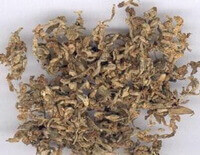
Characteristics of the Herb: The flower buds are rod-shaped or slender, cylindrical, usually occurring in loose clusters. They are hermaphroditic and lack petals. The calyx is cylindrical and thin—rarely slightly curved—3–8 mm long, light grayish-green or sallow (grayish-yellow) in color, and densely pubescent both externally and on the abaxial surface of the lobes. The four calyx lobes constitute 1/6–1/4 of the total calyx length. Anatomically, the calyx has 4 tip oval lobes, eight stamens are arranged in two rows and inserted into the calyx tube; filaments are absent. The herb has a faint odor and a sweet, pungent taste.
Medicinal Efficacy: IPurgative and hydragogue; resolves phlegm and fluid retention. Indicated for abdominal distension and fullness, phlegm-damp accumulation, cough with dyspneic fullness, infectious hepatitis, schizophrenia, and epilepsy.
Administration of Folium et Flos Wikstroemiae Chamaedephnis (Huáng Yuán Huā):
Reference:
Administration Guide for Folium et Flos Wikstroemiae Chamaedephnis (Huáng Yuán Huā)
TCM Books:
(1) Internally: powdered herb, 1.5–3 grams; water decoction,3–6 grams; For schizophrenia, the dosage may be gradually increased from a lower amount up to 6 grams (water decoction).
Contraindications, Precautions, and Adverse Reactions: Contraindicated during pregnancy and in individuals with physical debility.
Article Link:
URL QR code:
References:
1.Introduction of Huang Yuan Hua: Yellow Genkwa Leaf and Flower

 ✵The article documents the herb Folium et Flos Wikstroemiae Chamaedaphnis (Chamaedaphne Leaf and Flower, Yellow Genkwa Leaf and Flower), including its English name, Latin name, Pinyin name, properties and flavor, and its botanical source—only one plant species: (1) Wikstroemia chamaedaphne Meissn. It provides a detailed description of the botanical features, growth characteristics, and ecological environment of this species, as well as the morphological characteristics of the herb, its pharmacological actions, medicinal efficacy, and administration guidelines.
 Pinyin Name: Huáng Yuán Huā
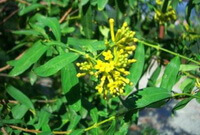 Botanical Description: Wikstroemia chamaedaphne Meissn. is commonly known as Hé Shuò Ráo Huā and Yuán Hāo. It is an upright, deciduous small shrub growing 30–120 cm tall (averaging 50 cm), with numerous slender, elongated branches. Twigs and young branches are tender green; older branches are brunneous (reddish-brown), smooth, and glabrous. Leaves are opposite or subopposite and coriaceous. Leaf blades are long elliptic-lanceolate to lanceolate, 2–5 cm long (rarely up to 6 cm) and 0.3–1 cm wide; the apex is acute or subacute; the base is attenuate, tapering into a short petiole. Both surfaces are smooth; the lower surface is pale green, and the margin is entire.
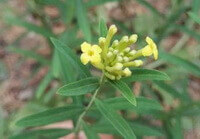 Flowers are small and arranged in terminal umbellate cymes or clustered in panicles. The perianth is fistulose (tubular), with a 4-lobed apex; the exterior bears sparse pubescence. There are eight stamens, arranged in two whorls (upper and lower), inserted inside the perianth tube. The floral disc is oblong, with a single scale. The upper portion of the ovary is covered with pale yellow pubescence; the stigma is rounded.
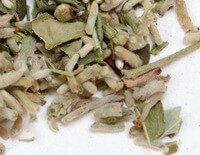 Characteristics of the Herb: The flower buds are rod-shaped or slender, cylindrical, usually occurring in loose clusters. They are hermaphroditic and lack petals. The calyx is cylindrical and thin—rarely slightly curved—3–8 mm long, light grayish-green or sallow (grayish-yellow) in color, and densely pubescent both externally and on the abaxial surface of the lobes. The four calyx lobes constitute 1/6–1/4 of the total calyx length. Anatomically, the calyx has 4 tip oval lobes, eight stamens are arranged in two rows and inserted into the calyx tube; filaments are absent. The herb has a faint odor and a sweet, pungent taste.
 URL QR code: