✵This article documents the herb Puffball—including its English name, Latin name, Pinyin name, properties and flavor—as well as its botanical sources: three fungal species—(1) Lasiosphaera fenzlii Reichb., (2) Calvatia gigantea (Batsch ex Pers.) Lloyd, and (3) Calvatia lilacina (Mont. et Berk.) Lloyd—along with detailed descriptions of their botanical features, growth characteristics, ecological environments, characteristics of the dried sporophores, pharmacological actions, medicinal efficacy, and administration guidelines.
Lasiosphaera seu Calvatia (Puff-ball)
Pinyin Name: Mǎ Bó
English Name: Puff-ball
Latin Name:Lasiosphaera seu Calvatia Properties and Flavor: Neutral; pungent
Brief Introduction:Lasiosphaera seu Calvatia refers to the dried sporophores of Lasiosphaera fenzlii Reichb., Calvatia gigantea (Batsch ex Pers.) Lloyd, or Calvatia lilacina (Mont. et Berk.) Lloyd (family Agaricaceae, formerly Lycoperdaceae). It is used to clear lung-heat, soothe the throat, counteract toxins, and arrest bleeding—primarily for sore throat with swelling and hoarseness due to wind-heat invasion or lung-fire, as well as for epistaxis, hematemesis, and traumatic bleeding. Common names include Mǎ Bó, Puffball, and Lasiosphaera seu Calvatia.
Botanical Source: Traditional herbal classics define Lasiosphaera seu Calvatia (Puffball) as the dried sporophore of (1) Lasiosphaera fenzlii Reichb., (2) Calvatia gigantea (Batsch ex Pers.) Lloyd, or (3) Calvatia lilacina (Mont. et Berk.) Lloyd (family Agaricaceae). These three commonly used species are described below:
(1) Lasiosphaera fenzlii Reichb.
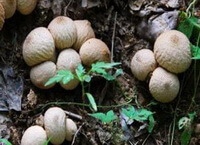
Botanical Description:Lasiosphaera fenzlii Reichb. is also known as Tuō Pí Mǎ Bó. It is a saprobic fungus (not parasitic), with a subspherical fruiting body measuring 15–20 cm in diameter and lacking a sterile base. The peridium consists of two layers—thin and fragile—disintegrating easily at maturity. The outer peridium is cream-white (milky white) when young, later turning taupe (dusty gray) or dirty gray; the inner peridium is chartaceous (papery), pale fumeus (smoky gray), and gradually flakes off, leaving only the spore mass. The spore mass is taupe to smoky brown. Spores are globose, brown, with minutely echinulate (spiny) sporoderm, 4.5–5.5 μm in diameter. Capillitium is long, branched, and interwoven; hyphae are 2–4.5 μm in diameter and pale brown.
Ecological Environment: The fungus grows in open grasslands, pastures, and meadows.
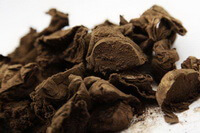
Characteristics of the Herb: The sporophore is oblate to nearly spherical, 15–18 cm (or more) in diameter, without a sterile base. The peridium is taupe-brown to brownish-yellow, papery, thin, and mostly absent—only remnants of the spore skin remain; the spore mass is yellowish-brown to tan (chocolate brown). The herb is lightweight, soft, elastic, and flocculent. Gentle shaking releases spores; when twisted, it yields a fine, delicate powder. Odor is faint.
Pharmacological Actions: (1) Hemostatic effects; (2) Inhibitory activity against Staphylococcus aureus, Pseudomonas aeruginosa, Streptococcus pneumoniae, and certain pathogenic fungi.
Medicinal Efficacy: Clears lung-heat and soothes the throat; detoxifies and arrests bleeding. Indicated for wind-heat invasion of the Lung manifesting as sore throat and hoarseness; sore throat with swelling; cough; loss of voice; epistaxis; hematemesis; external application for nasal bleeding, traumatic bleeding, and non-healing ulcers.
Administration of Lasiosphaera seu Calvatia (Mǎ Bó):
Reference:
Administration Guide for Lasiosphaera seu Calvatia (Mǎ Bó)
TCM Books:
(1) Internally: 1.5–6 grams; external use: appropriate amount, apply as a paste to the affected area. (2) Internally: water decoction, 0.5–1 qián (≈1.5–3 grams), or prepared as pills or powder; external use: finely ground herb powder applied as a paste, or blown onto the affected area. (3) Internally: water decoction, 1.5–6 grams, or prepared as pills or powder; external use: finely ground herb powder applied as a paste, or as a stick application, or blown onto the affected area.
(2) Calvatia gigantea (Batsch ex Pers.) Lloyd.
Botanical Description:Calvatia gigantea (Batsch ex Pers.) Lloyd is also known as Dà Mǎ Bó. It is a saprobic fungus. Its fruiting body is subspherical, 15–25 cm in diameter; the sterile base is inconspicuous. The peridium is white initially, gradually turning pale yellow to pale bluish-yellow; the outer peridium is membranous, with a floccose texture in the early stage, later shedding to become smooth; the inner peridium is thicker and composed of loosely interwoven hyphae. The peridium cracks upon maturity and undergoes residual exfoliation. The gleba (sporogenous tissue) is white initially, later turning bluish-brown. Spores are spherical (globular), with a smooth sporoderm, pale greenish-yellow, 3.8–4.7 μm in diameter. Capillitium is long, slightly branched, with sparse septa, 2.5–6 μm in diameter.
Ecological Environment: The fungus fruits from late summer to late autumn and occurs in open grasslands, meadows, and sandy grassy slopes on hillsides or mountain slopes.
Characteristics of the Herb: The fruiting body (encarpium) is oblate or irregularly squashed lumps, 15–20 cm in diameter or larger; it has a small sterile base or lacks one entirely. The outer peridium is straw-yellow (grayish-yellow), chartaceous (papery), and often detaches; the inner peridium is thick, hard, and brittle, splitting into fragments, yellowish-brown; the spore mass is pale bluish-brown, flocculent, light, and loose—spores disperse readily when gently shaken. The herb has a faint odor and tastes slightly bitter and astringent.
(3) Calvatia lilacina (Mont.et Berk.) Lloyd.
Botanical Description: Calvatia lilacina (Mont. et Berk.) Lloyd is also known as Zǐ Sè Tū Mǎ Bó. It is a saprobic fungus. Its fruiting body is suboblate, 1.5–12 cm in diameter; the base is constricted and connected to the substrate via rhizomorphs (root-like hyphal bundles). The surface is pale violet to fuscous (dark brown) and develops reticulate cracking (fissuring) at maturity. The gleba is white initially, later turning yellow to deep purple. The base consists of interwoven vegetative hyphae (nutrient hyphae), spongy in texture, cream-white (milky-white) with pale puce (light purple-brown). Spores are mauve (lilac), spherical (globular), with a short pedicel at one end, and echinate (spiny) sporoderm; dimensions: (5–5.5) μm × (6–6.5) μm. Capillitium is long and highly branched, with frequent septa; hyphae are 5–6 μm in diameter.
Ecological Environment: The fungus mainly grows in open meadow areas during summer and autumn.
Characteristics of the Herb: The complete fruiting body is oblate; incomplete specimens are cyathiform (cup-shaped), 5–12 cm in diameter, with a well-developed sterile base and stipe. The peridium is thin, purplish-brown, rough and wrinkled, bearing circular depressions; after the upper peridium sloughs off, the purple spore mass becomes exposed. The fruiting body is light and elastic; abundant spores are released upon manual crumbling. The herb has a faint odor.

 ✵This article documents the herb Puffball—including its English name, Latin name, Pinyin name, properties and flavor—as well as its botanical sources: three fungal species—(1) Lasiosphaera fenzlii Reichb., (2) Calvatia gigantea (Batsch ex Pers.) Lloyd, and (3) Calvatia lilacina (Mont. et Berk.) Lloyd—along with detailed descriptions of their botanical features, growth characteristics, ecological environments, characteristics of the dried sporophores, pharmacological actions, medicinal efficacy, and administration guidelines.
 Pinyin Name: Mǎ Bó
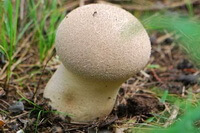 Botanical Description: Lasiosphaera fenzlii Reichb. is also known as Tuō Pí Mǎ Bó. It is a saprobic fungus (not parasitic), with a subspherical fruiting body measuring 15–20 cm in diameter and lacking a sterile base. The peridium consists of two layers—thin and fragile—disintegrating easily at maturity. The outer peridium is cream-white (milky white) when young, later turning taupe (dusty gray) or dirty gray; the inner peridium is chartaceous (papery), pale fumeus (smoky gray), and gradually flakes off, leaving only the spore mass. The spore mass is taupe to smoky brown. Spores are globose, brown, with minutely echinulate (spiny) sporoderm, 4.5–5.5 μm in diameter. Capillitium is long, branched, and interwoven; hyphae are 2–4.5 μm in diameter and pale brown.
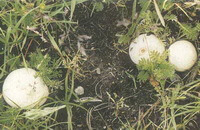 Ecological Environment: The fungus grows in open grasslands, pastures, and meadows.
 Characteristics of the Herb: The sporophore is oblate to nearly spherical, 15–18 cm (or more) in diameter, without a sterile base. The peridium is taupe-brown to brownish-yellow, papery, thin, and mostly absent—only remnants of the spore skin remain; the spore mass is yellowish-brown to tan (chocolate brown). The herb is lightweight, soft, elastic, and flocculent. Gentle shaking releases spores; when twisted, it yields a fine, delicate powder. Odor is faint.
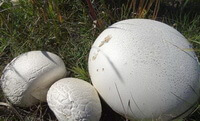 Botanical Description: Calvatia gigantea (Batsch ex Pers.) Lloyd is also known as Dà Mǎ Bó. It is a saprobic fungus. Its fruiting body is subspherical, 15–25 cm in diameter; the sterile base is inconspicuous. The peridium is white initially, gradually turning pale yellow to pale bluish-yellow; the outer peridium is membranous, with a floccose texture in the early stage, later shedding to become smooth; the inner peridium is thicker and composed of loosely interwoven hyphae. The peridium cracks upon maturity and undergoes residual exfoliation. The gleba (sporogenous tissue) is white initially, later turning bluish-brown. Spores are spherical (globular), with a smooth sporoderm, pale greenish-yellow, 3.8–4.7 μm in diameter. Capillitium is long, slightly branched, with sparse septa, 2.5–6 μm in diameter.
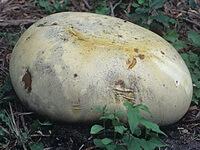 Ecological Environment: The fungus fruits from late summer to late autumn and occurs in open grasslands, meadows, and sandy grassy slopes on hillsides or mountain slopes.
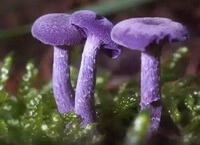 Botanical Description: Calvatia lilacina (Mont. et Berk.) Lloyd is also known as Zǐ Sè Tū Mǎ Bó. It is a saprobic fungus. Its fruiting body is suboblate, 1.5–12 cm in diameter; the base is constricted and connected to the substrate via rhizomorphs (root-like hyphal bundles). The surface is pale violet to fuscous (dark brown) and develops reticulate cracking (fissuring) at maturity. The gleba is white initially, later turning yellow to deep purple. The base consists of interwoven vegetative hyphae (nutrient hyphae), spongy in texture, cream-white (milky-white) with pale puce (light purple-brown). Spores are mauve (lilac), spherical (globular), with a short pedicel at one end, and echinate (spiny) sporoderm; dimensions: (5–5.5) μm × (6–6.5) μm. Capillitium is long and highly branched, with frequent septa; hyphae are 5–6 μm in diameter.
 URL QR code: