✵The article documents the herb Gypsum, including its English name, Latin name, Pinyin name, properties and flavor, and its mineral source—a single mineral: (1) gypsum. It provides a detailed introduction to the geological features of this mineral, its formation characteristics, and ecological environment; the macroscopic and microscopic characteristics of the crude herb Gypsum; its pharmacological actions, medicinal efficacy, and administration guidelines.
Gypsum Fibrosum (Gypsum)
Pinyin Name: Shí Gāo
English Name: Gypsum
Latin Name:Gypsum Fibrosum Properties and Flavor: Cold, pungent, sweet
Brief Introduction:Gypsum Fibrosum is a soft mineral composed primarily of hydrated calcium sulfate (CaSO42H2O). It is used to clear heat and drain fire, particularly for: (1) high fever with restlessness and thirst in warm diseases; (2) lung-heat manifesting as cough and dyspnea; and (3) stomach-heat causing toothache and painful gingival swelling. Externally, it promotes wound and ulcer healing. The herb is commonly known as Gypsum Fibrosum, Gypsum, or Shí Gāo.
Mineral Source:Gypsum Fibrosum (Gypsum) is a sulfate mineral—gypsum (calcium sulfate dihydrate). It is also known as Gypsum or Shí Gāo. This commonly used mineral is described as follows:
(1) Gypsum
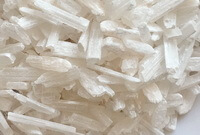
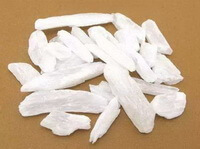
Mineral Description: Gypsum crystallizes in the monoclinic system. Well-formed crystals are typically plate-like or prismatic, often occurring as swallow-tailed twins. Aggregates commonly appear massive, flaky, fibrous, or powdery. Crystals are colorless and transparent or white and translucent; when impure, they may appear grayish-white, pale red (pinkish or light red), pale yellow, etc. The luster is vitreous; cleavage surfaces exhibit pearly luster, and fibrous aggregates show silky luster. Hardness ranges from 1.5 to 2; specific gravity is 2.3–2.37. Cleavage sheets are flexible.
Ecological Environment: Gypsum commonly occurs in sedimentary rocks formed in evaporitic environments such as coastal salt lakes and inland saline lakes.
Characteristics of the Herb: Gypsum is a fibrous aggregate, occurring as elongated blocks, plates, or irregular pieces. Color ranges from white to off-white or pale yellow; streak is white, and some specimens are translucent. The upper and lower surfaces are relatively flat, lacking texture and luster; the vertical surface typically displays a distinct vertical fibrous texture and exhibits a silky luster. The herb is heavy and soft in texture—nail scratches leave visible marks. It has a faint odor and a mild taste.
Pharmacological Actions: (1) Antipyretic effect; (2) enhancement of phagocytic activity of rabbit alveolar macrophages against Staphylococcus aureus and colloidal gold, and promotion of phagocytic cell maturation; (3) shortening of blood clotting time; (4) promotion of bile secretion; (5) diuretic and hypoglycemic effects, among others.
Medicinal Efficacy: Raw Gypsum clears heat and drains fire, alleviates restlessness, and quenches thirst. It is indicated for exogenous febrile diseases presenting with high fever and polydipsia, lung-heat asthma, stomach-heat hyperpyrexia, toothache, and headache. Calcined Gypsum dries dampness, promotes tissue regeneration, consolidates sores, and stops bleeding; it is used for non-healing ulcers, eczema with pruritus, scalds and burns, and traumatic bleeding.
Administration of Gypsum Fibrosum (Shí Gāo):
Reference:
Administration Guide for Gypsum Fibrosum (Shí Gāo)
TCM Books:
(1) Internally: 15–60 grams, decocted first (i.e., boiled for 15–20 minutes before adding other herbs); (2) Internally: water decoction, 0.3–1 liǎng (≈9–30 grams); higher doses may reach 6–8 liǎng (≈180–240 g); may also be formulated into pills or powders. External use: calcined and finely powdered, applied topically as a dusting powder or paste. (3) Internally:water decoction, 0.3–1 liǎng (≈9–30 grams); higher doses may reach 6–8 liǎng (≈180–240 g); may also be formulated into pills or powders. External use: calcined and finely powdered, applied topically as a dusting powder or paste.

 ✵The article documents the herb Gypsum, including its English name, Latin name, Pinyin name, properties and flavor, and its mineral source—a single mineral: (1) gypsum. It provides a detailed introduction to the geological features of this mineral, its formation characteristics, and ecological environment; the macroscopic and microscopic characteristics of the crude herb Gypsum; its pharmacological actions, medicinal efficacy, and administration guidelines.
 Pinyin Name: Shí Gāo
 Ecological Environment: Gypsum commonly occurs in sedimentary rocks formed in evaporitic environments such as coastal salt lakes and inland saline lakes.
 URL QR code:

