Introduction of Qīnɡ Xiānɡ Zǐ: Feather Cockscomb Seed
✵This article documents Feather Cockscomb Seed—including its English name, Latin name, Pinyin name, properties and flavor, botanical source—a single species: (1) Celosia argentea L., detailed botanical features of this species, its growth characteristics and ecological environment, characteristics of the herb, pharmacological actions, medicinal efficacy, and administration guidelines.
Semen Celosiae (Feather Cockscomb Seed)
Pinyin Name: Qīnɡ Xiānɡ Zǐ
English Name: Feather Cockscomb Seed
Latin Name:Semen Celosiae Properties and Flavor: Slightly cold; bitter
Brief Introduction:Semen Celosiae is the dried, ripe seed of Celosia argentea L. It clears liver heat, improves vision, and resolves nebulae. It is indicated for acute conjunctivitis, blurred vision due to corneal opacities (nebulae), and dizziness caused by liver-yang hyperactivity. It is commonly known as Semen Celosiae, Feather Cockscomb Seed, or Qīnɡ Xiānɡ Zǐ.
Botanical Source:Semen Celosiae (Feather Cockscomb Seed) is the dried, mature seed of Celosia argentea L., a plant of the genus Celosia (family Amaranthaceae, order Caryophyllales). The Amaranthaceae family is also known as the amaranth family.
Herbal classical works define Semen Celosiae (Feather Cockscomb Seed, Qīnɡ Xiānɡ Zǐ) as the dried, ripe seed of (1) Celosia argentea L. This commonly used species is described below:
(1) Celosia argentea L.
Botanical Description:Celosia argentea L. is also known as Qīnɡ Xiānɡ. It is an annual herb reaching 30–90 cm in height. The entire plant is glabrous. The stem is erect; the upper portion is usually branched and colored green or reddish-purple, with longitudinal striations. Leaves are simple and alternate; petioles measure 2–15 mm in length—or leaves may be sessile. Leaf blades are chartaceous (papery), lanceolate or oblong-lanceolate, 5–9 cm long and 1–3 cm wide; the apex is acute or long-acuminate; the base is cuneate and slightly decurrent; margins are entire.
Flowers are densely arranged. Initially faintly red, they later turn silvery-white. Inflorescences are terminal spikes—solitary on the stem apex or branch tips—cylindrical or conical, 3–10 cm long. Bracts, bracteoles, and tepals are scarious, white, and glossy. There are 5 tepals—white or pink, lanceolate in shape—and 5 stamens; the lower portions of the filaments are connate into a cyathiform (cup-shaped) structure; anthers are purple.
Utricles are ovate-elliptic. The fruit operculum dehisces by circumscission, with the upper portion detaching as a calyptra (cap-like structure); the persistent style remains at the apex, enveloped by persistent perianth lobes. Seeds are discoid, black, and lustrous. Flowering occurs from May to August; fruiting occurs from June to October.
Ecological Environment: The plant grows on slopes, roadsides, and sunny, well-drained plains.
Growth Characteristics: The plant prefers a warm, humid climate. Soil requirements are not stringent; however, fertile, sandy, well-drained soil is optimal. Waterlogging must be avoided; low-lying areas are unsuitable for cultivation.
Characteristics of the Herb: The herb is discoid; a few specimens are reniform. Diameter ranges from 1–1.8 mm. The surface is black or reddish-black and lustrous; the central region is slightly elevated. Reticulate venation is visible under magnification; a slightly concave area on one side corresponds to the hilum. Seeds are slightly mucilaginous when moistened. The seed coat (spermoderm) is thin and fragile; the endosperm is off-white. The herb is odorless and tasteless.
Pharmacological Actions: (1) Antibacterial effect: A 10% decoction exhibits strong inhibitory activity against Pseudomonas aeruginosa. When applied topically to infected wounds, it suppresses P. aeruginosa growth without causing significant local irritation. (2) Shortens recalcification time in rabbit plasma. (3) Reduces intraocular pressure.
Medicinal Efficacy: Clears liver heat, improves vision, and resolves mild corneal opacities (nebulae). Indicated for liver-heat-induced red, painful eyes; corneal opacities; blurred vision; hypertension; dizziness due to liver-fire hyperactivity; epistaxis; wind-heat-induced pruritus; and skin sores or tinea.
Administration of Semen Celosiae (Qīnɡ Xiānɡ Zǐ):
Reference:
Administration Guide for Semen Celosiae (Qīnɡ Xiānɡ Zǐ)
TCM Books:
(1) Internally: 9–15 grams; (2) Internally: as a water decoction, 3–5 qián (approximately 9–15 grams); (3) Internally: as a water decoction, 3–15 grams.Externally: apply an appropriate amount—prepare as a finely ground herb powder for topical application, or extract the juice and instill into the nose
Precautions and Adverse Reactions: Semen Celosiae has mydriatic effects (pupil dilation); it is contraindicated in glaucoma.
Article Link:
URL QR code:
References:
1.Introduction of Qing Xiang Zi: Feather Cockscomb Seed.

 ✵This article documents Feather Cockscomb Seed—including its English name, Latin name, Pinyin name, properties and flavor, botanical source—a single species: (1) Celosia argentea L., detailed botanical features of this species, its growth characteristics and ecological environment, characteristics of the herb, pharmacological actions, medicinal efficacy, and administration guidelines.
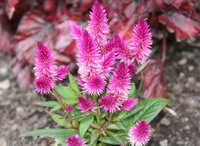 Pinyin Name: Qīnɡ Xiānɡ Zǐ
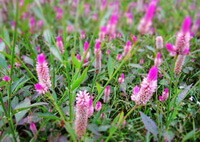 Botanical Description: Celosia argentea L. is also known as Qīnɡ Xiānɡ. It is an annual herb reaching 30–90 cm in height. The entire plant is glabrous. The stem is erect; the upper portion is usually branched and colored green or reddish-purple, with longitudinal striations. Leaves are simple and alternate; petioles measure 2–15 mm in length—or leaves may be sessile. Leaf blades are chartaceous (papery), lanceolate or oblong-lanceolate, 5–9 cm long and 1–3 cm wide; the apex is acute or long-acuminate; the base is cuneate and slightly decurrent; margins are entire.
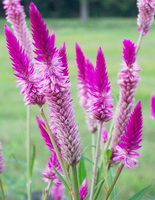 Utricles are ovate-elliptic. The fruit operculum dehisces by circumscission, with the upper portion detaching as a calyptra (cap-like structure); the persistent style remains at the apex, enveloped by persistent perianth lobes. Seeds are discoid, black, and lustrous. Flowering occurs from May to August; fruiting occurs from June to October.
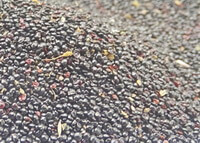 Characteristics of the Herb: The herb is discoid; a few specimens are reniform. Diameter ranges from 1–1.8 mm. The surface is black or reddish-black and lustrous; the central region is slightly elevated. Reticulate venation is visible under magnification; a slightly concave area on one side corresponds to the hilum. Seeds are slightly mucilaginous when moistened. The seed coat (spermoderm) is thin and fragile; the endosperm is off-white. The herb is odorless and tasteless.
 URL QR code: