✵This article documents the herb Medicated Leaven, including its English name, Latin name, Pinyin name, properties and flavors, botanical sources—two plant species: (1) Artemisia annua L. and (2) Polygonum hydropiper L.—as well as detailed descriptions of the botanical features, growth characteristics, and ecological environments of these two species; the macroscopic and organoleptic traits of Medicated Leaven; its pharmacological actions; medicinal efficacy; and administration guidelines.
Massa Fermentata Medicinalis (Medicated Leaven)
Pinyin Name: Shén Qū
English Name: Medicated Leaven
Latin Name:Massa Fermentata Medicinalis Properties and Flavors: Warm; pungent and sweet; non-toxic.
Brief Introduction:Massa Fermentata Medicinalis is a dried, fermented mass prepared from wheat flour, fresh aerial parts of Artemisia annua, apricot kernels, and Polygonum hydropiper. It is used to promote digestion and resolve food stagnation, particularly for dyspepsia and abdominal distension. It is commonly known as Massa Fermentata Medicinalis, Medicated Leaven, Massa Medicata Fermentata, or Shén Qū.
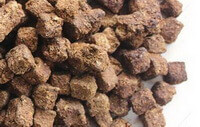
Trait identification: This herb appears as square or rectangular blocks, approximately 3 cm wide and 1 cm thick, with a khaki-colored, rough surface. It is hard and brittle, fracturing easily; the cross-section is uneven and whitish, revealing uncrushed brown residues and cavities formed during fermentation. It has a stale, bitter odor and taste. Higher-quality material is dry, mature, free from insect infestation, and contains minimal impurities.
Chemical Composition: The preparation contains microbial metabolites and enzymatic components, including yeasts, amylase, B-complex vitamins, ergosterol, proteins, lipids, and volatile oils.
Botanical Source: Classical herbal works define Massa Fermentata Medicinalis (Medicated Leaven) as the dried fermented mass composed of wheat flour, fresh aerial parts of Artemisia annua, apricot kernels, and Polygonum hydropiper. Apricot kernels are described in the entry "Apricot Kernel"; Artemisia annua and Polygonum hydropiper are detailed below:
(1) Artemisia annua L.
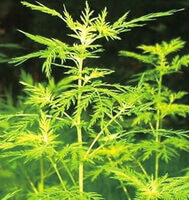
Botanical Description:Artemisia annua L. is an annual herb commonly known as Huáng Huā Hāo or Qīnɡ Hāo. It belongs to the genus Artemisia L. in the family Asteraceae (Compositae), order Asterales. The plant grows up to 40~150 cm high, the whole plant emits a strong aromatic odor. Roots are solitary, vertical, and narrowly fusiform. Stems are solitary, erect, longitudinally striated, highly branched, smooth, and glabrous. Basal leaves lie flat on the ground and wither before flowering; cauline leaves are alternate, green when young and turning tawny (yellowish-brown) with age, glabrous, short-stipitate at lower nodes and gradually becoming sessile upward. Leaf blades are typically tripinnatisect; lobes are narrow and slender, bearing minute powdery pubescence; the upper surface is dark green, the lower surface pale green (pea-green), sparsely covered with fine hairs or powdery glandular spots; both sides of the rachis bear narrow wings; upper stem leaves progressively reduce in size and become linear.
Capitula (flower heads) are small and globular, ~2 mm in diameter, borne on fine, soft, short peduncles; numerous capitula form a conical panicle. The involucre is small and globular; all florets are tubular and yellow—peripheral florets are female, central florets are bisexual.
Achenes are elliptic to ovoid and slightly oblate. Flowering occurs from August to October; fruiting from October to November.
Ecological Environment:Artemisia annua grows wild in fields, on hillsides and mountain slopes, roadsides, riverbanks, grasslands, forest margins, dry valleys, semi-deserts, gravelly slopes, and saline soils—often as a dominant or co-dominant species in plant communities.
Geographic Distribution: Widely distributed across temperate, cold-temperate, and subtropical regions of Asia and Europe—with highest abundance in northern, central, and eastern Asia, and central, eastern, and southern Europe. It has also naturalized in North America, including the USA (the United States of America) and Canada.
Growth Characteristics:Artemisia annua prefers warm, moist climates and is shade-intolerant; it does not tolerate waterlogging. Optimal seed germination temperature ranges from 8–25 °C (46.4–77 °F). Cultivation is best conducted in sunny, well-drained fields with loose, fertile, humus-rich sandy loam soil.
Characteristics of the Herb: The stem is cylindrical; the upper part is many-branched, 30–80 cm long, and 0.2–0.6 cm in diameter. The surface is yellowish-green or yellowish-brown and bears longitudinal ridges. The texture of the herb is slightly hard but easily broken, with a pith (medulla) visible in the center of the fracture surface. Leaves are alternate, dark green or brownish-green, curled, and brittle. When flattened, intact leaves are tripinnatipartite; the lobes and lobules are rectangular-circular or oblong-oval, and both surfaces are covered with short hairs. The odor is distinctive, and the taste is slightly bitter.
(2).Polygonum hydropiper.
Botanical Description: Commonly known as Là Liǎo, it refers to the whole herb—or the roots and leaves—of Polygonum flaccidum Meisn or Polygonum hydropiper L.
Polygonum flaccidum Meisn is a species of the genus Polygonum L., family Polygonaceae (smartweed or buckwheat family), order Caryophyllales (formerly in order Polygonales). It is commonly known as Là Liǎo ("hot-tasting Polygonum"). Leaves are lanceolate or elliptic-lanceolate, 4–8 cm long and approximately 0.5–2.5 cm wide; the apex is acuminate, the base is cuneate, margins are entire, both surfaces are glabrous and bear brown dots; petioles are 4–8 mm long.
Racemes are spicate, terminal or axillary, 3–8 cm long, usually drooping; flowers are sparse, with the lower portion discontinuous. Flower bracts are funnelform, 2–3 mm long, and green. Flowers are green with five deep longitudinal lines; the upper part is white or reddish.
Polygonum hydropiper L. is a species of the genus Polygonum L., family Polygonaceae (smartweed or buckwheat family), order Caryophyllales. It is also known as Persicaria hydropiper (L.) Spach and Shuǐ Liǎo ("Water Polygonum"). An annual herb, it grows 20–60 cm tall. The stem is erect or obliquely ascending, unbranched or branched at the base, glabrous, with adventitious roots arising from basal nodes. Simple leaves are alternate, petiolate; ocrea (stipular sheath) is terete, ~1 cm long, brown, membranous, sparsely covered with short appressed hairs, truncate at the apex, and fringed with short cilia. Leaf blades are lanceolate, 4–8 cm long and 0.8–2 cm wide; the apex is acuminate, the base is cuneate, both surfaces bear black glandular dots, and margins have marginal setae (trichomes).
Racemes are spicate, terminal or axillary, slender and elongated, with the upper portion curved and pendulous, 4–10 cm long; flowers are sparse. Bracts are funnelform (funnel-shaped), bearing brown glandular spots; the apex bears short cilia or is nearly glabrous. The perianth is 4–5-parted; lobes are pale green or faintly red and densely covered with brown glandular spots. There are 6 stamens (rarely 8), shorter than the perianth; 2–3 styles, basally connate, with capitate stigmas.
Achenes are ovoid (egg-shaped), laterally compressed, dark brown (dusky brown), arranged in at least three rows, ~2.5 mm long; the surface is speckled with thickened spots and enclosed within the persistent perianth. Flowering and fruiting occur from June to October.
Ecological Environment:Polygonum hydropiper grows on riverbanks, ditch margins, valley wetlands, and roadside marshes, at altitudes of 50–3,500 m above sea level. It is distributed across China.
Growth Characteristics: The plant thrives in low mountain areas, in partially shaded, moist habitats of dam regions, or in shallow water. It grows best in fertile clay or sandy loam soils.
Characteristics of the Herb: The stem is cylindrical and branched, 30–70 cm long and ~6 mm in diameter. The surface is celadon (sage green) or reddish-brown and bears fine longitudinal ridges; nodes are swollen. The texture is crisp and brittle; the fracture surface is light yellow and hollow. Leaves are alternate and petiolate; leaf blades are shriveled or fragmented. When fully expanded, intact leaves are lanceolate or oval-lanceolate, 5–10 cm long and 0.7–1.5 cm wide; the apex is acuminate, the base is cuneate, and margins are entire. The upper surface is tan (chocolate brown); the lower surface is brownish-green; both surfaces bear blackish-brown spots and minute glandular dots. Ocrea is terete, 0.8–1.1 cm long, purplish-brown (puce), with marginal setae (trichomes) 1–3 mm long. Racemes are 4–10 cm long; flowers are clustered sparsely and discontinuously. The perianth is pale green (pea green), 5-lobed, and densely covered with glandular spots. The herb has a mild odor and a pungent, spicy taste.
Pharmacological Actions: (1) B-group vitamin-like effects: Medicated Leaven contains abundant yeast and B vitamins. Dried yeast likewise contains various B vitamins; thus, the herb exhibits B-group vitamin-like effects—such as appetite stimulation and support of normal digestive function.
Medicinal Efficacy: Tonifies the spleen and harmonizes the stomach; aids digestion, regulates the middle jiao (middle energizer), and resolves food retention. It is indicated for food and drink retention, dyspepsia, chest fullness, abdominal distension, anorexia (inappetence), nausea and diarrhea or dysentery, postpartum abdominal pain due to blood stasis, pediatric abdominal masses and hard food accumulation, etc.
Administration of Massa Fermentata Medicinalis (Shén Qū):
Reference:
Administration Guide for Massa Fermentata Medicinalis (Shén Qū)
TCM Books:
(1) Internally: water decoction, 2–4 qian (approximately 6–12 grams); or as a finely powdered herb, pill, or powder formulation. (2) Internally: water decoction, 10–15 grams; or formulated into pills or powders.
Contraindications, Precautions, and Adverse Reactions: Massa Fermentata Medicinalis should be used with caution during pregnancy, as excessive dosage may stimulate uterine contraction and increase the risk of miscarriage. It is not recommended for prolonged or high-dose use in pregnant individuals.

 ✵This article documents the herb Medicated Leaven, including its English name, Latin name, Pinyin name, properties and flavors, botanical sources—two plant species: (1) Artemisia annua L. and (2) Polygonum hydropiper L.—as well as detailed descriptions of the botanical features, growth characteristics, and ecological environments of these two species; the macroscopic and organoleptic traits of Medicated Leaven; its pharmacological actions; medicinal efficacy; and administration guidelines.
 Pinyin Name: Shén Qū
 Botanical Description: Artemisia annua L. is an annual herb commonly known as Huáng Huā Hāo or Qīnɡ Hāo. It belongs to the genus Artemisia L. in the family Asteraceae (Compositae), order Asterales. The plant grows up to 40~150 cm high, the whole plant emits a strong aromatic odor. Roots are solitary, vertical, and narrowly fusiform. Stems are solitary, erect, longitudinally striated, highly branched, smooth, and glabrous. Basal leaves lie flat on the ground and wither before flowering; cauline leaves are alternate, green when young and turning tawny (yellowish-brown) with age, glabrous, short-stipitate at lower nodes and gradually becoming sessile upward. Leaf blades are typically tripinnatisect; lobes are narrow and slender, bearing minute powdery pubescence; the upper surface is dark green, the lower surface pale green (pea-green), sparsely covered with fine hairs or powdery glandular spots; both sides of the rachis bear narrow wings; upper stem leaves progressively reduce in size and become linear.
 Capitula (flower heads) are small and globular, ~2 mm in diameter, borne on fine, soft, short peduncles; numerous capitula form a conical panicle. The involucre is small and globular; all florets are tubular and yellow—peripheral florets are female, central florets are bisexual.
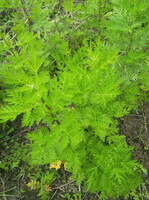 Ecological Environment: Artemisia annua grows wild in fields, on hillsides and mountain slopes, roadsides, riverbanks, grasslands, forest margins, dry valleys, semi-deserts, gravelly slopes, and saline soils—often as a dominant or co-dominant species in plant communities.
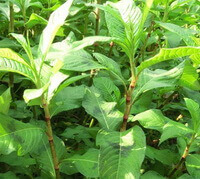 Polygonum flaccidum Meisn is a species of the genus Polygonum L., family Polygonaceae (smartweed or buckwheat family), order Caryophyllales (formerly in order Polygonales). It is commonly known as Là Liǎo ("hot-tasting Polygonum"). Leaves are lanceolate or elliptic-lanceolate, 4–8 cm long and approximately 0.5–2.5 cm wide; the apex is acuminate, the base is cuneate, margins are entire, both surfaces are glabrous and bear brown dots; petioles are 4–8 mm long.
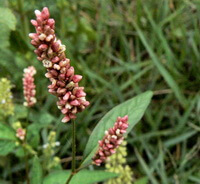 Racemes are spicate, terminal or axillary, 3–8 cm long, usually drooping; flowers are sparse, with the lower portion discontinuous. Flower bracts are funnelform, 2–3 mm long, and green. Flowers are green with five deep longitudinal lines; the upper part is white or reddish.
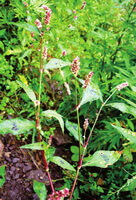 Racemes are spicate, terminal or axillary, slender and elongated, with the upper portion curved and pendulous, 4–10 cm long; flowers are sparse. Bracts are funnelform (funnel-shaped), bearing brown glandular spots; the apex bears short cilia or is nearly glabrous. The perianth is 4–5-parted; lobes are pale green or faintly red and densely covered with brown glandular spots. There are 6 stamens (rarely 8), shorter than the perianth; 2–3 styles, basally connate, with capitate stigmas.
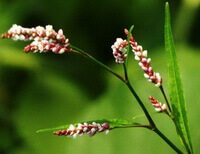 Ecological Environment: Polygonum hydropiper grows on riverbanks, ditch margins, valley wetlands, and roadside marshes, at altitudes of 50–3,500 m above sea level. It is distributed across China.
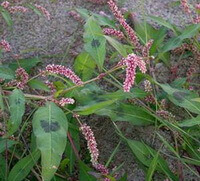 Characteristics of the Herb: The stem is cylindrical and branched, 30–70 cm long and ~6 mm in diameter. The surface is celadon (sage green) or reddish-brown and bears fine longitudinal ridges; nodes are swollen. The texture is crisp and brittle; the fracture surface is light yellow and hollow. Leaves are alternate and petiolate; leaf blades are shriveled or fragmented. When fully expanded, intact leaves are lanceolate or oval-lanceolate, 5–10 cm long and 0.7–1.5 cm wide; the apex is acuminate, the base is cuneate, and margins are entire. The upper surface is tan (chocolate brown); the lower surface is brownish-green; both surfaces bear blackish-brown spots and minute glandular dots. Ocrea is terete, 0.8–1.1 cm long, purplish-brown (puce), with marginal setae (trichomes) 1–3 mm long. Racemes are 4–10 cm long; flowers are clustered sparsely and discontinuously. The perianth is pale green (pea green), 5-lobed, and densely covered with glandular spots. The herb has a mild odor and a pungent, spicy taste.
 URL QR code:

