✵The article documents the herb Mulberry Mistletoe, including its English name, Latin name, Pinyin name, properties and flavor, and its officially recognized botanical source—namely, (1) Taxillus chinensis (DC.) Danser—as well as three additional species used in practice: (2) Taxillus sutchuenensis (Lecomte) Danser, (3) Scurrula parasitica L., and (4) Taxillus nigrans (Hance) Danser. It provides a detailed introduction to the botanical features, growth characteristics, and ecological environments of these four species; to the macroscopic and microscopic characteristics of the crude herb Mulberry Mistletoe; and to its pharmacological actions, medicinal efficacy, and administration guidelines.
Ramulus Taxilli (Mulberry Mistletoe)
Pinyin Name: Sānɡ Jì Shēnɡ
English Name: Mulberry Mistletoe
Latin Name:Ramulus Taxilli Properties and Flavor: Neutral; bitter and sweet
Brief Introduction:Ramulus Taxilli is the dried leaf-bearing stem and branch of Taxillus chinensis (DC.) Danser. It is used (1) to nourish the liver and kidney yin, strengthen tendons and bones, and dispel wind-dampness—indicated for bi syndrome with soreness and pain in the lower back and limbs—and (2) to nourish the blood and stabilize the fetus—indicated for menorrhagia and threatened abortion. The herb is commonly known as Ramulus Taxilli, Mulberry Mistletoe, or Sānɡ Jì Shēnɡ.
Botanical Source: Official Chinese pharmacopoeial standards define Ramulus Taxilli (Mulberry Mistletoe) as the dried leaf-bearing stem and branch of (1) Taxillus chinensis (DC.) Danser. Other authoritative herbal classics also accept (2) Taxillus sutchuenensis (Lecomte) Danser, (3) Scurrula parasitica L., and (4) Taxillus nigrans (Hance) Danser as acceptable sources. All belong to the family Loranthaceae (Juss.) Engl. (order Santalales). Descriptions of the officially designated species and other commonly used species follow:
(1) Taxillus chinensis (DC.) Danser.
Botanical Description:Taxillus chinensis (DC.) Danser—also known as Loranthus chinensis DC. and commonly referred to as Sānɡ Jì Shēnɡ—is a shrub of the genus Taxillus Van Tieghem in the family Loranthaceae (Juss.) Engl. (order Santalales). It grows up to 0.5–1 m tall. Branchlets and leaves are densely covered with brown or reddish-brown, rust-colored stellate hairs; scattered overlapping stellate hairs may also be present. The plant becomes glabrescent with age. Branchlets are taupe (dust-colored), glabrous, and bear scattered fine, small lenticels. Leaves are opposite or subopposite; petioles measure 8–10 mm; leaf blades are thick, chartaceous (papery), oval to ovate-oblong, 2.5–6 cm long and 1.5–4.0 cm wide; the apex is obtuse, and the base is cuneate or broadly cuneate. Lateral veins occur in 3–4 pairs and are slightly conspicuous.
Inflorescences consist of 1–3 axillary racemes on deciduous branchlets, each bearing 1–4 (commonly 2) flowers. Both inflorescences and flowers are densely covered with brown stellate hairs. Peduncles are 2–4 mm long; pedicels, 6–7 mm long. Bracts are scaly and ~1 mm long. Flowers are red or brown; receptacles are elliptic or ovoid, 2–3 mm long; the calycine tube (accessory calyx) is annular and 4-dentate. Corolla buds are tubular, 2.2–2.8 cm long (commonly 2.5–2.7 cm), slightly curved, with a swollen lower portion and an ovoid tip; the corolla has four spatulate lobes, 6–9 mm long, reflexed; hairs become sparse after flowering. Filaments are ~2 mm long—approximately two-thirds shorter than the anthers. Anthers are ~3–4 mm long and often possess a transverse septum. The floral disc is calathiform (cup-shaped). The style is linear; the stigma is capitate.
Fruits are elliptic or subsphaeroidal (nearly spherical), with a pericarp densely covered in tubercles and sparsely hairy. Mature fruits turn pale yellow, measuring 6–7 mm long (up to 1 cm) and 3–4 mm in diameter; both ends are obtuse; the color is yellowish-green; the pericarp surface is granular and sparsely piliferous. Flowering and fruiting occur from June to August and persist into January of the following year.
Ecological Environment: This species grows in plains or low-elevation evergreen broad-leaved forests at altitudes of 20–400 m above sea level. It is parasitic on mulberry, peach, plum, longan, lychee, carambola, oil-tea camellia (Camellia oleifera), tung tree (Aleurites montana), rubber tree (Hevea brasiliensis), banyan (Ficus microcarpa), ceiba (Ceiba pentandra), Masson pine (Pinus massoniana), and water pine (Glyptostrobus lineatus Druce), among others.
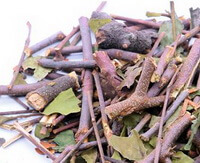
Characteristics of the Herb: The leaf-bearing stems and branches are cylindrical, branched, 30–40 cm long; thick branches measure 0.5–1 cm in diameter, while thin branches or branch tips measure 2–3 mm in diameter. The surface is coarse and rough; the tips of fresh twigs are covered with rust-colored trichomes. Coloration ranges from russet (reddish brown) to taupe (dust-colored or grayish brown). The stem bears numerous dot-shaped, tawny (yellowish brown) or sallow (grayish yellow) lenticels and fine longitudinal wrinkles. The surface of thick branches is russet or taupe, bearing prominent branch scars and leaf scars. The herb is hard and brittle, breaking easily; the fracture surface is uneven. The cortex is thin and dark brown, readily separable from the xylem; the xylem is broad, constituting most of the stem cross-section, and pale reddish brown. Medullary rays are conspicuous and radially arranged; the pith is small and slightly darker. Leaves are deciduous and commonly absent—only a few remain attached to the stems—and are often curled and fragmented. Intact leaves are oval to oblong-oval, 3–6 cm long and 2.5–4 cm wide; the apex is bluntly rounded, the base is rounded or broadly cuneate; color is tea brown or tawny; margins are entire; lateral veins occur in 3–4 pairs and are slightly distinct. Young leaves bear rust-colored villi and are somewhat coriaceous and brittle, breaking easily. Petioles measure 0.5–1 cm in length. Flowers and fruits are typically absent; flower buds are tubular and slightly curved, with an ovoid (egg-shaped) apex, densely covered with rust-colored tomentum. Berries are oblong, russet, and densely tuberculate. The herb has a faint odor and a mild, slightly astringent taste.
Medicinal Efficacy: Expels wind-dampness; tonifies the liver and kidney; strengthens tendons and bones; unblocks the channels and collaterals; nourishes the blood; stabilizes the fetus. It is indicated for wind-damp bi syndrome with arthralgia and pain; soreness and weakness of the lumbar region and knees; flaccidity and debility of muscles and bones; hemiplegia; beriberi; menorrhagia and metrostaxis (uterine bleeding); uterine bleeding during pregnancy; threatened abortion; postpartum lactation failure; dizziness; and blurred vision.
Administration of Ramulus Taxilli (Sānɡ Jì Shēnɡ):
Reference:
Administration Guide for Ramulus Taxilli (Sānɡ Jì Shēnɡ)
TCM Books:
(1) Internally: 9–15 grams; (2) Internally:water decoction, 3–6 qian (≈9–18 grams); also prepared as powders, wine infusions, or fresh juice; (3) Internally:water decoction, 10–15 grams; or formulated into pills, powders, wine infusions, or fresh juice. External use: appropriate amount, mashed and applied topically.
(2) Taxillus sutchuenensis (Lecomte) Danser
Botanical Description:Taxillus sutchuenensis (Lecomte) Danser—also known as Loranthus sutchuenensis Lecomte and commonly called Sì Chuān Jì Shēnɡ or Chuān Sānɡ Jì Shēnɡ—is a semiparasitic epiphytic shrub of the genus Taxillus in the family Loranthaceae (Juss.) Engl. (order Santalales). It grows up to 0.5–1 m tall. Young shoots and leaves are densely covered with brown or reddish-brown stellate hairs; sparse overlapping stellate hairs may also be present. Branchlets are blackish, glabrous, and bear scattered lenticels. Leaves are subopposite or alternate, coriaceous, and oval to ovate-oblong or elliptic, measuring 5–8 cm in length and 3–4.5 cm in width; the apex is obtuse; the base is orbicular (suborbicular); the upper surface is glabrous; the lower surface is tomentose. Lateral veins occur in 4–5 pairs and are conspicuous on the upper surface. Petioles measure 6–12 mm in length and are glabrous.
Inflorescences consist of 1–3 racemes, axillary or arising from branchlet axils, each bearing 2–5 flowers arranged in dense umbellate clusters. Both inflorescences and flowers are densely covered with brown stellate hairs. Peduncles and rachises measure 1–2 mm (occasionally up to 3 mm) in length; pedicels are 2–3 mm long. Bracts are ovate-triangular. Flowers are red; receptacles are elliptic; the accessory calyx is annular (ring-shaped) and 4-toothed. Corolla buds are slightly curved and tubular, 2.2–2.8 cm long; the lower portion is swollen; the apex is elliptic; the corolla has four lanceolate lobes, 6–9 mm long, reflexed; hairs become sparse after flowering. Filaments are ~2 mm long; anthers are 3–4 mm long and often possess a transverse septum. The style is linear; the stigma is conical.
Fruits are elliptic, yellowish green, 6–7 mm long and 3–4 mm in diameter; the pericarp is granular and sparsely piliferous. Flowering occurs from June to August.
Ecological Environment: The plant grows in montane broad-leaved forests at altitudes of 500–1,900 meters above sea level, parasitizing mulberry trees, pear trees, plum trees, oil-tea camellia (Camellia oleifera), Ternstroemia gymnanthera, lacquer trees (Rhus verniciflua), Juglans, Quercus, Lithocarpus, other Fagaceae plants, birch (Betula spp.), and Corylus.
Characteristics of the Herb: The stems and branches bearing leaves are cylindrical, 30–50 cm long, with thick branches about 1 cm in diameter and slender branches and branch tips 2–3 mm in diameter. The surface is coarse and rough, dark brown (nearly blackish-brown) or taupe (grayish brown or dusty brown), bearing longitudinal fine wrinkles, cracks, and punctate tawny (yellowish-brown) lenticels; branchlets and twig tips are densely covered with tawny or russet (reddish-brown) tomentum.
The herb is firm and hard, brittle, with an uneven fracture surface; the cortex is thin, tan (chocolate-brown), and readily separable from the xylem (wood); the xylem is broad, constituting most of the stem, tawny or yellowish-white; medullary rays are conspicuous; the pith is slightly darker.
Most leaves have abscised (deciduous), and many are broken or curled. Intact leaves are oblong-ovate, ovate-oblong, or oval (egg-shaped), 5–8 cm long and 3–4.5 cm wide. The apex is blunt, the base is rounded; the upper surface is smooth, dark brown or tawny, rarely greenish-brown; the lower surface is densely covered with tawny (yellowish-brown) to russet (reddish-brown) stellate hairs, or hazel (pale brown) to ash-gray stellate hairs (varietal); margins are entire; venation is pinnate, with 4–5 pairs of lateral veins, slightly prominent on the upper surface; lamina is coriaceous and crisp, easily broken; petioles are 0.5–1 cm long or absent, densely covered with tawny to russet tomentum. Occasionally present are persistent flowers and fruits; flower buds are tubular and slightly curved, with the lower half enlarged and the apical portion narrowly oblong and acutely pointed; berries are oblong (elongated-oval), with pericarps bearing granular protuberances. The herb has a faint odor and tastes mild and astringent.
(3) Scurrula parasitica L.
Botanical Description:Scurrula parasitica L. is also known as Loranthus scurrula L., Loranthus parasiticus (L.) Merr., and is commonly called Hóng Huā Jì Shēng. It is a shrub of the genus Scurrula L. in the family Loranthaceae (Juss.) Engl. (formerly classified under Loranthaceae Juss.), order Santalales. Plants grow up to 0.5–1 m tall. Young shoots and leaves are densely covered with rust-colored stellate hairs; these hairs are later shed completely, rendering the surfaces glabrescent. Branchlets are taupe (grayish brown or dusty brown) and lenticellate. Leaves are opposite or subopposite, thickly chartaceous; petioles are 5–6 mm long; leaf blades are oval to ovate-oblong, 5–8 cm long and 2–4 cm wide; apex is obtuse, base is broadly cuneate; lateral veins are in 5–6 pairs, conspicuous on both surfaces.
Inflorescences: 1–2 (rarely 3) racemes, axillary or arising from leafless axils of branchlets; all parts are densely covered with brown tomentum; peduncle and rachis are 2–3 mm long; each inflorescence bears 3–6 flowers, densely arranged; flowers are red; pedicels are 2–3 mm long; floral bracts are triangular; receptacles are turbinate, 2–2.5 mm long; calycine ring (accessory calyx) is annular and entire; corolla buds are tubular, 2–2.5 cm long, slightly curved, with swollen lower half and elliptic apical portion; at anthesis, the limb is 4-lobed; lobes are lanceolate, 5–8 mm long, reflexed; style is linear (filiform), stigma is capitate.
Fruits: Berries are pyriform (pear-shaped), ca. 10 mm long and 3 mm in diameter; lower half is abruptly constricted into a slender stalk-like base; pericarp is smooth, reddish-yellow. Flowering and fruiting occur from October to January of the following year.
Ecological Environment: The plant is parasitic on citrus hosts—including grapefruit (Citrus paradisi), tangerine (Citrus reticulata), and lemon (Citrus limon)—as well as peach (Prunus persica), pear (Pyrus spp.), apricot (Prunus armeniaca), and pomegranate (Punica granatum).
Characteristics of the Herb: Stems and branches bearing leaves are cylindrical and much-branched, 3–5 cm long and ca. 1 cm in diameter; thin twigs and branch tips are 2–3 mm in diameter. Surface is coarse and rough: older branches are russet (reddish-brown) or dark brown; branchlets and tips are ochraceous-red; some young branches bear tan (chocolate-brown) stellate hairs; surface is marked with numerous punctate, tawny (yellowish-brown) or taupe (grayish-brown) transverse lenticels and irregular, thick, dense vertical striations. Texture is firm and crisp, brittle; fracture is uneven; cortex is thin, ochre-brown, readily separable from the xylem (wood); xylem is broad, faint yellow (pale yellow) or khaki, with prominent radial (medullary) rays; pith is deep yellow. Leaves are opposite or subopposite, readily abscised; most are broken or curled; intact leaves are oval to ovate-oblong, 5–8 cm long and 2–4 cm wide, tawny (yellowish-brown) or tea-brown (dark brown); lateral veins are distinct; both surfaces are smooth and glabrous; margins are entire; lamina is coriaceous, crisp; some young leaves bear tan (chocolate-brown) stellate hairs; petioles are ca. 5 mm long. Occasionally present are persistent flowers and fruits: flower buds are tubular, apex is narrowly oblong and acutely pointed; at anthesis, the corolla is 4-lobed, lobes reflexed; four stamens and a single style are visible; berries are pyriform (pear-shaped), apex is blunt, base attenuated into a long stalk-like structure. The herb has a delicate fragrance and tastes slightly astringent and bitter.
(4) Taxillus nigrans (Hance) Danser
Botanical Description:Taxillus nigrans (Hance) Danser, formerly Loranthus nigrans Hance, is commonly known as Máo Yè Dùn Guǒ Jì Shēng and Máo Yè Jì Shēng. It is a shrub of the genus Taxillus Van Tieghem., family Loranthaceae (Juss.) Engl., order Santalales. Plants grow up to 0.5–1.5 m tall. Fresh twigs, leaves, inflorescences, and flowers are densely covered with sallow (grayish-yellow), yellowish-brown, or brown overlapping stellate hairs; branchlets are taupe (grayish-brown) or furvous (dark reddish-brown), glabrous, with scattered lenticels. Leaves are opposite or alternate, coriaceous, oblong-ovate, elongated-oval, or ovate-oblong, 6–11 cm long and 3–5 cm wide; apex is blunt or acute; base is cuneate to rounded; upper surface is glabrous, turning furvous or tawny (yellowish-brown) upon drying; lower surface is tomentose; lateral veins are in 4–5 pairs, slightly convex on the upper surface; petioles are 5–8 mm long, tomentose.
Racemes, 1–5 clustered in leaf axils or the axil of deciduous branchlets, bear 2 or 3–5 flowers, densely arranged in umbelliform (umbellate) inflorescences; the total length of peduncles and the inflorescence axis is 2–4 mm. Pedicels are 1–1.5 mm long; bracts are triangular, about 1 mm long; flowers are reddish-yellow, receptacles are ovoid, about 2 mm long; calycle (accessory calyx) is annular, entire, slightly involute (rolled inward); corolla buds are tubular, 1.2–1.8 cm long, slightly curved or suberect (nearly upright), corolla tube is slightly swollen, apex is ovoid, with 4 spatulate lobes, 4–6 mm long, slightly explanate or reflexed; filaments are 1.5–3 mm long, anthers are about 1.5 mm long; style is linear, stigma is capitate. The fruit is ellipsoid, about 7 mm long and 4 mm in diameter, both ends are blunt, pale yellow (yellowish), pericarp is coarse and rough, bearing sparse stellate hairs; infructescence stalk is 3–5 mm long; carpopodium (fruit stalks) is 2–3 mm long. Flowering occurs from August to November; fruiting from April to May.
Ecological Environment: The plant grows in broadleaf forests of mountains, hills, or valley basins at altitudes of 300–1,300 meters above sea level and parasitizes on camphor trees, mulberry trees, oil-tea camellias, species of Quercus L., and Salix spp.
Characteristics of the Herb: It consists of the dried branches and leaves of Taxillus nigrans. The stems and branches are cylindrical; the basal portion is 0.5–1 cm thick, and the apical portion of the branches is 2–3 mm thick. The surface is tan (chocolate-brown) with a slight purplish-red tinge, bearing numerous minute light-colored lenticels; slender branches exhibit irregular fine longitudinal striations. The leaves are oval (egg-shaped), with a yellow-brown abaxial surface; they are coriaceous and brittle, and most have fallen off, leaving only leaf scars. Dried flowers and fruits are occasionally present. The herb is firm and hard in texture, with a yellow-white fracture surface. It is odorless and tastes astringent.
Article Link:
URL QR code:
References:
1.Introduction of Sang Ji Sheng: Mulberry Mistletoe

 ✵The article documents the herb Mulberry Mistletoe, including its English name, Latin name, Pinyin name, properties and flavor, and its officially recognized botanical source—namely, (1) Taxillus chinensis (DC.) Danser—as well as three additional species used in practice: (2) Taxillus sutchuenensis (Lecomte) Danser, (3) Scurrula parasitica L., and (4) Taxillus nigrans (Hance) Danser. It provides a detailed introduction to the botanical features, growth characteristics, and ecological environments of these four species; to the macroscopic and microscopic characteristics of the crude herb Mulberry Mistletoe; and to its pharmacological actions, medicinal efficacy, and administration guidelines.
 Pinyin Name: Sānɡ Jì Shēnɡ
 Botanical Description: Taxillus chinensis (DC.) Danser—also known as Loranthus chinensis DC. and commonly referred to as Sānɡ Jì Shēnɡ—is a shrub of the genus Taxillus Van Tieghem in the family Loranthaceae (Juss.) Engl. (order Santalales). It grows up to 0.5–1 m tall. Branchlets and leaves are densely covered with brown or reddish-brown, rust-colored stellate hairs; scattered overlapping stellate hairs may also be present. The plant becomes glabrescent with age. Branchlets are taupe (dust-colored), glabrous, and bear scattered fine, small lenticels. Leaves are opposite or subopposite; petioles measure 8–10 mm; leaf blades are thick, chartaceous (papery), oval to ovate-oblong, 2.5–6 cm long and 1.5–4.0 cm wide; the apex is obtuse, and the base is cuneate or broadly cuneate. Lateral veins occur in 3–4 pairs and are slightly conspicuous.
 Inflorescences consist of 1–3 axillary racemes on deciduous branchlets, each bearing 1–4 (commonly 2) flowers. Both inflorescences and flowers are densely covered with brown stellate hairs. Peduncles are 2–4 mm long; pedicels, 6–7 mm long. Bracts are scaly and ~1 mm long. Flowers are red or brown; receptacles are elliptic or ovoid, 2–3 mm long; the calycine tube (accessory calyx) is annular and 4-dentate. Corolla buds are tubular, 2.2–2.8 cm long (commonly 2.5–2.7 cm), slightly curved, with a swollen lower portion and an ovoid tip; the corolla has four spatulate lobes, 6–9 mm long, reflexed; hairs become sparse after flowering. Filaments are ~2 mm long—approximately two-thirds shorter than the anthers. Anthers are ~3–4 mm long and often possess a transverse septum. The floral disc is calathiform (cup-shaped). The style is linear; the stigma is capitate.
 Fruits are elliptic or subsphaeroidal (nearly spherical), with a pericarp densely covered in tubercles and sparsely hairy. Mature fruits turn pale yellow, measuring 6–7 mm long (up to 1 cm) and 3–4 mm in diameter; both ends are obtuse; the color is yellowish-green; the pericarp surface is granular and sparsely piliferous. Flowering and fruiting occur from June to August and persist into January of the following year.
 Ecological Environment: This species grows in plains or low-elevation evergreen broad-leaved forests at altitudes of 20–400 m above sea level. It is parasitic on mulberry, peach, plum, longan, lychee, carambola, oil-tea camellia (Camellia oleifera), tung tree (Aleurites montana), rubber tree (Hevea brasiliensis), banyan (Ficus microcarpa), ceiba (Ceiba pentandra), Masson pine (Pinus massoniana), and water pine (Glyptostrobus lineatus Druce), among others.
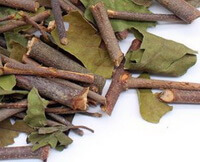 Characteristics of the Herb: The leaf-bearing stems and branches are cylindrical, branched, 30–40 cm long; thick branches measure 0.5–1 cm in diameter, while thin branches or branch tips measure 2–3 mm in diameter. The surface is coarse and rough; the tips of fresh twigs are covered with rust-colored trichomes. Coloration ranges from russet (reddish brown) to taupe (dust-colored or grayish brown). The stem bears numerous dot-shaped, tawny (yellowish brown) or sallow (grayish yellow) lenticels and fine longitudinal wrinkles. The surface of thick branches is russet or taupe, bearing prominent branch scars and leaf scars. The herb is hard and brittle, breaking easily; the fracture surface is uneven. The cortex is thin and dark brown, readily separable from the xylem; the xylem is broad, constituting most of the stem cross-section, and pale reddish brown. Medullary rays are conspicuous and radially arranged; the pith is small and slightly darker. Leaves are deciduous and commonly absent—only a few remain attached to the stems—and are often curled and fragmented. Intact leaves are oval to oblong-oval, 3–6 cm long and 2.5–4 cm wide; the apex is bluntly rounded, the base is rounded or broadly cuneate; color is tea brown or tawny; margins are entire; lateral veins occur in 3–4 pairs and are slightly distinct. Young leaves bear rust-colored villi and are somewhat coriaceous and brittle, breaking easily. Petioles measure 0.5–1 cm in length. Flowers and fruits are typically absent; flower buds are tubular and slightly curved, with an ovoid (egg-shaped) apex, densely covered with rust-colored tomentum. Berries are oblong, russet, and densely tuberculate. The herb has a faint odor and a mild, slightly astringent taste.
 Botanical Description: Taxillus sutchuenensis (Lecomte) Danser—also known as Loranthus sutchuenensis Lecomte and commonly called Sì Chuān Jì Shēnɡ or Chuān Sānɡ Jì Shēnɡ—is a semiparasitic epiphytic shrub of the genus Taxillus in the family Loranthaceae (Juss.) Engl. (order Santalales). It grows up to 0.5–1 m tall. Young shoots and leaves are densely covered with brown or reddish-brown stellate hairs; sparse overlapping stellate hairs may also be present. Branchlets are blackish, glabrous, and bear scattered lenticels. Leaves are subopposite or alternate, coriaceous, and oval to ovate-oblong or elliptic, measuring 5–8 cm in length and 3–4.5 cm in width; the apex is obtuse; the base is orbicular (suborbicular); the upper surface is glabrous; the lower surface is tomentose. Lateral veins occur in 4–5 pairs and are conspicuous on the upper surface. Petioles measure 6–12 mm in length and are glabrous.
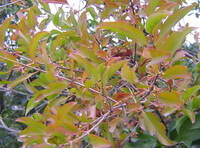 Botanical Description: Scurrula parasitica L. is also known as Loranthus scurrula L., Loranthus parasiticus (L.) Merr., and is commonly called Hóng Huā Jì Shēng. It is a shrub of the genus Scurrula L. in the family Loranthaceae (Juss.) Engl. (formerly classified under Loranthaceae Juss.), order Santalales. Plants grow up to 0.5–1 m tall. Young shoots and leaves are densely covered with rust-colored stellate hairs; these hairs are later shed completely, rendering the surfaces glabrescent. Branchlets are taupe (grayish brown or dusty brown) and lenticellate. Leaves are opposite or subopposite, thickly chartaceous; petioles are 5–6 mm long; leaf blades are oval to ovate-oblong, 5–8 cm long and 2–4 cm wide; apex is obtuse, base is broadly cuneate; lateral veins are in 5–6 pairs, conspicuous on both surfaces.
 Ecological Environment: The plant is parasitic on citrus hosts—including grapefruit (Citrus paradisi), tangerine (Citrus reticulata), and lemon (Citrus limon)—as well as peach (Prunus persica), pear (Pyrus spp.), apricot (Prunus armeniaca), and pomegranate (Punica granatum).
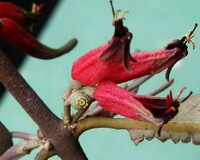 Botanical Description: Taxillus nigrans (Hance) Danser, formerly Loranthus nigrans Hance, is commonly known as Máo Yè Dùn Guǒ Jì Shēng and Máo Yè Jì Shēng. It is a shrub of the genus Taxillus Van Tieghem., family Loranthaceae (Juss.) Engl., order Santalales. Plants grow up to 0.5–1.5 m tall. Fresh twigs, leaves, inflorescences, and flowers are densely covered with sallow (grayish-yellow), yellowish-brown, or brown overlapping stellate hairs; branchlets are taupe (grayish-brown) or furvous (dark reddish-brown), glabrous, with scattered lenticels. Leaves are opposite or alternate, coriaceous, oblong-ovate, elongated-oval, or ovate-oblong, 6–11 cm long and 3–5 cm wide; apex is blunt or acute; base is cuneate to rounded; upper surface is glabrous, turning furvous or tawny (yellowish-brown) upon drying; lower surface is tomentose; lateral veins are in 4–5 pairs, slightly convex on the upper surface; petioles are 5–8 mm long, tomentose.
 URL QR code:

