Introduction of Huánɡ Yào Zǐ: Airpotato Yam Rhizome
✵The article records the herb Airpotato Yam Rhizome, including its English name, Latin name, Pinyin name, properties and flavor, and botanical source—the single plant species Dioscorea bulbifera L.—along with a detailed description of this species’ botanical features, growth characteristics, and ecological environment; as well as the herb’s macroscopic and microscopic characteristics, pharmacological actions, medicinal efficacy, and administration guidelines.
Rhizoma Dioscoreae Bulbiferae (Airpotato Yam)
Pinyin Name: Huánɡ Yào Zǐ
English Name: Airpotato Yam Rhizome
Latin Name:Rhizoma Dioscoreae Bulbiferae Properties and Flavor: Neutral; bitter
Brief Introduction:Rhizoma Dioscoreae Bulbiferae is the dried rhizome of Dioscorea bulbifera L., used for cooling the blood and arresting hemorrhage—indicated for various types of bleeding—and for detoxification in the treatment of boils, sores, and snakebites.
Botanical Source:Rhizoma Dioscoreae Bulbiferae (Airpotato Yam Rhizome) is the dried rhizome of Dioscorea bulbifera L., a species belonging to the genus Dioscorea, family Dioscoreaceae (yam family), order Dioscoreales. It is also known as Airpotato Yam Rhizome or Huánɡ Yào Zǐ.
Herbal classic works define Rhizoma Dioscoreae Bulbiferae (Airpotato Yam Rhizome) as the dried rhizome of (1) Dioscorea bulbifera L. This commonly used species is described below:
(1) Dioscorea bulbifera L.
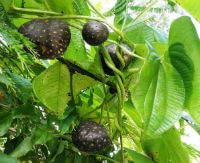
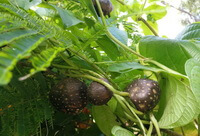
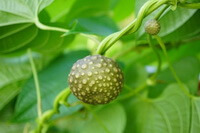
Botanical Description:Dioscorea bulbifera L. is also known as Huánɡ Dù, Yù Línɡ Shù, and Léi Gōnɡ Shù. It is a twining, herbaceous liana. Stem tubers are ovoid to oblong, located near the soil surface, tan (chocolate brown) in color, and densely covered with slender, fibrous roots. Stems are cylindrical, sinistrorse (left-twining), and glabrous. Leaves are simple and alternate; petioles are slightly shorter than the leaf blades; leaf blades are broadly ovate-cordate or ovate-cordate, 5–16 cm long and 2–14 cm wide (rarely up to 26 cm in exceptional specimens), with a caudate-acuminate apex, entire or slightly undulate margins, and glabrous surfaces on both sides. Purple-brown, globular or ovoid bulbils—1–3 cm in diameter, bearing rounded spots on the exterior—are growing in the leaf axils.
Flowers are unisexual and dioecious. Male inflorescences are spicate and pendulous; several flowers often cluster in leaf axils, while basal inflorescences may elongate and form panicles. Male flowers are solitary and densely arranged; each bears two ovate bracts at the base. Tepals are lanceolate and purple when fresh. Six stamens are inserted at the base of the perianth; filaments are nearly equal in length to the anthers. Female inflorescences resemble male ones but are typically 2–several per leaf axil, 20–50 cm long, and bear six staminodes approximately one-quarter the length of the perianth.
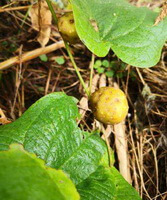
The capsule fruit is reflexed and pendulous, prismatic-oblong, 1.5–3 cm long and 0.5–1.5 cm wide, rounded at both ends, yellowish (light yellow) at maturity, and densely covered with purple spots. Seeds are dark brown and oblate, usually paired at the apex of the central axis within each locule; the seed wings are chestnut brown, extending toward the seeds and oblong in shape. Flowering occurs from July to October; fruiting from August to November.
Ecological Environment: This plant grows along valley margins, gullies, or forest edges (including mixed woodlands), at elevations below 2,000 m above sea level.
Growth Characteristics: The plant prefers warm, humid climates and tolerates partial shade. For cultivation, fields with ample sunlight, deep, loose, fertile, well-drained sandy loam soil are recommended.
Characteristics of the Herb: The herb consists mostly of transversely cut, thick slices—circular or orbicular—2.5–7 cm in diameter and 0.5–1.5 cm thick. The surface is brownish-black and shriveled, bearing numerous white, punctiform protrusions and fibrous root scars—or thin, curved residual roots—and the cork layer peels off easily. The fracture surface is yellowish-white to yellowish-brown, flat or uneven (with ridges and furrows). The texture is hard and brittle, breaking with a granular fracture; scattered orange-yellow punctate marks are visible. The herb has a faint odor and a distinctly bitter taste. High-grade herb material features large, intact slices, a brownish-black cortex, and a yellowish-white fracture surface.
Pharmacological Actions: (1) Myocardial inhibition; (2) Inhibitory effect on isolated intestinal smooth muscle; (3) Antibacterial activity against Staphylococcus aureus and multiple dermatophyte species; (4) Cytotoxic or growth-inhibitory effects on tumor cells.
Medicinal efficacy: Clears heat and detoxifies; cools the blood and resolves nodules. Indicated for sore throat, carbuncles and ulcers, snakebite, goitre (thyroid enlargement), hematemesis, and hemoptysis.
Administration of Airpotato Yam Rhizome (Huáng Yào Zǐ):
Reference:
Administration Guide for Airpotato Yam Rhizome (Huáng Yào Zǐ)
TCM Books:
(1) Internally: 3–9 grams; (2) Internally: water decoction, 1.5–3 qian (≈4.5–9 grams); externally: mash fresh herb and apply, or prepare finely ground herb powder and apply; (3) Internally: water decoction, 3–9 grams; or infuse in wine; or prepare finely ground herb powder, 1–2 g. Externally: appropriate amount—mash fresh herb, or prepare finely ground herb powder and apply, or extract juice and smear.
Precautions and Adverse Reactions: Airpotato Yam Rhizome should not be taken internally in large doses.
Article Link:
URL QR code:
References:
1.Introduction of Huáng Yào Zǐ: Airpotato Yam Rhizome.

 ✵The article records the herb Airpotato Yam Rhizome, including its English name, Latin name, Pinyin name, properties and flavor, and botanical source—the single plant species Dioscorea bulbifera L.—along with a detailed description of this species’ botanical features, growth characteristics, and ecological environment; as well as the herb’s macroscopic and microscopic characteristics, pharmacological actions, medicinal efficacy, and administration guidelines.
 Pinyin Name: Huánɡ Yào Zǐ
 Botanical Description: Dioscorea bulbifera L. is also known as Huánɡ Dù, Yù Línɡ Shù, and Léi Gōnɡ Shù. It is a twining, herbaceous liana. Stem tubers are ovoid to oblong, located near the soil surface, tan (chocolate brown) in color, and densely covered with slender, fibrous roots. Stems are cylindrical, sinistrorse (left-twining), and glabrous. Leaves are simple and alternate; petioles are slightly shorter than the leaf blades; leaf blades are broadly ovate-cordate or ovate-cordate, 5–16 cm long and 2–14 cm wide (rarely up to 26 cm in exceptional specimens), with a caudate-acuminate apex, entire or slightly undulate margins, and glabrous surfaces on both sides. Purple-brown, globular or ovoid bulbils—1–3 cm in diameter, bearing rounded spots on the exterior—are growing in the leaf axils.
 The capsule fruit is reflexed and pendulous, prismatic-oblong, 1.5–3 cm long and 0.5–1.5 cm wide, rounded at both ends, yellowish (light yellow) at maturity, and densely covered with purple spots. Seeds are dark brown and oblate, usually paired at the apex of the central axis within each locule; the seed wings are chestnut brown, extending toward the seeds and oblong in shape. Flowering occurs from July to October; fruiting from August to November.
 Ecological Environment: This plant grows along valley margins, gullies, or forest edges (including mixed woodlands), at elevations below 2,000 m above sea level.
 URL QR code: