✵This article documents the herb nacre, including its English name, Latin name, Pinyin name, properties and flavor, and animal sources—namely, the calcined shells of three pearl-producing bivalve species. It provides a detailed introduction to the macroscopic characteristics of the crude herb, pharmacological actions, medicinal efficacy, and administration guidelines.
Concha Margaritifera Usta (Nacre)
Pinyin Name: Zhēn Zhū Mǔ
English Name: Nacre
Latin Name:Concha Margaritifera Usta Properties and Flavor: Cool; salty
Brief Introduction:Concha Margaritifera Usta is the calcined shell of certain pearl-producing bivalves: Hyriopsis cumingii (Lea), Cristaria plicata (Leach) (family Unionidae), or Pteria martensii (Dunker) (family Pteriidae). It is used: (1) as a heavy tranquilizer to calm the mind—indicated for palpitations, insomnia, and mania; and (2) to calm the liver and subdue hyperactive yang—relieving headache and dizziness. The herb is commonly known as Concha Margaritifera Usta, nacre, or Zhēn Zhū Mǔ.
Source: Classical herbal works define Concha Margaritifera Usta (nacre) as the shell of bivalve species: (1) Hyriopsis cumingii (Lea); (2) Cristaria plicata (Leach); or (3) Pteria martensii (Dunker). These three species are also described in the entry “Margarita (Pearl)”.
Characteristics of the Herb: (1) Shell of Hyriopsis cumingii (Lea): The intact shell is unequilateral and quadrangular, with annual growth rings arranged in concentric patterns. The posterior dorsal margin projects upward, forming a large triangular, veil-like posterior wing. The pallial line on the inner surface is prominent; the scar of the anterior adductor muscle is oval (egg-shaped), and that of the posterior adductor muscle is slightly triangular. Both left and right valves bear two pseudocardinal teeth; the left valve has two elongated, strip-shaped lateral teeth. The surface is glossy. The shell texture is firm and hard, with a faintly fishy odor and a mild taste.
(2) Shell of Cristaria plicata (Leach): The intact shell is scalene triangular; the posterior dorsal margin extends upward to form a large crown-like projection. The pallial line on the inner surface is prominent; the scar of the anterior adductor muscle is large and wedge-shaped (cuneate), while that of the posterior adductor muscle is irregularly oval. Longitudinal ribs and concave grooves occur beneath the posterior lateral tooth, corresponding to surface features. Both left and right valves possess one short, stout posterior lateral tooth and one thin, delicate anterior lateral tooth; neither valve bears pseudocardinal teeth.
(3) Shell of Pteria martensii (Dunker): The intact shell is obliquely square; the posterior auricle is large, the anterior auricle is small, the dorsal margin is flat and straight, the ventrolateral edge is rounded, and growth lines are extremely dense and lamellar (flaky). The adductor muscle scar is large and oblong, with a single prominent, elongated cardinal tooth.
Pharmacological Actions: (1) Calcium supplementation; (2) increased amplitude of contraction in isolated toad heart; reduced intestinal tension in isolated rabbit intestine; (3) transient diuretic effect in rabbits.
Medicinal efficacy: Calming the liver and subduing hyperactive yang; calming the mind and relieving restlessness (relieve uneasiness of mind and body tranquilization); arresting convulsions (soothing fright-induced agitation); clearing liver heat; improving vision and resolving nebula (improving acuity of vision, eliminate slight corneal opacities), hemostasis (stanch bleeding). It is indicated for headache, dizziness, palpitations, insomnia, tinnitus, red and painful eyes, blurred vision, red eyes and nebula (mild corneal opacity), liver heat and red eyes, mania (madness), epilepsy, hematemesis, epistaxis, and uterine bleeding (metrorrhagia).
Administration of Concha Margaritifera Usta (Zhēn Zhū Mǔ):
Reference:
Administration Guide for Concha Margaritifera Usta (Zhēn Zhū Mǔ)
TCM Books:
(1) Internally: 10–25 grams per dose, decocted first; (2) Internally: water decoction, 0.3–1 liang (≈9–30 grams), or prepared as pills or powders; (3) Internally: water decoction, 10–30 grams per dose, crushed and decocted first; or finely powdered herb, 1.5–3 grams per dose; or prepared as pills or powders.

 ✵This article documents the herb nacre, including its English name, Latin name, Pinyin name, properties and flavor, and animal sources—namely, the calcined shells of three pearl-producing bivalve species. It provides a detailed introduction to the macroscopic characteristics of the crude herb, pharmacological actions, medicinal efficacy, and administration guidelines.
 Pinyin Name: Zhēn Zhū Mǔ
 Characteristics of the Herb: (1) Shell of Hyriopsis cumingii (Lea): The intact shell is unequilateral and quadrangular, with annual growth rings arranged in concentric patterns. The posterior dorsal margin projects upward, forming a large triangular, veil-like posterior wing. The pallial line on the inner surface is prominent; the scar of the anterior adductor muscle is oval (egg-shaped), and that of the posterior adductor muscle is slightly triangular. Both left and right valves bear two pseudocardinal teeth; the left valve has two elongated, strip-shaped lateral teeth. The surface is glossy. The shell texture is firm and hard, with a faintly fishy odor and a mild taste.
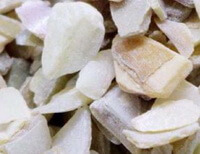 (3) Shell of Pteria martensii (Dunker): The intact shell is obliquely square; the posterior auricle is large, the anterior auricle is small, the dorsal margin is flat and straight, the ventrolateral edge is rounded, and growth lines are extremely dense and lamellar (flaky). The adductor muscle scar is large and oblong, with a single prominent, elongated cardinal tooth.
 URL QR code:

