✵The article records the herb Purple Cowry Shell—its English name, Latin name, Pinyin name, properties and flavor, and its source: one animal species, (1) Mauritia arabica (Linnaeus.). It provides a detailed introduction to the biological features of this species, its growth characteristics and ecological environment, as well as the morphological characteristics of the herb Purple Cowry Shell, its pharmacological actions, medicinal efficacy, and administration guidelines.
Concha Mauritiae (Purple Cowry Shell)
Pinyin Name: Zǐ Bèi Chǐ or Zǐ Bèi
English Name: Purple Cowry Shell
Latin Name:Concha Mauritiae Properties and Flavor: Neutral in nature; salty in taste
Brief Introduction:Concha Mauritiae is the dried shell of Mauritia (L.), used as a sedative to treat palpitations and infantile convulsions. It is commonly known as Concha Mauritiae, Purple Cowry Shell, or Zǐ Bèi Chǐ.
Source: Classical herbal works define Concha Mauritiae (Purple Cowry Shell) as the shell of the marine gastropod (1) Mauritia arabica (Linnaeus.). It belongs to the family Cypraeidae (cowrie family) within the order Littorinimorpha (formerly classified under Mesogastropoda). This species is described below:
(1) Cypraea
Shellfish Description: Commonly known as Mauritia arabica (Linnaeus.), Ē Wén Shòu Bèi, or Zǐ Bèi (“purple shell”). The shell is elongated-oval; the chitinous layer is firm and solid, typically measuring 75 mm in length, 42 mm in width, and 34 mm in height; larger specimens may reach 80 mm in length. The spire and protoconch are almost entirely covered by enamel. The dorsal surface is rounded; the lateral margins taper gradually toward the base, and the outer lip is slightly thickened. The shell surface is lustrous and smooth, brown or light brown, bearing irregular, crisscrossing tan (chocolate brown) interrupted bands and numerous asterisk-like markings. The dorsum is conspicuously unmarked; the dorsal surface bears faint horizontal bands of brown or bice (stone blue or grayish-blue), which are more distinct in juvenile specimens. The lateral margins are taupe (dust-colored), with puce (purplish-brown) spots extending from the margins to the base. The aperture is long and narrow, slightly curved, with the anterior end somewhat widened; each lip bears approximately 32 labial teeth, colored puce (purplish-brown). The interior surface of the shell is mauve (lilac). Both the anterior and posterior siphonal canals are short.
Ecological Environment:Mauritia arabica (Linnaeus.) is primarily distributed along coastal regions of China.
Life Habit:Mauritia arabica (Linnaeus.) inhabits rocky intertidal zones or coral reef caves, is nocturnal—hiding during the day and emerging at night—and is dioecious. On Hainan Island, its spawning season (egg-laying period) occurs from April to June.
Characteristics of the Herb: The shell is elongated-oval; the ventral surface is flat; the anterior end is slightly widened; the anterior and posterior ends are invaginated (folded inward) and aperture-like; and numerous fine teeth line the lips of the aperture. The shell measures approximately 7 cm in length, 4 cm in width, and 3.5 cm in height. The surface is nearly entirely covered with enamel and exhibits a lustrous sheen; the dorsal surface is brown or hazel (pale brown), bearing irregular, crisscrossing tan (chocolate brown) bands; both lateral margins are taupe (dust-colored) and bear conspicuous puce (purplish-brown) spots. The lips bear puce (purplish-brown) teeth; the shell is firm and hard in texture, odorless, and tasteless. High-grade herb material is distinctly purple, with thick, intact, and clean shells.
Medicinal Efficacy: Clears heat; calms the mind (alleviates restlessness and induces sedation); pacifies the liver; and improves vision (enhances visual acuity). It is indicated for conditions including heat toxin and nebula (corneal opacity), infantile macula affecting the eyes, infantile convulsions accompanied by high fever, fright-induced insomnia, dizziness, vertigo, palpitations, anxiety, insomnia with vivid dreams, redness, swelling, and pain in the eyes, and heat toxin–induced nebula.
Administration of Concha Mauritiae (Zǐ Bèi Chǐ):
Reference:
Administration Guide for Concha Mauritiae (Zǐ Bèi Chǐ)
TCM Books:
(1) Internally:water decoction, 2–5 qian (approximately 6–15 grams); or finely powdered herb. External use: finely powdered herb mixed with water as an eye drop. (2) Internally:water decoction, 10–15 grams; the shell should be cracked and decocted first. External use: appropriate amount; finely powdered herb mixed with water as an eye drop.

 ✵The article records the herb Purple Cowry Shell—its English name, Latin name, Pinyin name, properties and flavor, and its source: one animal species, (1) Mauritia arabica (Linnaeus.). It provides a detailed introduction to the biological features of this species, its growth characteristics and ecological environment, as well as the morphological characteristics of the herb Purple Cowry Shell, its pharmacological actions, medicinal efficacy, and administration guidelines.
 Pinyin Name: Zǐ Bèi Chǐ or Zǐ Bèi
 Shellfish Description: Commonly known as Mauritia arabica (Linnaeus.), Ē Wén Shòu Bèi, or Zǐ Bèi (“purple shell”). The shell is elongated-oval; the chitinous layer is firm and solid, typically measuring 75 mm in length, 42 mm in width, and 34 mm in height; larger specimens may reach 80 mm in length. The spire and protoconch are almost entirely covered by enamel. The dorsal surface is rounded; the lateral margins taper gradually toward the base, and the outer lip is slightly thickened. The shell surface is lustrous and smooth, brown or light brown, bearing irregular, crisscrossing tan (chocolate brown) interrupted bands and numerous asterisk-like markings. The dorsum is conspicuously unmarked; the dorsal surface bears faint horizontal bands of brown or bice (stone blue or grayish-blue), which are more distinct in juvenile specimens. The lateral margins are taupe (dust-colored), with puce (purplish-brown) spots extending from the margins to the base. The aperture is long and narrow, slightly curved, with the anterior end somewhat widened; each lip bears approximately 32 labial teeth, colored puce (purplish-brown). The interior surface of the shell is mauve (lilac). Both the anterior and posterior siphonal canals are short.
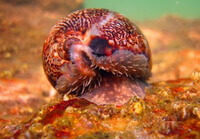 Ecological Environment: Mauritia arabica (Linnaeus.) is primarily distributed along coastal regions of China.
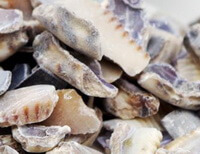 Characteristics of the Herb: The shell is elongated-oval; the ventral surface is flat; the anterior end is slightly widened; the anterior and posterior ends are invaginated (folded inward) and aperture-like; and numerous fine teeth line the lips of the aperture. The shell measures approximately 7 cm in length, 4 cm in width, and 3.5 cm in height. The surface is nearly entirely covered with enamel and exhibits a lustrous sheen; the dorsal surface is brown or hazel (pale brown), bearing irregular, crisscrossing tan (chocolate brown) bands; both lateral margins are taupe (dust-colored) and bear conspicuous puce (purplish-brown) spots. The lips bear puce (purplish-brown) teeth; the shell is firm and hard in texture, odorless, and tasteless. High-grade herb material is distinctly purple, with thick, intact, and clean shells.
 URL QR code: