Introduction of Suo Yang: Songaria Cynomorium Herb
✵This article documents the herb Songaria Cynomorium Herb, including its Pinyin name, English name, Latin name, properties and flavor, botanical source—namely, Cynomorium songaricum Rupr.—and provides a detailed description of the plant’s botanical features, growth characteristics, ecological environment, as well as the herb’s macroscopic characteristics, pharmacological actions, medicinal efficacy, and administration guidelines.
Herba Cynomorii (Songaria Cynomorium Herb)
Pinyin Name: Suǒ Yánɡ
English Name: Songaria Cynomorium Herb
Latin Name:Herba Cynomorii Properties and Flavor: Warm; sweet
Brief Introduction:Herba Cynomorii is the dried succulent stem of Cynomorium songaricum Rupr. It is used (1) to reinforce kidney Yang for treating impotence and seminal emission, and (2) as a mild laxative for chronic constipation in the elderly. Common names include Herba Cynomorii, Songaria Cynomorium Herb, and Suǒ Yánɡ.
Botanical Source: Classical herbal works define Herba Cynomorii (Suo Yang) as the dried succulent stem—or occasionally the whole part—of Cynomorium songaricum Rupr. This species belongs to the genus Cynomorium L., family Cynomoriaceae (Cynomoriaceae Endl. ex Lindl.), order Myrtales. The following describes this commonly used species:
(1) Cynomorium songaricum Rupr.
Botanical Description:Cynomorium songaricum Rupr. is a perennial, succulent, parasitic herb of the Cynomoriaceae family (Cynomoriaceae Endl. ex Lindl.) and the genus Cynomorium L. It lacks chlorophyll and is also known as Cynomorium coccineum L. Common names include Cynomorium songaricum, Songaria Cynomorium Herb, and Suo Yang ("locking Yang"). The plant grows 10–100 cm tall. The stem is cylindrical and dark purplish-red to red. The underground stem is short and thick, bearing numerous tuberculate and protuberant absorptive roots. The aboveground stem is succulent and cylindrical; the lower portion remains buried in soil, with only the apical portion emergent. The base is slightly enlarged, 3–6 cm in diameter. Scale leaves are alternate, densely imbricated at the stem base and sparsely spirally arranged toward the apex; they reach up to 1 cm in length and less than 1 cm in width, with an acute apex.
Flowers are monoecious. Inflorescences are terminal, succulent, clavate spikes, 5–12 cm long and 2–4 cm in diameter, florets are densely covered with scale-like bracts. Flowers are dark purple. Male flowers possess 1–6 tepals (perianth lobes), which are linear (filiform); one pistil, longer than the perianth; and an indistinct or occasionally obovate, protuberant pistillode. Female flowers bear several linear, succulent involucral bracts—one broader and larger—and clavate perianth lobes (tepal); one pistil; an inferior or half-inferior ovary; and a clavate style. Hermaphroditic flowers bloom before male flowers and contain one stamen and one pistil.
Fruits are globose (spherical) and very small. Flowering occurs from May to June; fruiting from August to September.
The herb is harvested in spring and autumn; spring-collected material is considered superior. After excavation, the inflorescence is removed, and the herb is stored in a semi-buried, semi-exposed state before drying the exposed portion.
Ecological Environment: The plant grows in arid, sandy, or desert habitats and parasitizes the roots of Nitraria sibirica Pall. (Zygophyllaceae family).
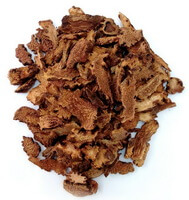
Characteristics of the Herb: The dried whole herb is flattened-cylindrical or slightly tapered at one end, often curved, and typically cut into segments 5–15 cm (or 8–21 cm) long and 1.5–5 cm (or 2–5 cm) in diameter. The surface is brown to reddish-brown or dark brown, coarse and rough, wrinkled and uneven, with conspicuous longitudinal grooves and transverse, intermittent, shallow fissures. Some specimens retain triangular, blackish-brown scale leaves; in certain inflorescences, areas where corky bark has exfoliated reveal fine, vertical vascular veins. The herb is heavy, with a firm, hard, and dense texture—difficult to break. The fracture surface is slightly granular, soft and smooth, light brown to brown or tan (chocolate-brown), and bears yellow, triangular, raised vascular bundle spots. It has a faint fragrance and tastes slightly bitter and astringent—or sweet and astringent. Slices are cross-sectioned or obliquely cut, ~1 cm thick, and often strung on rope.
Medicinal Efficacy: Invigorates kidney Yang, replenishes essence and blood, and moistens the intestines to relieve constipation. It is indicated for kidney Yang deficiency; impotence and spermatorrhea due to kidney deficiency; nocturnal emission and premature ejaculation; deficiency of essence and blood; soreness and weakness of the lower back and knees; weakness of the legs and feet; impotence and seminal emission (asynodia and spermatorrhea); hematuria; physical debility with constipation; blood deficiency with constipation; and intestinal dryness with constipation.
Administration of Herba Cynomorii (Suǒ Yánɡ):
Reference:
Administration Guide for Herba Cynomorii (Suǒ Yánɡ)
TCM Books:
(1) Internally: 5–10 grams; (2) Internally: water decoction, 1.5–3 qián (≈4.5–9 grams); or formulated into pills, powders, or ointments; (3) Internally: water decoction, 5–15 grams; or processed into pills or powders.
Article Link:
URL QR code:
References:
1.Introduction of Suo Yang: Songaria Cynomorium Herb

 ✵This article documents the herb Songaria Cynomorium Herb, including its Pinyin name, English name, Latin name, properties and flavor, botanical source—namely, Cynomorium songaricum Rupr.—and provides a detailed description of the plant’s botanical features, growth characteristics, ecological environment, as well as the herb’s macroscopic characteristics, pharmacological actions, medicinal efficacy, and administration guidelines.
 Pinyin Name: Suǒ Yánɡ
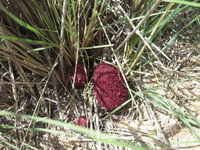 Botanical Description: Cynomorium songaricum Rupr. is a perennial, succulent, parasitic herb of the Cynomoriaceae family (Cynomoriaceae Endl. ex Lindl.) and the genus Cynomorium L. It lacks chlorophyll and is also known as Cynomorium coccineum L. Common names include Cynomorium songaricum, Songaria Cynomorium Herb, and Suo Yang ("locking Yang"). The plant grows 10–100 cm tall. The stem is cylindrical and dark purplish-red to red. The underground stem is short and thick, bearing numerous tuberculate and protuberant absorptive roots. The aboveground stem is succulent and cylindrical; the lower portion remains buried in soil, with only the apical portion emergent. The base is slightly enlarged, 3–6 cm in diameter. Scale leaves are alternate, densely imbricated at the stem base and sparsely spirally arranged toward the apex; they reach up to 1 cm in length and less than 1 cm in width, with an acute apex.
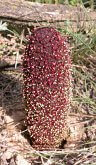 Flowers are monoecious. Inflorescences are terminal, succulent, clavate spikes, 5–12 cm long and 2–4 cm in diameter, florets are densely covered with scale-like bracts. Flowers are dark purple. Male flowers possess 1–6 tepals (perianth lobes), which are linear (filiform); one pistil, longer than the perianth; and an indistinct or occasionally obovate, protuberant pistillode. Female flowers bear several linear, succulent involucral bracts—one broader and larger—and clavate perianth lobes (tepal); one pistil; an inferior or half-inferior ovary; and a clavate style. Hermaphroditic flowers bloom before male flowers and contain one stamen and one pistil.
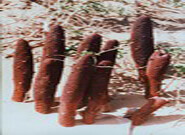 The herb is harvested in spring and autumn; spring-collected material is considered superior. After excavation, the inflorescence is removed, and the herb is stored in a semi-buried, semi-exposed state before drying the exposed portion.
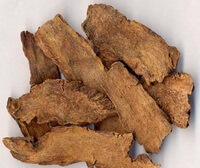 Characteristics of the Herb: The dried whole herb is flattened-cylindrical or slightly tapered at one end, often curved, and typically cut into segments 5–15 cm (or 8–21 cm) long and 1.5–5 cm (or 2–5 cm) in diameter. The surface is brown to reddish-brown or dark brown, coarse and rough, wrinkled and uneven, with conspicuous longitudinal grooves and transverse, intermittent, shallow fissures. Some specimens retain triangular, blackish-brown scale leaves; in certain inflorescences, areas where corky bark has exfoliated reveal fine, vertical vascular veins. The herb is heavy, with a firm, hard, and dense texture—difficult to break. The fracture surface is slightly granular, soft and smooth, light brown to brown or tan (chocolate-brown), and bears yellow, triangular, raised vascular bundle spots. It has a faint fragrance and tastes slightly bitter and astringent—or sweet and astringent. Slices are cross-sectioned or obliquely cut, ~1 cm thick, and often strung on rope.
 URL QR code: