Introduction of Sha Yuan Zi: Flatstem Milkvetch Seed
✵The article documents the herb Flatstem Milkvetch Seed, including its Pinyin name, English name, Latin name, properties and flavor, and its botanical sources as defined in classical herbal texts. The primary source is (1) Astragalus complanatus R. Br., with two additional approved species: (2) Astragalus chinensis L. f. and (3) Astragalus adsurgens Pall. It provides a detailed introduction to the botanical features, growth characteristics, and ecological environments of these three plant species, as well as the morphological characteristics, pharmacological actions, medicinal efficacy, and administration guidelines for the herb Flatstem Milkvetch Seed.
Pinyin Name: Shā Yuàn Zǐ
English Name: Flatstem Milkvetch Seed
Latin Name:Semen Astragali Complanati Properties and Flavor: Warm; sweet
Brief Introduction:Semen Astragali Complanati is the dried, ripe seed of Astragalus complanatus R. Br. It is used to tonify the Liver and Kidney Yin, and is indicated for dizziness, blurred vision, seminal emission, premature ejaculation, impotence, frequent urination, and leukorrhea. It is commonly known as Semen Astragali Complanati, Flatstem Milkvetch Seed, or Shā Yuàn Zǐ.
Botanical Source: Classical herbal works define Semen Astragali Complanati (Shā Yuàn Zǐ) as the dried, ripe seeds of plants in the Fabaceae family (also known as Leguminosae or Papilionaceae—the legume or pea family). The primary source is (1) Astragalus complanatus R. Br. Other authoritative works also accept (2) Astragalus chinensis L. f. and (3) Astragalus adsurgens Pall. as legitimate sources. These three commonly used species are described below:
(1) Astragalus complanatus R. Br.
Botanical Description:Astragalus complanatus R. Br. is a perennial herb of the Fabaceae family and the genus Astragalus L. It is commonly known as Astragalus complanatus, Mán Huáng Qí, or Biǎn Jīng Huáng Qí ("Flat-stemmed Astragalus"). The plant grows over 1 meter tall and is covered throughout with short, hirsute pubescence. It has a thick, elongated taproot. Stems are decumbent, angled and ridged, and typically ramify near the base. Leaves are imparipinnate (odd-pinnate compound), alternate, and petiolate; stipules are narrow-lanceolate, ~3 mm long and ~0.5 mm wide, pilose; leaflets number 9–21, elliptic, 6–14 cm long and 3–7 mm wide, with a blunt or emarginate apex bearing a fine mucro, a blunt to obtuse base, and an entire margin. The upper surface is green and glabrous; the lower surface is celadon (sage green).
Racemes are axillary, bearing 3–9 flowers. Peduncles are slender, elongated, and pilose. Each pedicel bears a linear-lanceolate bracteole at its base. The calyx is campanulate (bell-shaped), green, and 5-lobed at the apex; the exterior is covered with short, black hirsute hairs; the hypanthium (calyx tube) bears two oval (egg-shaped) bracteoles at its base, densely covered with short hirsute hairs. The corolla is papilionaceous and yellow: the vexillum is orbicular with an emarginate apex and clawed base, ~10 mm long and ~8 mm wide; the alae are slightly shorter; the keel is subequal in length to the vexillum. There are 10 stamens, diadelphous [(9)+1]; the pistil extends beyond the stamens; the ovary is superior, densely white-pilose, with a gynophore; the style is glabrous; the stigma is penicillate and covered with beard hairs.
Fruits (legumes) are fusiform (spindle-shaped), 3–4 cm long, with a prolonged, pointed rostrum (beak) at the apex. Both the ventral and dorsal surfaces are slightly flattened and covered with short, black hirsute hairs. Each pod contains 20–30 seeds. Seeds are reniform and rounded. Flowering occurs from August to September; fruiting occurs from September to October.
Ecological Environment: This species grows on mountain slopes, ditch banks, and barren lands. It is predominantly distributed in China.
Growth characteristics: The plant prefers a warm climate, exhibits cold and drought tolerance, but is sensitive to high temperatures and waterlogging. Soil requirements are not stringent: sandy loam and clay loam are both suitable. Continuous cropping should be avoided; it is preferable to rotate with Gramineae (grass family) crops.
Characteristics of the Herb: The dried seeds of Astragalus complanatus are reniform and slightly flattened, measuring approximately 2–2.5 mm in length, 1.5–2 mm in width, and less than 1 mm in thickness. The surface is taupe (grayish brown, dust-colored) or greenish-brown and smooth. One side bears a shallowly concave hilum with a faintly colored margin. The hilum is distinct and located in the concavity. The herb is firm and hard, not easily fractured. It contains two cotyledons—pale yellow, slightly oval—and a curved radicle approximately 1 mm long. The herb is odorless, has a mild taste, and emits a characteristic beany aroma when chewed.
Medicinal Efficacy: Tonifies Kidney Yang, invigorates the Liver, replenishes the Kidney, controls nocturnal emission, and arrests polyuria. It is indicated for: Kidney deficiency–induced low back pain (kidney deficiency, low back pain); combined Liver–Kidney deficiency; soreness and weakness of the lumbar region and knees; spermatorrhea and premature ejaculation; frequent urination; enuresis; hematuria; tinnitus; dizziness; blurred vision; diminished visual acuity; leukorrhea (including white turbidity, morbid leukorrhea, and white leukorrhea).
Administration of Semen Astragali Complanati (Shā Yuàn Zǐ):
Reference:
Administration Guide for Semen Astragali Complanati (Shā Yuàn Zǐ)
TCM Books:
(1) Internally: 9–15 grams; (2) Internally: water decoction, 2–3 qián (approximately 6–9 grams), or prepared as pills or powder; (3) Internally: water decoction, 6–9 grams;, or formulated into pills, powders, or ointments.
(2) Astragalus chinensis L.f.
Botanical Description:Astragalus chinensis L. f. is a perennial herb of the Fabaceae family (syn. Leguminosae) and the genus Astragalus L. It is commonly known as Astragalus sinensis, Huá Huáng Qí, and Dì Huáng Qí. Plants grow 20–100 cm tall (commonly 30–90 cm). Stems are erect, usually simple, ribbed or deeply grooved, and glabrous or subglabrous. Leaves are imparipinnate (odd-pinnate), with 17–25 leaflets, 5–12 cm (or 8–12 cm) in length; petioles are 1–2 cm long; stipules are free (not adnate), with bases slightly auriculate around the petiole, lanceolate, 7–11 mm long, glabrous or sparsely pubescent with white hairs on the lower surface; leaflets are elliptic to oblong, 1.5–2.5 cm long and 4–9 mm wide, with a blunt apex bearing a minute mucro, and a broadly cuneate or suborbicular base. The upper surface is glabrous; the lower surface is sparsely covered with appressed white hairs, rarely becoming glabrescent.
Racemes are dense and many-flowered; peduncles are axillary in the upper part of the stem and shorter than the leaves; bracts are lanceolate and membranaceous, 2–3 mm long; pedicels are 4–5 mm long and sparsely pilose with white hairs along the pedicels and inflorescence axis; the calyx is tubular-campanulate, 6–7 mm long, sparsely covered with appressed white hairs externally; calyx teeth are triangular-lanceolate, ~2 mm long, with the inner surface densely covered with appressed white pubescence; bracteoles are lanceolate; the corolla is yellow: the vexillum is broadly elliptic or subrotund, 12–16 mm long, emarginate at the apex, attenuated at the base into a clawed petal stalk; the alae are smaller, 9–12 mm long, with oblong lobes ~2 mm wide, blunt at the apex, auriculate at the base, and petal stalks 4–5 mm long; the keel is subequal in length to the vexillum, with semiovoid lobes and petal stalks approximately half the length of the lobes; the ovary is glabrous and longly stipitate.
Fruits (legumes) are elliptic, 1–1.5 cm long and 5–6 mm wide, somewhat inflated; the apex bears a curved rostrum (beak) ~1 mm long; the surface is glabrous but densely marked with fine reticulate wrinkles (mold-like texture); the valves are firm and thick, pseudo-bilocular; the fruit neck measures ~6–9 mm in length; seeds are reniform, 2.5–3 mm long, and brown. Flowering occurs from June to July; fruiting occurs from July to August.
Ecological Environment: This species grows on hillsides, mountain slopes, roadsides, sandy soils, grasslands, and riverbanks. It is predominantly distributed in China.
Characteristics of the Herb: The dried seeds of Astragalus chinensis are regularly reniform and plump, measuring 2–2.8 mm in length and 1.8–2 mm in width. The surface is dark green or brownish-green and smooth. A distinct hilum is situated in the slightly concave central region of the seed’s ventral surface. The herb is hard and firm, not easily fractured. It has a faint odor and a mild taste.
(3) Astragalus adsurgens Pall.
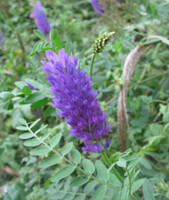
Botanical Description:Astragalus adsurgens Pall. is a perennial herb of the Fabaceae (Leguminosae) family and the genus Astragalus L. It is commonly known as Astragalus adsurgens, Astragalus laxmannii, Zhí Lì Huáng Qí, Xié Jīng Huáng Qí, Bó Dì Qiáng, and Shā Dá Wàng. It grows up to 50–70 cm tall—or 20–100 cm tall—and the whole plant is covered with T-shaped hairs. The taproot is thick and long; lateral roots are numerous and mainly distributed in soil layers 20–30 cm deep. The root system spreads up to ~150 cm wide and bears brown, nodulated root nodules. Stems are erect or ascending, caespitose (tufted), highly branched, with an inconspicuous main stem; typically, 10–25 stems arise from the base. Leaves are imparipinnate (odd-pinnate compound leaves) with 3–27 leaflets, which are oblong; stipules are membranaceous and ovate.
Inflorescences are racemes, mostly axillary, long-cylindrical and spicate (spiciform), rarely subcapitate; each inflorescence bears 17–79 florets, densely arranged—though sometimes sparse. Peduncles arise from the upper part of the stem and are longer than or equal in length to the leaves. Pedicels are very short. Floral bracts are narrowly lanceolate to triangular, with an acute apex. The calyx is tubular-campanulate, 5–6 mm long, covered with dark brown (or blackish-brown) or white hairs—sometimes a mixture of black and white hairs. Calyx teeth are narrow-lanceolate and about one-third the length of the hypanthium (calyx tube). The corolla is nearly blue or reddish-violet: the vexillum is 11–15 mm long, obovate, apex is slightly emarginated (retuse), base is attenuated, alae is shorter than vexilla, lobes are oblong, equal length as petal stalk,
keel is 7–10 mm long, with lobes slightly shorter than the petiole. The ovary is densely hairy and very shortly stipitate.
Fruits are legumes (pods), oblong, 7–18 mm long, slightly flattened on both sides; the dorsal suture is concave, forming a groove; the apex bears a short, recurved rostrum (beak); pods are covered with mixed black, brown, or white hairs and are pseudo-bilocular. Flowering occurs from June to August; fruiting from August to October.
Ecological Environment: This species grows on sunny hillsides and mountain slopes, forest margins, open grasslands, and wild, sun-exposed slopes. It is primarily distributed in China and also occurs in North Asia, Northeast Asia, and the temperate zone of North America.
Characteristics of the Herb: Roots are robust; most specimens exhibit prominent taproots and numerous long lateral roots. Root nodules are abundant. Roots are concentrated predominantly in the 15–40 cm soil layer. In barren sandy soils, fibrous roots extend deeper, mainly within the 30–100 cm layer.
Article Link:
URL QR code:
References:
1.Introduction of Sha Yuan Zi: Flatstem Milkvetch Seed

 ✵The article documents the herb Flatstem Milkvetch Seed, including its Pinyin name, English name, Latin name, properties and flavor, and its botanical sources as defined in classical herbal texts. The primary source is (1) Astragalus complanatus R. Br., with two additional approved species: (2) Astragalus chinensis L. f. and (3) Astragalus adsurgens Pall. It provides a detailed introduction to the botanical features, growth characteristics, and ecological environments of these three plant species, as well as the morphological characteristics, pharmacological actions, medicinal efficacy, and administration guidelines for the herb Flatstem Milkvetch Seed.
 Pinyin Name: Shā Yuàn Zǐ
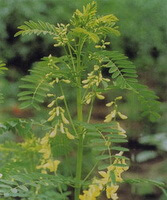 Botanical Description: Astragalus complanatus R. Br. is a perennial herb of the Fabaceae family and the genus Astragalus L. It is commonly known as Astragalus complanatus, Mán Huáng Qí, or Biǎn Jīng Huáng Qí ("Flat-stemmed Astragalus"). The plant grows over 1 meter tall and is covered throughout with short, hirsute pubescence. It has a thick, elongated taproot. Stems are decumbent, angled and ridged, and typically ramify near the base. Leaves are imparipinnate (odd-pinnate compound), alternate, and petiolate; stipules are narrow-lanceolate, ~3 mm long and ~0.5 mm wide, pilose; leaflets number 9–21, elliptic, 6–14 cm long and 3–7 mm wide, with a blunt or emarginate apex bearing a fine mucro, a blunt to obtuse base, and an entire margin. The upper surface is green and glabrous; the lower surface is celadon (sage green).
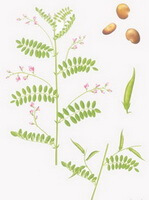 Racemes are axillary, bearing 3–9 flowers. Peduncles are slender, elongated, and pilose. Each pedicel bears a linear-lanceolate bracteole at its base. The calyx is campanulate (bell-shaped), green, and 5-lobed at the apex; the exterior is covered with short, black hirsute hairs; the hypanthium (calyx tube) bears two oval (egg-shaped) bracteoles at its base, densely covered with short hirsute hairs. The corolla is papilionaceous and yellow: the vexillum is orbicular with an emarginate apex and clawed base, ~10 mm long and ~8 mm wide; the alae are slightly shorter; the keel is subequal in length to the vexillum. There are 10 stamens, diadelphous [(9)+1]; the pistil extends beyond the stamens; the ovary is superior, densely white-pilose, with a gynophore; the style is glabrous; the stigma is penicillate and covered with beard hairs.
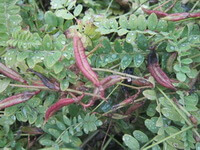 Fruits (legumes) are fusiform (spindle-shaped), 3–4 cm long, with a prolonged, pointed rostrum (beak) at the apex. Both the ventral and dorsal surfaces are slightly flattened and covered with short, black hirsute hairs. Each pod contains 20–30 seeds. Seeds are reniform and rounded. Flowering occurs from August to September; fruiting occurs from September to October.
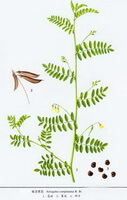 Ecological Environment: This species grows on mountain slopes, ditch banks, and barren lands. It is predominantly distributed in China.
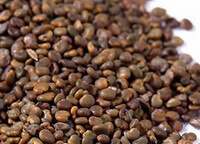 Characteristics of the Herb: The dried seeds of Astragalus complanatus are reniform and slightly flattened, measuring approximately 2–2.5 mm in length, 1.5–2 mm in width, and less than 1 mm in thickness. The surface is taupe (grayish brown, dust-colored) or greenish-brown and smooth. One side bears a shallowly concave hilum with a faintly colored margin. The hilum is distinct and located in the concavity. The herb is firm and hard, not easily fractured. It contains two cotyledons—pale yellow, slightly oval—and a curved radicle approximately 1 mm long. The herb is odorless, has a mild taste, and emits a characteristic beany aroma when chewed.
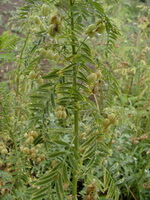 Botanical Description: Astragalus chinensis L. f. is a perennial herb of the Fabaceae family (syn. Leguminosae) and the genus Astragalus L. It is commonly known as Astragalus sinensis, Huá Huáng Qí, and Dì Huáng Qí. Plants grow 20–100 cm tall (commonly 30–90 cm). Stems are erect, usually simple, ribbed or deeply grooved, and glabrous or subglabrous. Leaves are imparipinnate (odd-pinnate), with 17–25 leaflets, 5–12 cm (or 8–12 cm) in length; petioles are 1–2 cm long; stipules are free (not adnate), with bases slightly auriculate around the petiole, lanceolate, 7–11 mm long, glabrous or sparsely pubescent with white hairs on the lower surface; leaflets are elliptic to oblong, 1.5–2.5 cm long and 4–9 mm wide, with a blunt apex bearing a minute mucro, and a broadly cuneate or suborbicular base. The upper surface is glabrous; the lower surface is sparsely covered with appressed white hairs, rarely becoming glabrescent.
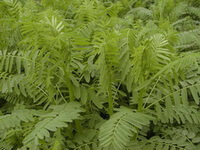 Fruits (legumes) are elliptic, 1–1.5 cm long and 5–6 mm wide, somewhat inflated; the apex bears a curved rostrum (beak) ~1 mm long; the surface is glabrous but densely marked with fine reticulate wrinkles (mold-like texture); the valves are firm and thick, pseudo-bilocular; the fruit neck measures ~6–9 mm in length; seeds are reniform, 2.5–3 mm long, and brown. Flowering occurs from June to July; fruiting occurs from July to August.
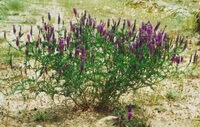 Botanical Description: Astragalus adsurgens Pall. is a perennial herb of the Fabaceae (Leguminosae) family and the genus Astragalus L. It is commonly known as Astragalus adsurgens, Astragalus laxmannii, Zhí Lì Huáng Qí, Xié Jīng Huáng Qí, Bó Dì Qiáng, and Shā Dá Wàng. It grows up to 50–70 cm tall—or 20–100 cm tall—and the whole plant is covered with T-shaped hairs. The taproot is thick and long; lateral roots are numerous and mainly distributed in soil layers 20–30 cm deep. The root system spreads up to ~150 cm wide and bears brown, nodulated root nodules. Stems are erect or ascending, caespitose (tufted), highly branched, with an inconspicuous main stem; typically, 10–25 stems arise from the base. Leaves are imparipinnate (odd-pinnate compound leaves) with 3–27 leaflets, which are oblong; stipules are membranaceous and ovate.
 Inflorescences are racemes, mostly axillary, long-cylindrical and spicate (spiciform), rarely subcapitate; each inflorescence bears 17–79 florets, densely arranged—though sometimes sparse. Peduncles arise from the upper part of the stem and are longer than or equal in length to the leaves. Pedicels are very short. Floral bracts are narrowly lanceolate to triangular, with an acute apex. The calyx is tubular-campanulate, 5–6 mm long, covered with dark brown (or blackish-brown) or white hairs—sometimes a mixture of black and white hairs. Calyx teeth are narrow-lanceolate and about one-third the length of the hypanthium (calyx tube). The corolla is nearly blue or reddish-violet: the vexillum is 11–15 mm long, obovate, apex is slightly emarginated (retuse), base is attenuated, alae is shorter than vexilla, lobes are oblong, equal length as petal stalk,
keel is 7–10 mm long, with lobes slightly shorter than the petiole. The ovary is densely hairy and very shortly stipitate.
Inflorescences are racemes, mostly axillary, long-cylindrical and spicate (spiciform), rarely subcapitate; each inflorescence bears 17–79 florets, densely arranged—though sometimes sparse. Peduncles arise from the upper part of the stem and are longer than or equal in length to the leaves. Pedicels are very short. Floral bracts are narrowly lanceolate to triangular, with an acute apex. The calyx is tubular-campanulate, 5–6 mm long, covered with dark brown (or blackish-brown) or white hairs—sometimes a mixture of black and white hairs. Calyx teeth are narrow-lanceolate and about one-third the length of the hypanthium (calyx tube). The corolla is nearly blue or reddish-violet: the vexillum is 11–15 mm long, obovate, apex is slightly emarginated (retuse), base is attenuated, alae is shorter than vexilla, lobes are oblong, equal length as petal stalk,
keel is 7–10 mm long, with lobes slightly shorter than the petiole. The ovary is densely hairy and very shortly stipitate.
 URL QR code: