✵This article documents the herb Glossy Privet Fruit, including its English name, Latin name, Pinyin name, properties and flavor, botanical source—namely, the single plant species Ligustrum lucidum Ait.—and provides a detailed description of the plant’s morphology, growth characteristics, ecological environment, macroscopic features of the fruit, pharmacological actions, medicinal efficacy, and administration guidelines.
Fructus Ligustri Lucidi (Glossy Privet Fruit)
Pinyin Name: Nǚ Zhēn Zǐ
English Name: Glossy Privet Fruit
Latin Name:Fructus Ligustri Lucidi Properties and Flavor: Cool in nature; bitter and sweet in taste
Brief Introduction:Fructus Ligustri Lucidi is the dried, ripe fruit of Ligustrum lucidum Ait. It nourishes the yin of the liver and kidney, darkens the hair, and improves vision. It is used to treat premature graying of hair, blurred vision, lumbago, and low-grade fever due to yin deficiency. Common names include Fructus Ligustri Lucidi, Glossy Privet Fruit, and Nǚ Zhēn Zǐ.
Botanical Source: Classical herbal works define Fructus Ligustri Lucidi (Nǚ Zhēn Zǐ) as the fruit of Ligustrum lucidum Ait., a species in the genus Ligustrum L., family Oleaceae (olive family), order Lamiales (formerly in order Scrophulariales). This widely used species is described below:
(1) Ligustrum lucidum Ait.
Botanical description:Ligustrum lucidum Ait. is an evergreen shrub or small tree belonging to the Oleaceae family and the genus Ligustrum. It is commonly known as Nǚ Zhēn, broad-leaved privet, Chinese privet, glossy privet, tree privet, or wax-leaf privet. It grows up to 10 m—or exceptionally up to 25 m—in height. The bark is gray to taupe (grayish brown or dusty gray); branches are smooth, tawny (yellowish brown), gray, or purplish red (prunus), cylindrical, and bear sparse circular or oblong lenticels. Leaves are simple and opposite; petioles are 1–3 cm long and grooved on the upper surface; leaf blades are coriaceous, oval (egg-shaped), ovate-oblong, or elliptic to broadly elliptical, 6–17 cm long and 3.5–6 cm wide (or occasionally 3–8 cm wide); apices are acute, acuminate, or obtuse; bases are rounded, sometimes broadly cuneate or attenuate. The upper surface is dark green and glossy; the lower surface is pale green, densely covered with minute translucent glands, and bears a prominent midvein.
Panicles are terminal, 10–15 cm long (or 8–20 cm long) and 8–25 cm wide (or 8–17 cm in diameter); peduncles are approximately 3 cm long or absent; bracts at the base of the inflorescence resemble leaves in shape; bracteoles (bractlets) are lanceolate, linear, or linear-lanceolate, sessile, and caducous. Flowers are sessile or subsessile; the calyx is glabrous, 1.5–2 cm long, with inconspicuous or subtruncate teeth; the corolla is 4–5 mm long, with lobes 2–2.5 mm long and reflexed; filaments are 1.5–3 mm long, slender, and exserted beyond the corolla; there is one pistil; the ovary is superior, spherical, and bilocular; anthers are oblong, 1–1.5 mm long; the style is 1.5–2 mm long, terete, with a clavate, shallowly bifid stigma.
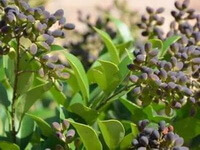
Fruits are drupes, oblong, reniform, or subreniform, 7–10 mm long (or 6–12 mm long) and 4–6 mm in diameter; they are green when immature, turning blue-black and finally reddish black at maturity, and are coated with a whitish bloom. Each fruit contains 1–2 seeds, which are long-ovoid. The flowering period extends from May to July; the fruiting period spans from July to the following May.
Ecological Environment:Ligustrum lucidum grows in mountainous regions and is commonly cultivated in gardens, open forests, or dense forests, at elevations below 2,900 m. It is also planted in courtyards and along roadsides. This species is native to southern China and has become naturalized in many regions, including Argentina, Australia, the Canary Islands, Italy, Lesotho, New Zealand, Norfolk Island, and the southern United States (California, Arizona, Maryland, and the southeastern states from Texas to North Carolina).
Growth Characteristics:Ligustrum lucidum Ait. prefers a warm, humid climate; it thrives in full sun but tolerates partial shade. It is not cold-hardy but exhibits strong resistance to air pollutants—including sulfur dioxide, chlorine, hydrogen fluoride, and lead vapor—as well as to high levels of dust and smoke. Soil requirements are not stringent; it grows well in sandy loam or clay loam, and also adapts to red or yellow loam soils.
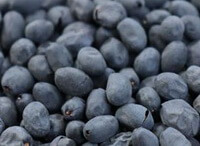
Characteristics of the Herb: The fruit is oval (egg-shaped), elliptical, or reniform, 6–8.5 mm long and 3.5–5.5 mm in diameter. The surface is murrey (dark purple) or brownish-black, with uneven shrinkage; the base bears carpopodium scars (fruit-stalk scars) or a persistent calyx and short carpopodium (fruit stalk). The fruit is light in weight; the exocarp is thin; the mesocarp is slightly thick and soft (not floppy), easily separable from the endocarp; the endocarp is woody, yellowish-brown, and marked with several longitudinal ridges. Each fruit contains one seed, which is elliptic, with one end flattened or slightly curved, atropurpureus (deep purple-black), and oily. The herb has a faint odor and a sweet, slightly sour, and mildly astringent taste.
Pharmacological Actions: (1) Anti-inflammatory effects; (2) Immunomodulatory effects; (3) Hypolipidemic and anti-atherosclerotic effects—reducing the incidence of atherosclerosis—hypoglycemic effects, and stimulation of hematopoietic function; (4) Hepatoprotective effects; (5) Anticancer effects, among others.
Medicinal Efficacy: Nourishes the liver and kidney yin, clears deficiency-heat, improves vision, and darkens the hair; strengthens the lower back and knees. It is indicated for liver-kidney yin deficiency, yin deficiency with internal heat, soreness and weakness of the lower back and knees, premature graying of beard and hair, dizziness, blurred vision, tinnitus, night blindness (diminished visual acuity), spermatorrhea (nocturnal emission), internal heat with consumptive thirst, bone-steaming fever (low-grade fever with subjective sensation of heat in the bones), and tidal fever.
Administration of Fructus Ligustri Lucidi (Nǚ Zhēn Zǐ):
Reference:
Administration Guide for Fructus Ligustri Lucidi (Nǚ Zhēn Zǐ)
TCM Books:
(1) Internally: 6–12 grams; (2) Internally: water decoction, 1.5–3 qián (≈4.5–9 grams); also prepared as an ointment or pills. Externally: ointment applied topically (e.g., for ocular use under professional guidance). (3) Internally: water decoction, 6–15 grams, or prepared as pills. Externally: appropriate amount, prepared as an ointment for topical application (e.g., ocular use under professional guidance).

 ✵This article documents the herb Glossy Privet Fruit, including its English name, Latin name, Pinyin name, properties and flavor, botanical source—namely, the single plant species Ligustrum lucidum Ait.—and provides a detailed description of the plant’s morphology, growth characteristics, ecological environment, macroscopic features of the fruit, pharmacological actions, medicinal efficacy, and administration guidelines.
 Pinyin Name: Nǚ Zhēn Zǐ
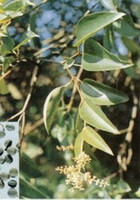 Botanical description: Ligustrum lucidum Ait. is an evergreen shrub or small tree belonging to the Oleaceae family and the genus Ligustrum. It is commonly known as Nǚ Zhēn, broad-leaved privet, Chinese privet, glossy privet, tree privet, or wax-leaf privet. It grows up to 10 m—or exceptionally up to 25 m—in height. The bark is gray to taupe (grayish brown or dusty gray); branches are smooth, tawny (yellowish brown), gray, or purplish red (prunus), cylindrical, and bear sparse circular or oblong lenticels. Leaves are simple and opposite; petioles are 1–3 cm long and grooved on the upper surface; leaf blades are coriaceous, oval (egg-shaped), ovate-oblong, or elliptic to broadly elliptical, 6–17 cm long and 3.5–6 cm wide (or occasionally 3–8 cm wide); apices are acute, acuminate, or obtuse; bases are rounded, sometimes broadly cuneate or attenuate. The upper surface is dark green and glossy; the lower surface is pale green, densely covered with minute translucent glands, and bears a prominent midvein.
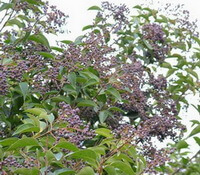 Panicles are terminal, 10–15 cm long (or 8–20 cm long) and 8–25 cm wide (or 8–17 cm in diameter); peduncles are approximately 3 cm long or absent; bracts at the base of the inflorescence resemble leaves in shape; bracteoles (bractlets) are lanceolate, linear, or linear-lanceolate, sessile, and caducous. Flowers are sessile or subsessile; the calyx is glabrous, 1.5–2 cm long, with inconspicuous or subtruncate teeth; the corolla is 4–5 mm long, with lobes 2–2.5 mm long and reflexed; filaments are 1.5–3 mm long, slender, and exserted beyond the corolla; there is one pistil; the ovary is superior, spherical, and bilocular; anthers are oblong, 1–1.5 mm long; the style is 1.5–2 mm long, terete, with a clavate, shallowly bifid stigma.
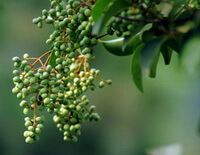 Fruits are drupes, oblong, reniform, or subreniform, 7–10 mm long (or 6–12 mm long) and 4–6 mm in diameter; they are green when immature, turning blue-black and finally reddish black at maturity, and are coated with a whitish bloom. Each fruit contains 1–2 seeds, which are long-ovoid. The flowering period extends from May to July; the fruiting period spans from July to the following May.
 Ecological Environment: Ligustrum lucidum grows in mountainous regions and is commonly cultivated in gardens, open forests, or dense forests, at elevations below 2,900 m. It is also planted in courtyards and along roadsides. This species is native to southern China and has become naturalized in many regions, including Argentina, Australia, the Canary Islands, Italy, Lesotho, New Zealand, Norfolk Island, and the southern United States (California, Arizona, Maryland, and the southeastern states from Texas to North Carolina).
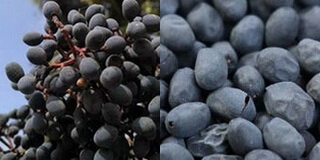
 Characteristics of the Herb: The fruit is oval (egg-shaped), elliptical, or reniform, 6–8.5 mm long and 3.5–5.5 mm in diameter. The surface is murrey (dark purple) or brownish-black, with uneven shrinkage; the base bears carpopodium scars (fruit-stalk scars) or a persistent calyx and short carpopodium (fruit stalk). The fruit is light in weight; the exocarp is thin; the mesocarp is slightly thick and soft (not floppy), easily separable from the endocarp; the endocarp is woody, yellowish-brown, and marked with several longitudinal ridges. Each fruit contains one seed, which is elliptic, with one end flattened or slightly curved, atropurpureus (deep purple-black), and oily. The herb has a faint odor and a sweet, slightly sour, and mildly astringent taste.
 URL QR code:

