Introduction of Mo Han Lian: Eclipta, Yerba-de-tajo Herb
✵The article records the herb Eclipta (Yerba-de-tajo Herb)—its English name, Latin name, Pinyin name, property and flavor, and its botanical source: one plant species, Eclipta prostrata L. It provides a detailed introduction to the botanical features, growth characteristics, and ecological environment of this plant species; the characteristics of the herb; its pharmacological actions, medicinal efficacy, and administration guidelines.
Herba Ecliptae (Eclipta, Yerba-de-tajo Herb)
Pinyin Name: Mò Hàn Lián
English Name: Eclipta, Yerba-de-tajo Herb
Latin Name:Herba Ecliptae Property and Flavor: Cold; sour and sweet.
Brief Introduction:Herba Ecliptae is the dried aerial part of Eclipta prostrata L., used (1) as a blood-cooling hemostatic agent for hemorrhages due to excessive heat in the blood, and (2) as a tonic to nourish the liver and kidneys—for the treatment of dizziness, tinnitus, premature graying of hair, and soreness and weakness of the lower back and legs. The herb is commonly known as Herba Ecliptae, Eclipta, Yerba-de-tajo Herb, or Mò Hàn Lián.
Botanical Source: Classical herbal works define Herba Ecliptae (Mò Hàn Lián), also known as Yerba-de-tajo Herb, as the dried aerial part (above-ground portion) or dried whole plant of Eclipta prostrata L.. It is a member of the genus Eclipta, family Asteraceae (aster or daisy family), order Asterales (formerly in order Campanulales). This commonly used species is introduced below:
(1) Eclipta prostrata L.
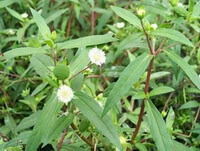
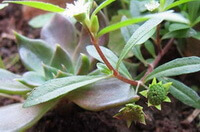
Botanical Description:Eclipta prostrata (L.) L. is an annual herb of the genus Eclipta, family Asteraceae. Synonyms include Eclipta alba (L.) Haussk. and Verbesina prostrata L. It is commonly known as eclipta, yerba-de-tajo herb, or Lǐ Cháng. Plants grow 10–60 cm tall. The entire plant is covered with white, coarse hairs; when broken, the sap exudes and turns blue-black within several minutes. Stems are erect, or the base is obliquely ascending or procumbent—touching the ground and producing adventitious roots—and are green or reddish-brown. Leaves are opposite; leaf blades are linear-ovate to lanceolate, sessile or shortly petiolate, 3–10 cm long and 0.5–2.5 cm wide, with entire or finely serrated margins; both surfaces bear white, coarse hairs.
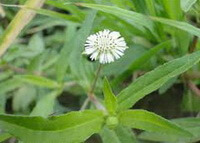
Capitula (flower heads) are terminal or axillary. The general involucre is campanulate (bell-shaped), comprising 5–6 phyllaries (involucral bracts). The receptacle is flat, bearing a few ligulate flowers and numerous tubular flowers. Ligulate flowers are staminate (male), with white corollas that may be fertile or sterile; tubular flowers are hermaphroditic, yellowish-green, and fertile.
Achenes are black-and-yellow (not “yellow-and-black”), approximately 3 mm long, and lack a pappus. Flowering occurs from July to September; fruiting from September to October.
Ecological Environment: Eclipta prostrata L. grows in fields, along roadsides, on stream banks, and in wetlands. It is widely distributed across China and throughout tropical and subtropical regions worldwide.
The species thrives in moist habitats—including roadsides, field margins, pond edges, riverbanks, wet paddy fields, and abandoned rice paddies—often co-occurring with Portulaca oleracea, Hedyotis diffusa, and Leptochloa chinensis. It exhibits strong shade tolerance and grows well on damp soil but is drought-intolerant; plants become stunted and underdeveloped in slightly dry conditions. In the wild, flowering occurs from May to August; seeds mature 20–30 days after flowering, and the entire plant senesces and disintegrates naturally. Under cultivation, seedlings develop over 1–2 months; flowering begins 20–30 days after transplanting, fruiting requires 15–20 days, and the flowering period extends to approximately one month—after which the plant withers.
Growth Characteristics: Eclipta prostrata prefers a warm, humid climate and tolerates shade and moisture. For cultivation, moist, loose, fertile, humus-rich sandy loam or loam soils are recommended.
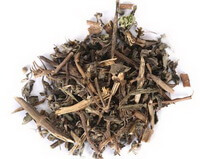
Characteristics of the Herb: The whole herb, with or without roots, is covered with white, coarse hairs. The root is fibrous and 5–10 cm long. The stem is cylindrical and many-branched, 2–7 mm in diameter; its surface is celadon (sage green or grayish green) or slightly purplish, with longitudinal ridges. The texture of the herb is crisp and easily broken; the fracture surface is yellow-white, with a white, loose pith at the center, and sometimes hollow. The leaves are opposite, mostly curled or fragmented, dark green to blackish green; intact leaves, when flattened, are lanceolate, 3–10 cm long and 0.5–2.5 cm wide, with entire or slightly serrulate margins and subsessile attachment. Capitula (flower heads) are solitary and grow at the ends of branches, 6–11 mm in diameter; the peduncle is slender and elongated; there are 5–6 involucral bracts, yellow-green or tan (chocolate brown); the corolla is mostly absent. Achenes are oblate-elliptic, brown, and bear tubercular protrusions on the surface. The herb has a slight fragrance, a mild taste, and is slightly salty and astringent.
Pharmacological Actions: (1) Hemostasis (stanching bleeding); (2) Cardiovascular effects; (3) Effects on the central nervous system; (4) Antibacterial effects.
Medicinal Efficacy: Nourishes the liver and kidney, nourishes yin, cools the blood, and stops bleeding. It is indicated for deficiency of the liver and kidney, loosening of teeth, premature graying of hair, dizziness and blurred vision, vertigo and tinnitus, soreness and pain in the lower back and knees, yin deficiency with blood-heat, hematemesis (vomiting blood), hemoptysis (coughing up blood), epistaxis (nasal bleeding or bleeding from the orifices or subcutaneous tissue), hematuria (blood in urine), hematochezia (passage of blood in stool), bloody dysentery, uterine bleeding, diphtheria, strangury with turbid discharge, pathological leukorrhea, vulvar dampness and itching, traumatic bleeding, and bleeding from incised wounds.
Administration of Herba Ecliptae (Mò Hàn Lián):
Reference:
Administration Guide for Herba Ecliptae (Mò Hàn Lián)
TCM Books:
(1) Internally: 6–12 grams. Externally: fresh herb, appropriate amount. (2) Internally: water decoction, 0.3–1 liang (≈9–30 grams); also prepared as paste, juice, pills, or powder. Externally: mashed and applied topically; powdered herb sprinkled on lesions; or inserted into the nasal cavity. (3) Internally: water decoction, 9–30 grams; also prepared as paste, juice, pills, or powder. Externally: appropriate amount, mashed and applied topically; inserted into the nasal cavity; or finely powdered herb applied topically.
Article Link:
URL QR code:
References:
1.Introduction of Mo Han Lian: Eclipta, Yerba-de-tajo Herb

 ✵The article records the herb Eclipta (Yerba-de-tajo Herb)—its English name, Latin name, Pinyin name, property and flavor, and its botanical source: one plant species, Eclipta prostrata L. It provides a detailed introduction to the botanical features, growth characteristics, and ecological environment of this plant species; the characteristics of the herb; its pharmacological actions, medicinal efficacy, and administration guidelines.
 Pinyin Name: Mò Hàn Lián
 Botanical Source: Classical herbal works define Herba Ecliptae (Mò Hàn Lián), also known as Yerba-de-tajo Herb, as the dried aerial part (above-ground portion) or dried whole plant of Eclipta prostrata L.. It is a member of the genus Eclipta, family Asteraceae (aster or daisy family), order Asterales (formerly in order Campanulales). This commonly used species is introduced below:
 Botanical Description: Eclipta prostrata (L.) L. is an annual herb of the genus Eclipta, family Asteraceae. Synonyms include Eclipta alba (L.) Haussk. and Verbesina prostrata L. It is commonly known as eclipta, yerba-de-tajo herb, or Lǐ Cháng. Plants grow 10–60 cm tall. The entire plant is covered with white, coarse hairs; when broken, the sap exudes and turns blue-black within several minutes. Stems are erect, or the base is obliquely ascending or procumbent—touching the ground and producing adventitious roots—and are green or reddish-brown. Leaves are opposite; leaf blades are linear-ovate to lanceolate, sessile or shortly petiolate, 3–10 cm long and 0.5–2.5 cm wide, with entire or finely serrated margins; both surfaces bear white, coarse hairs.
 Capitula (flower heads) are terminal or axillary. The general involucre is campanulate (bell-shaped), comprising 5–6 phyllaries (involucral bracts). The receptacle is flat, bearing a few ligulate flowers and numerous tubular flowers. Ligulate flowers are staminate (male), with white corollas that may be fertile or sterile; tubular flowers are hermaphroditic, yellowish-green, and fertile.
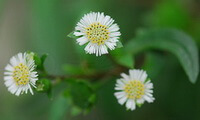 Ecological Environment: Eclipta prostrata L. grows in fields, along roadsides, on stream banks, and in wetlands. It is widely distributed across China and throughout tropical and subtropical regions worldwide.
 Growth Characteristics: Eclipta prostrata prefers a warm, humid climate and tolerates shade and moisture. For cultivation, moist, loose, fertile, humus-rich sandy loam or loam soils are recommended.
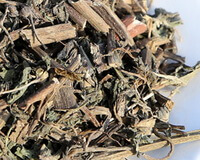 Characteristics of the Herb: The whole herb, with or without roots, is covered with white, coarse hairs. The root is fibrous and 5–10 cm long. The stem is cylindrical and many-branched, 2–7 mm in diameter; its surface is celadon (sage green or grayish green) or slightly purplish, with longitudinal ridges. The texture of the herb is crisp and easily broken; the fracture surface is yellow-white, with a white, loose pith at the center, and sometimes hollow. The leaves are opposite, mostly curled or fragmented, dark green to blackish green; intact leaves, when flattened, are lanceolate, 3–10 cm long and 0.5–2.5 cm wide, with entire or slightly serrulate margins and subsessile attachment. Capitula (flower heads) are solitary and grow at the ends of branches, 6–11 mm in diameter; the peduncle is slender and elongated; there are 5–6 involucral bracts, yellow-green or tan (chocolate brown); the corolla is mostly absent. Achenes are oblate-elliptic, brown, and bear tubercular protrusions on the surface. The herb has a slight fragrance, a mild taste, and is slightly salty and astringent.
 URL QR code: