Introduction: Sit still for half an hour after finishing your meal, listen to pure and fresh music, and close your eyes to rest your mind. This practice not only relaxes your mood but also aids digestion—it is a beneficial habit that allows one to enjoy music and promote health.
Ancient and modern enlightenments: Sun Simiao, a great medical scientist of the Tang Dynasty, once proposed postprandial health principles: “After each meal, rub your face and abdomen with your hands to facilitate the flow of body fluids. After eating, take a gentle walk… Rub your abdomen hundreds of times with your hands and chew your teeth 36 times… Then food is easily digested and greatly benefits the body; people can eat well and remain free from disease… Eat and then rest… Undigested food leads to illness and makes you sick.”
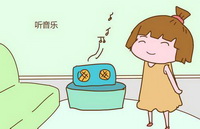
Listen to music after dinner.
Ancient texts such as Shou Shi Bao Yuan (Longevity and Health Preservation) state: “The spleen delights in music; hearing sound stimulates its function of transforming and transporting food.” Ancient medical compendium Yi Fang Lei Ju (Medical Prescriptions in Categories) records: “The spleen delights in music; upon hearing the playing of stringed and bamboo instruments, the spleen becomes active in digestion.” Taoist tradition likewise holds that “the spleen perceives music and thereby enhances food transformation.” In daily language, we often describe pleasant music as “refreshing”—a reflection of the close relationship between music and spleen function.
In traditional cultures both East and West, music is closely linked to medicine. For example, the ancient Greek god of healing was depicted holding a harp, and Apollo—the sun god—was simultaneously the deity of music and healing.
In ancient China, music was considered a recreational therapy that could cultivate morality, improve health, and extend life. As early as the Spring and Autumn Annals of Lu Shi Chun Qiu during the Qin Dynasty, music was proposed as a means of "harmonizing the mind" and "fitting the movement" of medical aesthetics. According to Chinese medicine, "the sky has five tones and people have five Zang viscera; the sky has six rhythms and people have six Fu viscera." In the ancient works Huangdi Neijing (Yellow Emperor's Inner Canon), the five sounds of gong, shang, jiao, zheng, and yu are attributed to the spleen, lungs, liver, heart, and kidneys. It is also stated that these sounds can regulate the flow of qi, the growth of the zang and fu viscera, and the cultivation of consciousness. Scholars of health care such as Zhuang Zi and Ji Kang all understood the rules of music.
The heart is fire, and the spleen is earth. According to the five elements of the law of generation, "fire produces earth," so the heart affects the spleen and stomach. The ancient work The Book of Jin points out: "Hearing the palace voice makes a person gentle and lenient." Listening to soft, fresh music can complement eating. Enjoying music after dinner can improve one's temperament, restore one's primordial Qi, and bring joy while alleviating worry.
You should not take a shower, go to bed, read a book, work at a desk, or sing karaoke immediately after a meal. You also should not drive. Rinse your mouth after meals, but don't brush your teeth right away to avoid damaging the soft enamel. If you're thirsty or choking, drink water, but don't drink tea, smoke, eat fruit, or drink anything cold. All of these can interfere with digestion. Also, do not loosen your pants belt; it can cause gastric sagging! Right now, sit down comfortably with your palm on your abdomen, with your navel as the center. Slowly and gently massage in a clockwise and counterclockwise direction for 20 turns. While massaging, close your eyes and listen to some music. The music should be thick and deep with a slow rhythm and an infectious beat. The volume, audio, and timbre should be harmonious. Avoid percussion and rock and roll because their lively, sonorous, and powerful rhythm can make your heart beat faster and excite your mood, which can affect your appetite and hinder digestion. Also, avoid sad music.
The Benefits of Listening to Music After Meals
✵1. Promote Digestion: From the perspective of modern medicine, wonderful music enters the human body through the auditory system and induces subtle, harmonious resonance. Meanwhile, gentle, light, and beautiful music serves as a positive stimulus that acts via the central nervous system to regulate blood flow, improve circulation, enhance heart, brain, liver, and kidney function, increase gastric and intestinal motility, stimulate digestive gland secretion, and boost metabolism.
✵2. Therapeutic Fitness: In 1972, the Polish government established the first “Music Therapy Research Institute” upon the recommendation of several pathologists and music scientists—a measure proven highly effective. The “prescription” prescribed by physicians was Bach’s music recordings, administered three times daily, specifically after meals. Patients suffering from chronic nervous gastritis experienced timely recovery through consistent musical listening. Soon, hospitals in other countries adopted this music-based therapeutic approach: listening to music three times daily alleviates nervous gastritis; hypertensive patients who listen to lyrical music experience reduced blood pressure; and frightened individuals who listen to soft, relaxing music gradually calm down and regain normal physiological and psychological function.
✵3. Weight Management and Slimming: Studies show that listening to light music can reduce appetite by approximately 20%. Since soft, slow music promotes relaxation and slows the pace of eating, the first portion of food consumed begins digesting before additional food is ingested—causing blood sugar levels to rise earlier. As a result, the brain’s satiety center signals fullness before excessive intake occurs.
✵Tips: Listen to music after meals—but avoid watching TV simultaneously, as it may impair digestion.

 Introduction: Sit still for half an hour after finishing your meal, listen to pure and fresh music, and close your eyes to rest your mind. This practice not only relaxes your mood but also aids digestion—it is a beneficial habit that allows one to enjoy music and promote health.
 Ancient texts such as Shou Shi Bao Yuan (Longevity and Health Preservation) state: “The spleen delights in music; hearing sound stimulates its function of transforming and transporting food.” Ancient medical compendium Yi Fang Lei Ju (Medical Prescriptions in Categories) records: “The spleen delights in music; upon hearing the playing of stringed and bamboo instruments, the spleen becomes active in digestion.” Taoist tradition likewise holds that “the spleen perceives music and thereby enhances food transformation.” In daily language, we often describe pleasant music as “refreshing”—a reflection of the close relationship between music and spleen function.
 In ancient China, music was considered a recreational therapy that could cultivate morality, improve health, and extend life. As early as the Spring and Autumn Annals of Lu Shi Chun Qiu during the Qin Dynasty, music was proposed as a means of "harmonizing the mind" and "fitting the movement" of medical aesthetics. According to Chinese medicine, "the sky has five tones and people have five Zang viscera; the sky has six rhythms and people have six Fu viscera." In the ancient works Huangdi Neijing (Yellow Emperor's Inner Canon), the five sounds of gong, shang, jiao, zheng, and yu are attributed to the spleen, lungs, liver, heart, and kidneys. It is also stated that these sounds can regulate the flow of qi, the growth of the zang and fu viscera, and the cultivation of consciousness. Scholars of health care such as Zhuang Zi and Ji Kang all understood the rules of music.
 The heart is fire, and the spleen is earth. According to the five elements of the law of generation, "fire produces earth," so the heart affects the spleen and stomach. The ancient work The Book of Jin points out: "Hearing the palace voice makes a person gentle and lenient." Listening to soft, fresh music can complement eating. Enjoying music after dinner can improve one's temperament, restore one's primordial Qi, and bring joy while alleviating worry.
 ✵1. Promote Digestion: From the perspective of modern medicine, wonderful music enters the human body through the auditory system and induces subtle, harmonious resonance. Meanwhile, gentle, light, and beautiful music serves as a positive stimulus that acts via the central nervous system to regulate blood flow, improve circulation, enhance heart, brain, liver, and kidney function, increase gastric and intestinal motility, stimulate digestive gland secretion, and boost metabolism.
