✵The article documents the herb Chinese Tamarisk Twig—including its English name, Latin name, Pinyin name, properties and flavor, botanical source —one plant species: Tamarix chinensis Lour., with a detailed description of the plant’s botanical features, growth characteristics, ecological environment, characteristics of the herb, pharmacological actions, medicinal efficacy, and administration guidelines.
Cacumen Tamaricis (Chinese Tamarisk Twig)
Pinyin Name: Xī Hé Liǔ
English Name: Chinese Tamarisk Twig
Latin Name:Cacumen Tamaricis Properties and Flavor: Neutral; pungent and sweet
Brief Introduction:Cacumen Tamaricis is the dried young green twigs and leaves of Tamarix chinensis Lour., used to promote eruption in measles and to alleviate arthralgia in rheumatism. Commonly known as Cacumen Tamaricis, Chinese Tamarisk Twig, or Xī Hé Liǔ.
Botanical Source:Cacumen Tamaricis (Chinese Tamarisk Twig) is the dried young green twigs and leaves of Tamarix chinensis Lour., a plant of the genus Tamarix L., family Tamaricaceae (tamarisk family), order Caryophyllales. Also known as Chinese tamarisk.
Herbal classical works define Cacumen Tamaricis (Chinese Tamarisk Twig) as the dried young green twigs and leaves of (1) Tamarix chinensis Lour. This commonly used species is described below:
(1) Tamarix chinensis Lour.
Botanical Description:Tamarix chinensis Lour. is also known as Tamarix juniperina Bunge. It is commonly called tamarisk willow or Xī Hé Liǔ ("est River Willow"). A deciduous shrub or small tree, growing up to 3–6 m tall. Young branches are soft and flexible, pendulous, reddish-violet or dark purple. Leaves are scale-like, subulate or ovate-lanceolate, 1–3 mm long, semiconnate; the abaxial surface bears keel-shaped structures (keels). It blooms two to three times annually: lateral racemes develop on last year’s branchlets in spring, bearing relatively larger and sparser flowers; in summer and autumn, terminal panicles form on the current year’s young branches—usually reflexed downward—with smaller, denser flowers, each subtended by a linear, subulate, green bractlet. Flowers are pink-red (5 per cluster); sepals are oval; petals are ellipsoid-ovoid, ~2 mm long; stamens are inserted on the lobes of the floral disc and longer than the petals; the ovary is ellipsoid-doleiform, with three clavate styles. The capsule fruit is ~3.5 mm long and trilobed. Flowering occurs from April to September; fruiting from June to October.
Growth Characteristics: The plant grows on riverbank alluvial soils, seashores, coastal beaches, humid alkaline soils, and sandy wastelands.
It exhibits strong environmental adaptability, with no strict requirements for climate or soil. It is tolerant of alkalinity and drought, and thrives in clay loam, sandy loam, and riverside alluvial soils. It is commonly planted along riverbanks, roadsides, ditches, and courtyards.
Characteristics of the Herb: Stems and branches are thin and cylindrical, 0.5–1.5 mm in diameter. Surface is yellow-green; nodes are dense; leaves are scale-like, subulate or ovate-lanceolate, 1–3 mm long; the abaxial surface bears keel-shaped structures (keels). Texture is crisp and easily broken. The fracture surface is yellow-white, with a central pith. Odor is slight; taste is mild or bland.
Young, pre-flowering branch tips are harvested and shade-dried.
Medicinal Efficacy: Expels wind, detoxifies, and promotes eruption; indicated for measles with insufficient eruption, rheumatism, and numbness with pain.
Administration of Cacumen Tamaricis (Xī Hé Liǔ):
Reference:
Administration Guide for Cacumen Tamaricis (Xī Hé Liǔ)
TCM Books:
(1) Internally: 3–6 grams, as a water decoction. Externally: use an appropriate amount—scrub and wash the affected area with the water decoction.
Article Link:
URL QR code:
References:
1.Introduction of Xī Hé Liǔ: Chinese Tamarisk Twig

 ✵The article documents the herb Chinese Tamarisk Twig—including its English name, Latin name, Pinyin name, properties and flavor, botanical source —one plant species: Tamarix chinensis Lour., with a detailed description of the plant’s botanical features, growth characteristics, ecological environment, characteristics of the herb, pharmacological actions, medicinal efficacy, and administration guidelines.
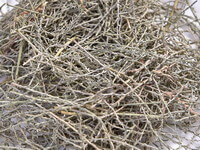 Pinyin Name: Xī Hé Liǔ
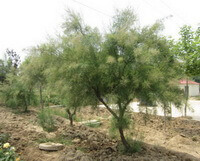 Botanical Description: Tamarix chinensis Lour. is also known as Tamarix juniperina Bunge. It is commonly called tamarisk willow or Xī Hé Liǔ ("est River Willow"). A deciduous shrub or small tree, growing up to 3–6 m tall. Young branches are soft and flexible, pendulous, reddish-violet or dark purple. Leaves are scale-like, subulate or ovate-lanceolate, 1–3 mm long, semiconnate; the abaxial surface bears keel-shaped structures (keels). It blooms two to three times annually: lateral racemes develop on last year’s branchlets in spring, bearing relatively larger and sparser flowers; in summer and autumn, terminal panicles form on the current year’s young branches—usually reflexed downward—with smaller, denser flowers, each subtended by a linear, subulate, green bractlet. Flowers are pink-red (5 per cluster); sepals are oval; petals are ellipsoid-ovoid, ~2 mm long; stamens are inserted on the lobes of the floral disc and longer than the petals; the ovary is ellipsoid-doleiform, with three clavate styles. The capsule fruit is ~3.5 mm long and trilobed. Flowering occurs from April to September; fruiting from June to October.
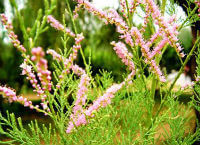 Growth Characteristics: The plant grows on riverbank alluvial soils, seashores, coastal beaches, humid alkaline soils, and sandy wastelands.
 URL QR code: