✵This article documents the herb Fermented Soybean—including its English name, Latin name, Pinyin name, properties and flavor, botanical source—one plant species: Glycine max (L.) Merr., with a detailed description of the plant’s botanical features, growth characteristics, ecological environment, macroscopic and microscopic traits of the processed herb, pharmacological actions, medicinal efficacy, and administration guidelines.
Semen Sojae Preparatum (Fermented Soybean)
Pinyin Name: Dàn Dòu Chǐ
English Name: Fermented Soybean
Latin Name:Semen Sojae Preparatum Properties and Flavor: Neutral; bitter and pungent
Brief Introduction:Semen Sojae Preparatum is the fermented preparation of the ripe seed of Glycine max (L.) Merr. It is used in the early stage of febrile diseases to release the exterior and in the late stage to alleviate restlessness and insomnia. Commonly known as Semen Sojae Preparatum, Fermented Soybean, or Dàn Dòu Chǐ.
Botanical Source:Semen Sojae Preparatum (Fermented Soybean) is the fermented preparation of the ripe seed of Glycine max (L.) Merr., a plant of the genus Glycine Willd., family Fabaceae (Leguminosae, legume or pea family), order Rosales. Also known as soybean.
Herbal classical works define Semen Sojae Preparatum (Fermented Soybean) as the fermented preparation of the ripe seed of (1) Glycine max (L.) Merr. This commonly used species is described below:
(1) Glycine max (L.) Merr.
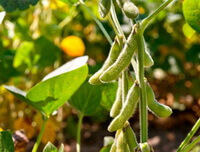
Botanical Description:Glycine max (L.) Merr. is also known as Phaseolus max L. and commonly called soybean. It is an annual, upright herb growing 60–180 cm tall. Stems are stout and densely covered with brown, long, hirsute hairs; petioles are long and densely covered with yellow hirsute hairs; stipules are small and lanceolate; leaves are trifoliolate, with terminal leaflets rhomboid-ovate (7–13 cm long, 3–6 cm wide), acuminate at the apex and broadly cuneate or rounded at the base; both surfaces are white-villous; lateral leaflets are smaller and obliquely ovate; leaf rachis and petiolules are densely yellow-hirsute.
Racemes are axillary; bracts and bracteoles are lanceolate and pilose; calyx is campanulate (bell-shaped), with five lanceolate teeth—the lowest tooth being the longest—and all densely white-villous; corolla is small, white or mauve (lilac), slightly longer than the calyx; the apex of the vexillum is slightly concave; petals include one auricle; keel petals are falciform; stamens are ten, diadelphous; ovary is linear and pilose.
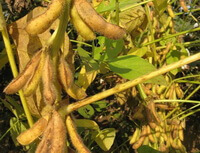
Pods are oblong-band-shaped, slightly curved, pendulous, yellow-green, and densely covered with yellow hirsute hairs. Each pod contains 2–5 seeds—yellow-green or black, ovate to subsphaeroidal, ~1 cm long. Flowering occurs from June to July; fruiting from August to October.
Ecological Environment: The plant is widely distributed and cultivated throughout China and many other regions worldwide.
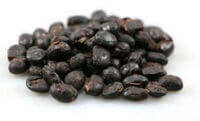
Trait Identification: The bean is elliptic and slightly flattened, 0.6–1 cm long and 0.5–0.7 cm in diameter. Surface is black, wrinkled and uneven, dull; one side bears a brown, stripe-like hilum; the micropyle is inconspicuous. Two cotyledons are thickened, soft; cross-section appears brown to black. Odor is slight; taste is mildly sweet. Higher-grade herb is large, plump, and dark-colored.
Growth Characteristics: The plant requires abundant sunlight and sufficient nitrogen, phosphorus, and potassium. Soybean seeds germinate only when water absorption reaches ≥5%; soil moisture must be adequate at sowing, with field moisture content not less than 60%.
Characteristics of the Herb: Fermented Soybean is elliptical, slightly flattened, 0.6–1 cm long, and 0.5–0.7 cm in diameter. The surface is black, slightly shiny, sometimes vertically wrinkled and uneven, with a long-oval hilum on one side. The seed coat (testa) is thin; the internal surface is gray-yellow. After removal of the seed coat, two cotyledons are exposed—yellow-green, thick, and succulent. The texture is slightly soft or brittle; the fracture surface (cross-section) is brown to black. The odor is aromatic, and the taste is mildly sweet.
Medicinal Efficacy: Releases the exterior, alleviates restlessness, clears stagnant heat; indicated for wind-cold or wind-heat exterior syndromes, headache, irritability, chest tightness, dysphoria, and insomnia.
Administration of Semen Sojae Preparatum (Dàn Dòu Chǐ):
Reference:
Administration Guide for Semen Sojae Preparatum (Dàn Dòu Chǐ)
TCM Books:
(1) Internally: 6–12 grams; (2) as a water decoction, 2–4 qián (≈6–12 g), or prepared into pills or powder. Externally: apply mashed herb topically, or stir-bake until browned, then grind into fine powder and apply as a paste. (3) 5–15 grams, water decoction—or prepared into pills or powder. Externally: use an appropriate amount—apply mashed herb topically, or stir-bake until browned, grind into fine powder, and apply as a paste.

 ✵This article documents the herb Fermented Soybean—including its English name, Latin name, Pinyin name, properties and flavor, botanical source—one plant species: Glycine max (L.) Merr., with a detailed description of the plant’s botanical features, growth characteristics, ecological environment, macroscopic and microscopic traits of the processed herb, pharmacological actions, medicinal efficacy, and administration guidelines.
 Pinyin Name: Dàn Dòu Chǐ
 Botanical Description: Glycine max (L.) Merr. is also known as Phaseolus max L. and commonly called soybean. It is an annual, upright herb growing 60–180 cm tall. Stems are stout and densely covered with brown, long, hirsute hairs; petioles are long and densely covered with yellow hirsute hairs; stipules are small and lanceolate; leaves are trifoliolate, with terminal leaflets rhomboid-ovate (7–13 cm long, 3–6 cm wide), acuminate at the apex and broadly cuneate or rounded at the base; both surfaces are white-villous; lateral leaflets are smaller and obliquely ovate; leaf rachis and petiolules are densely yellow-hirsute.
 Ecological Environment: The plant is widely distributed and cultivated throughout China and many other regions worldwide.
 URL QR code: