✵The article provides records of the herb Common Duckweed Herb, including its English name, Latin name, Pinyin name, properties and flavor, and its botanical sources—two plant species: (1) Spirodela polyrrhiza (L.) Schleiden, and (2) Lemna minor L. It offers a detailed introduction to the botanical features, growth characteristics, and ecological environments of these two plants; the characteristics of the herb Common Duckweed Herb; its pharmacological actions; medicinal efficacy; and administration guidelines.
Herba Spirodelae (Common Duckweed Herb)
Pinyin Name: Fú Pínɡ
English Name: Common Duckweed Herb, Duckweed
Latin Name:Herba Spirodelae Properties and Flavor: Cold, pungent
Brief Introduction:Herba Spirodelae is the dried whole plant of Spirodela polyrrhiza (L.) Schleiden. It is used to promote measles eruption, relieve itching in urticaria, and induce diuresis in edema.
Botanical Source:Herba Spirodelae (Common Duckweed Herb) is the dried whole plant of Spirodela polyrrhiza (L.) Schleiden, a member of the genus Lemna L., family Lemnaceae (commonly known as the duckweed family), order Arales. It is also known as Herba Spirodelae, Common Duckweed Herb, and Fu Ping.
Classical herbal works define Herba Spirodelae (Common Duckweed Herb) as the dried whole plant of: (1) Spirodela polyrrhiza (L.) Schleiden, or (2) Lemna minor L. These two commonly used species are described below:
(1) Spirodela polyrrhiza (L.) Schleiden
Botanical Description:Spirodela polyrrhiza (L.) Schleiden is also known as Lemna polyrrhiza L. It is commonly called Zǐ Píng or purple duckweed—a perennial, minute floating herb. It bears 5–11 roots in fascicles; the roots are slender, fibrous, and 3–5 cm long. New fronds arise from one side of the root base, connected to the parent by a thin stalk before detaching. The thallus is flat, solitary or clustered in groups of 2–5, broadly obovate, 4–10 mm long and 4–6 mm wide, with a blunt apex; the upper surface is slightly concave and dark green; the lower surface is purplish, bearing 5–11 inconspicuous palmate veins.
Inflorescences develop within the marginal indentations of the thalli. Flowers are unisexual and monoecious. The spathe is sac-like, short and small, bilabiate (two-lipped), enclosing two male flowers and one female flower; the perianth is absent. Each male flower has two stamens; the anthers are bilocular; the filaments are extremely slender. The female flower has one pistil; the ovary is sessile, unilocular, with two erect ovules; the style is short; the stigma is flat or annular. The fruit is spherical, with a winged margin. Flowering occurs from April to June; fruiting from May to July.
Ecological Environment: This plant grows in marshes, paddy fields, bays, and still waters.
Growth Characteristics: It prefers warm, moist climates and avoids severe cold and freezing conditions. Cultivation is best carried out in paddy fields, ponds, and lakes.
Characteristics of the Herb: The thallus is oval, ovoid, or ovate-elliptic, with a major diameter of 3–6 mm. Thalli occur singly or in clusters of 2–5. The upper surface is light green to gray-green, with smooth or slightly curled margins. The lower surface is purple-green to purple-brown, with orderly or slightly curled margins and small concavities on both sides of the upper surface; several fibrous roots emerge from the lower surface. The herb is lightweight and brittle when twisted by hand. It has a faint odor and a mild taste.
The herb is harvested from June to September, scooped from water, freed from impurities, washed thoroughly, and sun-dried.
Pharmacological Actions: (1) Cardiovascular effects; (2) Antipyretic effects; (3) Other effects: larvicidal activity against Culex pipiens larvae and mosquito pupae, demonstrated both in laboratory and field settings.
Medicinal efficacy: Promotes diaphoresis and resolves exterior syndromes; induces diuresis and reduces swelling; clears heat and detoxifies. It is indicated for wind-heat exterior syndrome; measles with incomplete eruption; urticaria (hidden rashes) and pruritus; edema and oliguria; urinary retention (difficulty in urination); skin ulcers and tinea; erysipelas (an acute inflammatory skin infection characterized by redness and swelling); scalds and burns.
Administration of Herba Spirodelae (Fú Pínɡ):
Reference:
Administration Guide for Herba Spirodelae (Fú Pínɡ)
TCM Books:
(1) Internally: 3–9 grams; externally: appropriate amount, used as a fumigation wash with water decoction. (2) water decoction, 1–2 qián (≈3–6 grams); fresh herb: 0.5–1 liǎng (≈15–30 g); may be used fresh to extract juice or processed into pills or powder. Externally: fumigation wash of the affected area with water decoction; or finely ground herb powder applied topically. (3) water decoction, 3–9 grams; fresh herb dosage: 15–30 g; may be used fresh to extract juice or processed into pills or powder. Externally: fumigation wash of the affected area with water decoction; or finely ground herb powder applied topically.
(2) Lemna minor L.
Botanical Description:Lemna minor L. is also known as Fú Pínɡ or duckweed—a small floating herb. It bears a single root, 3–4 cm long, thin and slender; the root sheath is wingless; the pileorhiza (root cap) is obtuse or truncate. The thallus is symmetrical, obovate, elliptic, or subcircular, 1.5–6 mm long and 2–3 mm wide. The upper surface is smooth, green, and opaque; the lower surface is light yellow or purplish, entire, and bears three inconspicuous veins. A capsule occurs on one side of the lower surface; the new thallus emerges from this capsule, floats free, and remains briefly connected to the mother thallus by a very short, thin stalk before detaching. Flowers are unisexual and monoecious, grow at the lobulated margins of the thallus. The spathe is wing-like, enclosing one pistillate flower and two staminate flowers. Male anthers are bilocular; filaments are slender. The pistillate flower has one pistil; the ovary is unilocular, containing a single curved ovule. The fruit is subturbinate and wingless, containing one seed with a raised endosperm and 12–15 irregularly convex veins.
Ecological Environment: This plant grows in ponds, paddy fields, lakes, or other still waters—and often co-occurs with purple duckweed (Spirodela polyrrhiza).
Growth Characteristics: It prefers warm, moist climates and avoids severe cold and freezing conditions. Cultivation is best carried out in paddy fields, ponds, and lakes.

 ✵The article provides records of the herb Common Duckweed Herb, including its English name, Latin name, Pinyin name, properties and flavor, and its botanical sources—two plant species: (1) Spirodela polyrrhiza (L.) Schleiden, and (2) Lemna minor L. It offers a detailed introduction to the botanical features, growth characteristics, and ecological environments of these two plants; the characteristics of the herb Common Duckweed Herb; its pharmacological actions; medicinal efficacy; and administration guidelines.
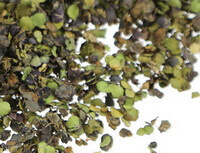 Pinyin Name: Fú Pínɡ
 Botanical Description: Spirodela polyrrhiza (L.) Schleiden is also known as Lemna polyrrhiza L. It is commonly called Zǐ Píng or purple duckweed—a perennial, minute floating herb. It bears 5–11 roots in fascicles; the roots are slender, fibrous, and 3–5 cm long. New fronds arise from one side of the root base, connected to the parent by a thin stalk before detaching. The thallus is flat, solitary or clustered in groups of 2–5, broadly obovate, 4–10 mm long and 4–6 mm wide, with a blunt apex; the upper surface is slightly concave and dark green; the lower surface is purplish, bearing 5–11 inconspicuous palmate veins.
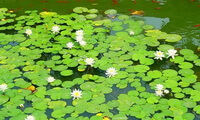 Botanical Description: Lemna minor L. is also known as Fú Pínɡ or duckweed—a small floating herb. It bears a single root, 3–4 cm long, thin and slender; the root sheath is wingless; the pileorhiza (root cap) is obtuse or truncate. The thallus is symmetrical, obovate, elliptic, or subcircular, 1.5–6 mm long and 2–3 mm wide. The upper surface is smooth, green, and opaque; the lower surface is light yellow or purplish, entire, and bears three inconspicuous veins. A capsule occurs on one side of the lower surface; the new thallus emerges from this capsule, floats free, and remains briefly connected to the mother thallus by a very short, thin stalk before detaching. Flowers are unisexual and monoecious, grow at the lobulated margins of the thallus. The spathe is wing-like, enclosing one pistillate flower and two staminate flowers. Male anthers are bilocular; filaments are slender. The pistillate flower has one pistil; the ovary is unilocular, containing a single curved ovule. The fruit is subturbinate and wingless, containing one seed with a raised endosperm and 12–15 irregularly convex veins.
 URL QR code: