✵The article records the herb Cat-tail Pollen, including its English name, Latin name, Pinyin name, property and flavor, botanical sources—as defined in classical herbal texts—namely, two primary species: (1) Typha angustifolia L. and (2) Typha orientalis Presl., as well as two additional acceptable species: (3) Typha latifolia L. and (4) Typha angustata Bory et Chaub. It provides a detailed introduction to the botanical features, growth characteristics, and ecological environments of these four species; the characteristics of the herb Cat-tail Pollen; its pharmacological actions, medicinal efficacy, and administration guidelines.
Pollen Typhae (Cat-tail Pollen)
Pinyin Name: Pú Huánɡ
English Name: Cat-tail Pollen
Latin Name:Pollen Typhae Property and Flavor: Neutral; slightly pungent and sweet
Brief Introduction:Pollen Typhae is the dried pollen of Typha angustifolia L., Typha orientalis Presl., or related species. It is used to invigorate blood circulation, dispel blood stasis, and alleviate pain—particularly in the treatment of dysmenorrhea, postpartum abdominal pain, and gastralgia. It is commonly known as Pollen Typhae, Cat-tail Pollen, or Pú Huánɡ.
Botanical Source: Classical herbal works define Pollen Typhae (Pú Huánɡ) as the dried pollen of (1) Typha angustifolia L. and (2) Typha orientalis Presl. Other authoritative materia medica also accept (3) Typha latifolia L. and (4) Typha angustata Bory et Chaub. These are plants of the genus Typha L., family Typhaceae (commonly referred to as the cattail family), order Typhales. The two primary and two supplementary species are described below:
(1) Typha angustifolia L.
Botanical Description:Typha angustifolia L. is commonly known as Shuǐ Zhú Xiāng Pú or Xiá Yè Xiāng Pú (meaning “narrow-leaf cattail”). A perennial herb, it grows up to 1.5–3 meters tall. Roots are procumbent, with numerous fibrous roots. Leaves are narrowly linear, 5–8 mm wide, rarely up to 10 mm wide.
Flowers are small, unisexual (i.e., separate male and female flowers), and monoecious. Spikes are long-cylindrical and brown. The female and male inflorescences are separate: the male inflorescence is located in the upper part, 20–30 cm long; the female inflorescence is located in the lower part, 9–28 cm long, subtended by phyllaries (leafy bracts) that are caducous. Male flowers have 2–3 stamens; basal hairs are longer than the anthers; the apical tip of the stigma is simple, bifurcated, or trifurcated; pollen grains are solitary. Female flowers bear bracteoles (bractlets) that are spatulate and shorter than the stigma; the indumentum (fuzz) is caducous and approximately equal in length to the bracteoles; the stigma is linear or linear-oblong.
Fruit spikes are 10–15 mm in diameter. The nutlets are minute, smooth (ungrooved), indehiscent, and the epicarp does not separate. Flowering occurs from June to July; fruiting occurs from July to August.
Ecological Environment:Typha angustifolia L. grows in shallow water.
Growth Characteristics:Typha angustifolia prefers a warm, moist climate and a humid environment. It is best cultivated in sunny, fertile locations along pond margins or in shallow water.
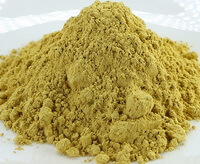
Characteristics of the Herb: The herb is a fine, yellow powder—light in weight and easily airborne. When rubbed between the fingers, it feels lubricating, adheres readily to the skin, and floats on the water surface when sprinkled onto water. It is odorless and has a mild taste.
Pharmacological Actions: (1) inhibition of coagulation and antiplatelet aggregation; (2) hypotensive and hypolipidemic effects, and other vascular actions; (3) anti-inflammatory activity; (4) choleretic effect; (5) bacteriostatic activity, etc.
Medicinal efficacy: Hemostasis (stanching bleeding), promoting blood circulation to remove stasis, relieving stranguria, and promoting diuresis. It is indicated for hematemesis, hemoptysis, epistaxis (nasal bleeding or bleeding from the orifices or subcutaneous tissue), hematochezia, uterine bleeding, traumatic bleeding, cardiac and abdominal pain, epigastric stabbing pain, amenorrhea and dysmenorrhea (including postmenstrual abdominal pain), morbid leukorrhea, bloody stranguria with dysuria and pain (i.e., hematuria-associated stranguria with pain and difficulty in urination), postpartum pain due to stasis and stagnation, “double tongue” (sublingual swelling/inflammation), oral ulcers, contusion-induced swelling and pain, and pruritus vulvae with dampness.
Administration of Pollen Typhae (Pú Huánɡ):
Reference:
Administration Guide of Pollen Typhae (Pú Huánɡ)
TCM Books:
(1) Internally: 5–9 grams, wrapped for decoction; topical: appropriate amount, applied as a paste to the affected area. (2) Internally: water decoction, 1.5–8 qian (≈4.5–24 grams), or prepared as pills or powder; topical: ground herb powder sprinkled or applied as a paste. (3) Internally: water decoction, 5–10 grams, wrapped for decoction, or prepared as pills or powder; topical: appropriate amount, ground herb powder sprinkled or applied as a paste. Raw herb is preferred for activating blood and relieving pain; stir-fried herb is preferred for hemostasis; a combination of raw and stir-fried herb (1:1) is used when both stasis and bleeding are present.
Contraindications, Precautions, and Adverse Reactions: Pollen Typhae should be used with caution during pregnancy. Raw Pollen Typhae is contraindicated in pregnancy.
(2) Typha orientalis Presl.
Botanical Description:Typha orientalis Presl is commonly known as Dōng Fāng Xiāng Pú (meaning “oriental cattail”), a perennial hydrophyte (aquatic plant) or torose plant. Its aerial stems are stout and gradually attenuate upward, reaching 1.3–2 meters in height. Key distinctions from Typha angustifolia include: leaves are linear (strap-shaped), 40–70 cm long and 4–9 mm wide (rarely 5–10 mm wide), smooth and glabrous; the upper surface is flat; the lower (ventral) surface is slightly concave; the abaxial (back) surface is gradually convex and protuberant; the cross-section is semicircular, with large air cavities and spongy texture; the leaf base is sheathing and amplexicaul (stem-clasping).
Spikes are terete (cylindrical); the male and female inflorescences are contiguous (not separate). The male inflorescence occupies the upper portion, measuring 3–5 cm long (up to 9 cm), with the rachis bearing white, curly, pilose hairs; one to three leafy bracts arise from the base upward and are caducous (abscising after flowering). Each male flower bears 2–4 stamens (typically 3); anthers are ~3 mm long, bilocular, and linear; pollen grains are solitary; filaments are very short, with their bases connate to form a short stalk. The female inflorescence occupies the lower portion, measuring 6–15 cm long (up to 15 cm), subtended by a single caducous leafy bract at the base. Female flowers are ebracteolate and bear numerous long, white, basal hairs approximately equal in length to the stigma; the stigma is spatulate; the sterile pistil is clavate. In fertile female flowers, the stigma is spatulate and curved, 0.5–0.8 mm long; the style is 1.2–2 mm long; the ovary is fusiform to lanceolate; the podogynium (gynophore) is slender and delicate, ~2.5 mm long. In sterile female flowers, the ovary is ~1.2 mm long and subconical, with a rounded apex; the sterile style is persistent; white filaments are typically solitary.
The nutlet (nucule) bears a longitudinal groove, is elliptic to oblong-ovate in outline, and exhibits elongated brown spots on the epicarp. Seeds are brown and slightly curved. Flowering and fruiting occur from May to August.
Ecological Environment: The plant grows at watersides or in marshes, along riversides and lake margins, in ditches, and in slow-flowing sections of rivers.
(3) Typha latifolia L.
Botanical Description:Typha latifolia L. is commonly known as Kuān Yè Xiāng Pú (meaning “broad-leaf cattail”), a perennial hydrophyte (aquatic plant). Key distinctions from Typha angustifolia include: rhizomes are creamy-yellow (milky-yellow), with white apices; leaves are broadly linear, 45–95 cm long (occasionally up to 1 m) and 10–15 mm wide, glabrous, glossy, and elongated; the upper surface is flat; the lower surface becomes gradually convex below the mid-point; the apex is acuminate; the base is sheathing and amplexicaul.
Spikes are terete (cylindrical); the male and female inflorescences are tightly contiguous. The male inflorescence is positioned above, measuring 8–15 cm long and thicker than the female inflorescence; the rachis is covered with ash-gray, curly, pilose hairs and bears 1–3 caducous leafy bracts. The female inflorescence is ~10 cm long and ~2 cm in diameter, developing fully after flowering, and bears 2–3 caducous leafy bracts. Male flowers possess 3–4 stamens; pollen grains are arranged in tetrads; anthers are oblong, ~3 mm long; filaments are shorter than the anthers, with bases connate to form a short stalk. Female flowers are ebracteolate and bear numerous long, white, basal hairs. In fertile female flowers, the ovary is lanceolate (~1 mm long); the podogynium (gynophore) is ~4 mm long; the style is 2.5–3 mm long; the stigma is lanceolate, 1–1.2 mm long. In sterile female flowers, the ovary is obconical; the podogynium is stout and asymmetric; conspicuous white, thread-like hairs are markedly shorter than the style.
Fruit spikes are thick; nutlets (nucules) are minute, 1–1.2 mm long, lanceolate, and often dehisce (split open) upon contact with water; the epicarp separates readily; the brown epicarp is typically eguttulate (unspotted). Seeds are brown, elliptic, and less than 1 mm long. Flowering and fruiting occur from May to August.
Ecological Environment: The plant grows along riverbanks, in ponds and marshes, around lakes and ditches, in shallow, tranquil-flow sections of rivers, and on shallow-water beaches in arid regions.
(4) Typha angustata Bory et Chaub.
Botanical Description:Typha angustata Bory et Chaub. is commonly known as Cháng Bāo Xiāng Pú, a perennial hydrophyte (aquatic plant) or torose plant. Key distinguishing features from the aforementioned species include: rhizomes are stout and creamy-yellow (milky-yellow), with white apices; leaves are linear (strap-shaped), 0.4–1.5 meters long and 6–15 mm wide; the upper surface is flat; the lower surface becomes gradually convex below the mid-point; the leaf base is sheathing and amplexicaul; leaf sheaths are elongated.
Spikes are terete (cylindrical) and stout; male and female inflorescences may each reach up to 50 cm in length, but they are distinctly separated. The male inflorescence is positioned above, measuring 20–30 cm long; the rachis is covered with curly, pilose hairs and bears one or two caducous leafy bracts (~32 cm long and ~8 mm wide). Male flowers possess two or three stamens; basal hairs exceed the anthers in length; anthers are oblong, 1.2–1.5 mm long; filament bases are connate to form a short stalk; pollen grains are solitary. The female inflorescence is positioned below and is shorter than the male inflorescence, measuring 4.7–23 cm long; it bears a single caducous leafy bract broader than the leaf blade. Female flowers bear bracteoles approximately equal in length to the stigma; the stigma is broadly linear to lanceolate; both bracteoles and stigma exceed the hairs in length. In fertile female flowers, the ovary is lanceolate (~1 mm long); the podogynium (gynophore) measures 3–6 mm long; the style is 0.5–1.5 mm long; the stigma is broadly linear or lanceolate, 1–1.2 mm long, and wider than the style. In sterile female flowers, the ovary is nearly obconical; numerous white, thread-like hairs arise from the base of the podogynium and are shorter than the stigma.
Nutlets (nucules) are ungrooved, fusiform (spindle-shaped), ~1.2 mm long, dehiscent along a longitudinal suture, and bear elongated brown spots on the epicarp. Seeds are tawny (yellowish-brown), ~1 mm long. Flowering and fruiting occur from June to August.
Ecological Environment: The plant grows in marshes and shallow-water zones of ponds, lakes, and rivers; along watersides; and is commonly found in canals and ditches.
Brief Introduction:Pollen Typhae Carbonisatum is used as a hemostatic herb that also promotes blood circulation to remove stasis.
✵Pollen Typhae Carbonisatum is the carbonized residue obtained by traditional processing of Pollen Typhae. Its botanical origin is identical to that of Pollen Typhae, as described in the preceding entry “Pollen Typhae (Cattail Pollen)”.

 ✵The article records the herb Cat-tail Pollen, including its English name, Latin name, Pinyin name, property and flavor, botanical sources—as defined in classical herbal texts—namely, two primary species: (1) Typha angustifolia L. and (2) Typha orientalis Presl., as well as two additional acceptable species: (3) Typha latifolia L. and (4) Typha angustata Bory et Chaub. It provides a detailed introduction to the botanical features, growth characteristics, and ecological environments of these four species; the characteristics of the herb Cat-tail Pollen; its pharmacological actions, medicinal efficacy, and administration guidelines.
 Pinyin Name: Pú Huánɡ
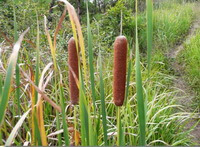 Botanical Description: Typha angustifolia L. is commonly known as Shuǐ Zhú Xiāng Pú or Xiá Yè Xiāng Pú (meaning “narrow-leaf cattail”). A perennial herb, it grows up to 1.5–3 meters tall. Roots are procumbent, with numerous fibrous roots. Leaves are narrowly linear, 5–8 mm wide, rarely up to 10 mm wide.
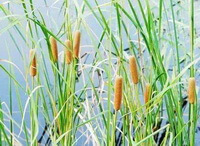 Ecological Environment: Typha angustifolia L. grows in shallow water.
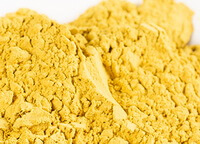 Characteristics of the Herb: The herb is a fine, yellow powder—light in weight and easily airborne. When rubbed between the fingers, it feels lubricating, adheres readily to the skin, and floats on the water surface when sprinkled onto water. It is odorless and has a mild taste.
 Botanical Description: Typha orientalis Presl is commonly known as Dōng Fāng Xiāng Pú (meaning “oriental cattail”), a perennial hydrophyte (aquatic plant) or torose plant. Its aerial stems are stout and gradually attenuate upward, reaching 1.3–2 meters in height. Key distinctions from Typha angustifolia include: leaves are linear (strap-shaped), 40–70 cm long and 4–9 mm wide (rarely 5–10 mm wide), smooth and glabrous; the upper surface is flat; the lower (ventral) surface is slightly concave; the abaxial (back) surface is gradually convex and protuberant; the cross-section is semicircular, with large air cavities and spongy texture; the leaf base is sheathing and amplexicaul (stem-clasping).
 The nutlet (nucule) bears a longitudinal groove, is elliptic to oblong-ovate in outline, and exhibits elongated brown spots on the epicarp. Seeds are brown and slightly curved. Flowering and fruiting occur from May to August.
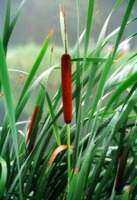 Botanical Description: Typha latifolia L. is commonly known as Kuān Yè Xiāng Pú (meaning “broad-leaf cattail”), a perennial hydrophyte (aquatic plant). Key distinctions from Typha angustifolia include: rhizomes are creamy-yellow (milky-yellow), with white apices; leaves are broadly linear, 45–95 cm long (occasionally up to 1 m) and 10–15 mm wide, glabrous, glossy, and elongated; the upper surface is flat; the lower surface becomes gradually convex below the mid-point; the apex is acuminate; the base is sheathing and amplexicaul.
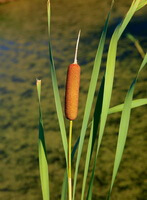 Fruit spikes are thick; nutlets (nucules) are minute, 1–1.2 mm long, lanceolate, and often dehisce (split open) upon contact with water; the epicarp separates readily; the brown epicarp is typically eguttulate (unspotted). Seeds are brown, elliptic, and less than 1 mm long. Flowering and fruiting occur from May to August.
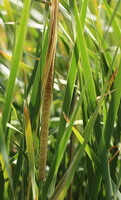 Botanical Description: Typha angustata Bory et Chaub. is commonly known as Cháng Bāo Xiāng Pú, a perennial hydrophyte (aquatic plant) or torose plant. Key distinguishing features from the aforementioned species include: rhizomes are stout and creamy-yellow (milky-yellow), with white apices; leaves are linear (strap-shaped), 0.4–1.5 meters long and 6–15 mm wide; the upper surface is flat; the lower surface becomes gradually convex below the mid-point; the leaf base is sheathing and amplexicaul; leaf sheaths are elongated.
 Nutlets (nucules) are ungrooved, fusiform (spindle-shaped), ~1.2 mm long, dehiscent along a longitudinal suture, and bear elongated brown spots on the epicarp. Seeds are tawny (yellowish-brown), ~1 mm long. Flowering and fruiting occur from June to August.
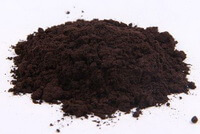 Brief Introduction: Pollen Typhae Carbonisatum is used as a hemostatic herb that also promotes blood circulation to remove stasis.
 URL QR code: