✵The article records the herb Plum Flower—including its English name, Latin name, Pinyin name, properties and flavor—and identifies its botanical source as a single plant species: (1) Prunus mume Sieb. et Zucc. It provides a detailed introduction to the botanical features, growth characteristics, and ecological environment of this plant species, as well as the characteristics of the herbal material Plum Flower, its pharmacological actions, medicinal efficacy, and administration guidelines.
Flos Mume (Plum Flower)
Pinyin Name: Méi Huā
English Name: Plum Flower
Latin Name:Flos Mume Properties and Flavor: Cool, bitter, slightly sweet, slightly sour
Brief Introduction: The herb Flos Mume consists of the dried flower buds of Prunus mume Sieb. et Zucc. (family Rosaceae). It is used to regulate Qi, calm the mind, and resolve phlegm—indicated for depression, restlessness, hypochondriac and epigastric pain, and globus hystericus. It is commonly known as Flos Mume, Plum Flower, or Méi Huā.
Botanical Source: Classical herbal works define Flos Mume (Plum Flower) as the dried flower buds of Prunus mume Sieb. et Zucc. It is a plant belonging to the genus Prunus, family Rosaceae (rose family), order Rosales. The commonly accepted source species is introduced below:
(1) Prunus mume Sieb. et Zucc.
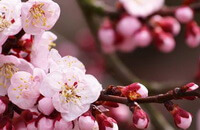
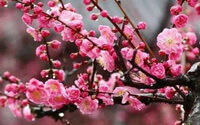
Botanical Description:Prunus mume Sieb. et Zucc. is also known as Armeniaca mume Sieb. The tree is commonly called “mei” (plum blossom). It is a deciduous tree growing up to 4–10 meters tall; its bark is taupe brown (grayish brown) or greenish and smooth; branchlets are green, smooth, and glabrous—thin, long, and acanthous (spinose) at the apex. Leaves are simple and alternate; petioles are about 1.5 cm long and pubescent; stipules (peraphylla) are caducous; leaf blades are broadly elliptic to ovate; flowering occurs before leaf emergence in spring; flowers are fragrant, with 1–3 flowers clustered in the leaf axils of biennial lateral branches.
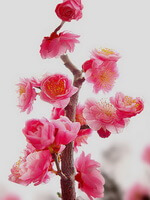
Pedicels (flower stalks) are usually russet (brunneous), though the calyx of some individuals is green or greenish-purple; flowers have five petals, white or faintly pink (rosy), approximately 1.5 cm in diameter and broadly obovate; stamens are numerous.
Fruits are subglobose (nearly spherical), 2–3 cm in diameter, yellow or greenish-white, and pubescent; the fruit stone (endocarp) is circular or rounded, with small protruding tips at the apex; the ventral surface and dorsal ribs bear grooves, and the surface exhibits a honeycomb-like cavity structure. Flowering occurs in late winter to early spring; fruiting takes place from May to June.
Ecological Environment: The tree is cultivated in China.
Growth Characteristics:Prunus mume exhibits strong adaptability and cold tolerance. It prefers a warm, moist climate and requires ample sunlight. Temperature during the flowering stage greatly influences yield: fruit set is markedly reduced when temperatures fall to −5 °C to −6 °C (23 °F to 21.2 °F) or rise above 20 °C (68 °F). The most suitable cultivation regions have an annual mean air temperature of 16–23 °C (60.8–73.4 °F) and average annual precipitation exceeding 1,000 mm. Soil requirements are not stringent; however, deep, loose, fertile, well-drained sandy loam is optimal. The plant is intolerant of waterlogging but drought-tolerant; therefore, low-lying or poorly drained, moisture-retentive soils are unsuitable for cultivation.
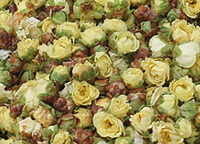
Characteristics of the Herb: The dried flower buds are subspherical (nearly spherical), 3–6 mm in diameter, and bear very short pedicels. Bracts are arranged in several layers, scaly, measuring approximately 3.5 mm in length and 2 mm in width, dark brown, and covered with short hairs. There are five sepals (calyx lobes), broadly ovate, ~4 mm in diameter, celadon (sage green) or brown, and pilose. There are five petals—or sometimes more—broadly ovoid, ~4 mm long and ~5.5 mm wide, yellowish-white. Numerous stamens and one pistil are present; the ovary is embedded in a sunken receptacle, and its surface is densely puberulent. The herb is lightweight, possesses a faint aroma, and tastes slightly bitter and puckering.
Medicinal Efficacy: Promotes the free flow of Qi and regulates the middle jiao (the middle energizer); stimulates appetite and promotes salivation and body fluid secretion; resolves phlegm; detoxifies. Indicated for emotional depression and irritability; epigastric pain due to emotional depression and liver-Qi stagnation invading the stomach; globus hystericus; scrofula (lymph node tuberculosis); skin ulcers, sores, and poison.
Administration of Flos Mume (Méi Huā):
Reference:
Administration Guide for Flos Mume (Méi Huā)
TCM Books:
(1) Internally: 3–5 grams; (2) Internally: water decoction, 2–6 grams; or prepared as pills or powder. External use: fresh herb mashed and applied topically.

 ✵The article records the herb Plum Flower—including its English name, Latin name, Pinyin name, properties and flavor—and identifies its botanical source as a single plant species: (1) Prunus mume Sieb. et Zucc. It provides a detailed introduction to the botanical features, growth characteristics, and ecological environment of this plant species, as well as the characteristics of the herbal material Plum Flower, its pharmacological actions, medicinal efficacy, and administration guidelines.
 Pinyin Name: Méi Huā
 Botanical Source: Classical herbal works define Flos Mume (Plum Flower) as the dried flower buds of Prunus mume Sieb. et Zucc. It is a plant belonging to the genus Prunus, family Rosaceae (rose family), order Rosales. The commonly accepted source species is introduced below:
 Botanical Description: Prunus mume Sieb. et Zucc. is also known as Armeniaca mume Sieb. The tree is commonly called “mei” (plum blossom). It is a deciduous tree growing up to 4–10 meters tall; its bark is taupe brown (grayish brown) or greenish and smooth; branchlets are green, smooth, and glabrous—thin, long, and acanthous (spinose) at the apex. Leaves are simple and alternate; petioles are about 1.5 cm long and pubescent; stipules (peraphylla) are caducous; leaf blades are broadly elliptic to ovate; flowering occurs before leaf emergence in spring; flowers are fragrant, with 1–3 flowers clustered in the leaf axils of biennial lateral branches.
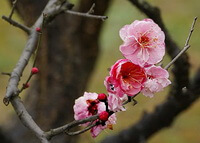 Pedicels (flower stalks) are usually russet (brunneous), though the calyx of some individuals is green or greenish-purple; flowers have five petals, white or faintly pink (rosy), approximately 1.5 cm in diameter and broadly obovate; stamens are numerous.
 Growth Characteristics: Prunus mume exhibits strong adaptability and cold tolerance. It prefers a warm, moist climate and requires ample sunlight. Temperature during the flowering stage greatly influences yield: fruit set is markedly reduced when temperatures fall to −5 °C to −6 °C (23 °F to 21.2 °F) or rise above 20 °C (68 °F). The most suitable cultivation regions have an annual mean air temperature of 16–23 °C (60.8–73.4 °F) and average annual precipitation exceeding 1,000 mm. Soil requirements are not stringent; however, deep, loose, fertile, well-drained sandy loam is optimal. The plant is intolerant of waterlogging but drought-tolerant; therefore, low-lying or poorly drained, moisture-retentive soils are unsuitable for cultivation.
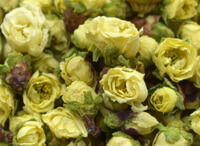 Characteristics of the Herb: The dried flower buds are subspherical (nearly spherical), 3–6 mm in diameter, and bear very short pedicels. Bracts are arranged in several layers, scaly, measuring approximately 3.5 mm in length and 2 mm in width, dark brown, and covered with short hairs. There are five sepals (calyx lobes), broadly ovate, ~4 mm in diameter, celadon (sage green) or brown, and pilose. There are five petals—or sometimes more—broadly ovoid, ~4 mm long and ~5.5 mm wide, yellowish-white. Numerous stamens and one pistil are present; the ovary is embedded in a sunken receptacle, and its surface is densely puberulent. The herb is lightweight, possesses a faint aroma, and tastes slightly bitter and puckering.
 URL QR code: