✵The article records the herb Lychee Seed, including its English name, Latin name, Pinyin name, properties and flavor, botanical source—namely the single plant species (1) Litchi chinensis Sonn.—and provides a detailed introduction to the botanical features, growth characteristics, and ecological environment of this species; the characteristics of the herb Lychee Seed; its pharmacological actions; medicinal efficacy; and administration guidelines.
Semen Litchi (Lychee Seed)
Pinyin Name: Lì Zhī Hé
English Name: Lychee Seed
Latin Name:Semen Litchi Properties and Flavor: Warm, sweet, slightly bitter
Brief Introduction:Semen Litchi is the dried ripe seed of Litchi chinensis Sonn., used to regulate Qi, dissipate nodulation, dispel cold, and alleviate pain. It is indicated for hernial pain, dysmenorrhea, lower abdominal distension and pain, and testicular swelling and pain. The herb is commonly known as Semen Litchi, Lychee Seed, or Lì Zhī Hé.
Botanical Source: Classical herbal works define Semen Litchi (Lychee Seed) as the dried ripe seed of (1) Litchi chinensis Sonn., an evergreen tree in the genus Litchi Sonn. of the family Sapindaceae (soapberry family), order Sapindales. This widely accepted species is described below:
(1) Litchi chinensis Sonn.
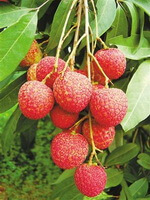
Botanical Description:Litchi chinensis Sonn. is commonly known as Lì Zhī. It is an evergreen tree, 10–15 m tall—typically under 10 m, but occasionally reaching 15 m or more—with grayish-black bark. Branchlets are terete (cylindrical), maroon, and densely covered with white lenticels.
The leaves are paripinnate compound and alternate; the rachis with petiole measures 10–25 cm, sometimes exceeding 25 cm. Leaflets occur in 2 or 3 pairs, rarely 4 pairs; petiolules are 7–8 mm long; leaf blades are lanceolate or ovate-lanceolate, sometimes oblong-lanceolate, 6–15 cm long and 2–4 cm wide; the apex is cuspidate or shortly caudate-acuminate; margins are entire; surfaces are glabrous; texture is thinly coriaceous to coriaceous.
Panicles are terminal, broad and large, and highly branched. Flowers are unisexual and monoecious. The calyx is shallow cyathiform (shallow calathiform), deeply 5-lobed, and covered with golden short pubescence. There are 5 petals; broad scales bearing dense hairs are present at the inner base of each petal. Stamens number 6–7, occasionally 8; filaments are ~4 mm long. The ovary is densely tuberculate and hirsute.
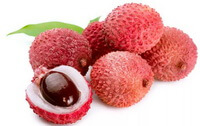
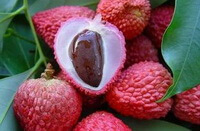
Fruits are oval to subsphaeroidal, 2–3.5 cm long, and turn dull red to ruby-red upon maturity. Seeds are entirely enveloped by a succulent aril. Flowering occurs in spring; fruiting occurs in summer.
Ecological Environment: The tree is native to and predominantly cultivated in China. It is also cultivated in Southeast Asia and has been introduced to the Americas and Oceania.
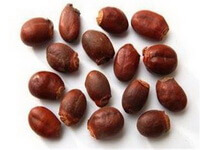
Characteristics of the Herb: Seeds are oblong or ovate-oblong, slightly flattened (oblate), 1.5–2.5 cm long and 0.5–1.5 cm in diameter. The surface is brown to reddish-brown or purplish-brown, smooth and slightly lustrous, with irregular concave markings and fine wrinkles. One end is truncate, bearing a nearly circular, yellowish-brown hilum (5–7 mm in diameter); the other end is blunt. The texture is firm and hard; the seed coat is thinly coriaceous and brittle when fractured. Two fleshy cotyledons are present, orange-yellow or tan (brownish-yellow). The herb is odorless or nearly odorless, with a slightly sweet, bitter, and astringent taste.
Pharmacological Actions: (1) Hypoglycemic effect; (2) Regulation of lipid metabolism disorders (both systemic and tissue-level); (3) Antioxidant activity; (4) Hepatoprotective and anti-hepatitis B virus (anti-HBV) effects.
Medicinal efficacy: Regulates Qi and resolves stagnation; warms the middle jiao (the middle energizer); dispels cold and alleviates pain; dissipates nodulation. Indicated for cold-type hernia and abdominal pain, epigastric pain, testicular swelling and pain, Qi- and blood-stagnation-induced stabbing pain in women, dysmenorrhea (painful menstruation), and postpartum abdominal pain.
Administration of Semen Litchi (Lì Zhī Hé):
Reference:
Administration Guide for Semen Litchi (Lì Zhī Hé)
TCM Books:
(1) Internally: 4.5–9 grams; (2) Internally: water decoction, 1.5–3 qian (~4.5–9 grams), or prepare to pill, powder; (3) Internally: water decoction, 6–10 grams; or prepared into powdered herb, 1.5–3 grams; or prepared into pills or powders. Externally: Apply an appropriate amount of finely powdered herb as a topical paste.

 ✵The article records the herb Lychee Seed, including its English name, Latin name, Pinyin name, properties and flavor, botanical source—namely the single plant species (1) Litchi chinensis Sonn.—and provides a detailed introduction to the botanical features, growth characteristics, and ecological environment of this species; the characteristics of the herb Lychee Seed; its pharmacological actions; medicinal efficacy; and administration guidelines.
 Pinyin Name: Lì Zhī Hé
 Botanical Description: Litchi chinensis Sonn. is commonly known as Lì Zhī. It is an evergreen tree, 10–15 m tall—typically under 10 m, but occasionally reaching 15 m or more—with grayish-black bark. Branchlets are terete (cylindrical), maroon, and densely covered with white lenticels.
 Panicles are terminal, broad and large, and highly branched. Flowers are unisexual and monoecious. The calyx is shallow cyathiform (shallow calathiform), deeply 5-lobed, and covered with golden short pubescence. There are 5 petals; broad scales bearing dense hairs are present at the inner base of each petal. Stamens number 6–7, occasionally 8; filaments are ~4 mm long. The ovary is densely tuberculate and hirsute.
 Ecological Environment: The tree is native to and predominantly cultivated in China. It is also cultivated in Southeast Asia and has been introduced to the Americas and Oceania.
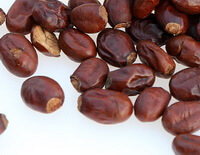 Characteristics of the Herb: Seeds are oblong or ovate-oblong, slightly flattened (oblate), 1.5–2.5 cm long and 0.5–1.5 cm in diameter. The surface is brown to reddish-brown or purplish-brown, smooth and slightly lustrous, with irregular concave markings and fine wrinkles. One end is truncate, bearing a nearly circular, yellowish-brown hilum (5–7 mm in diameter); the other end is blunt. The texture is firm and hard; the seed coat is thinly coriaceous and brittle when fractured. Two fleshy cotyledons are present, orange-yellow or tan (brownish-yellow). The herb is odorless or nearly odorless, with a slightly sweet, bitter, and astringent taste.
 Pharmacological Actions: (1) Hypoglycemic effect; (2) Regulation of lipid metabolism disorders (both systemic and tissue-level); (3) Antioxidant activity; (4) Hepatoprotective and anti-hepatitis B virus (anti-HBV) effects.
 URL QR code:

